US awaits Iranian response on deal as Israel strikes Lebanon
Published in News & Features
The United States is waiting on Iran to respond to its proposal to reopen the Strait of Hormuz and end a war that has killed thousands of people, with tensions still high in both the Persian Gulf and in Lebanon.
Iran’s leaders are yet to indicate whether they’ll accept the terms of the deal, though they’ve previously shown little sign of yielding on their nuclear program and accepting a moratorium on enriching uranium, both top U.S. demands.
Stocks fell and oil climbed Thursday amid doubts that a deal could be reached and the vital Strait of Hormuz reopened.
Reopening Hormuz, where a fifth of the world’s oil and liquefied natural gas flowed before the war brought traffic to a standstill, is a key objective for U.S. President Donald Trump. Iran has halted the flow of international traffic through the waterway while the U.S. is carrying out its own blockade of ships transiting to and from Iranian ports.
In a bid to ease the crisis, Trump had announced “Project Freedom,” an initiative to help ships transit the strait, but he abruptly suspended it. Saudi Arabia and Kuwait have lifted restrictions on the U.S. military’s ability to use regional bases, the Wall Street Journal reported Thursday, indicating that could allow the Trump administration to restart an effort to ease traffic through the strait.
Diplomatic efforts received new momentum this week. Washington has relayed a one-page memo to the Islamic Republic that could reopen the strait and lift the U.S. blockade of Iranian ports, according to the person familiar with the matter. That would set the stage for a month of talks aimed at securing a final agreement to bring the 10-week conflict to a close.
Iran’s President Masoud Pezeshkian recently met with Supreme Leader Ayatollah Mojtaba Khamenei for nearly 2 1/2 hours, the state-owned Mizan news agency reported Thursday, without saying what the talks were about or when they were held. Iran is expected to send a response via Pakistan, acting as a mediator, in the next two days, a person familiar with the matter said Wednesday, asking not to be identified discussing sensitive information.
Should the negotiation get to that stage, the sides will discuss Iran’s nuclear activities. Trump has repeatedly said the objective of the war is to prevent Tehran having a nuclear weapon, something Iran has always denied. He said Wednesday the U.S. is “going to get” the Islamic Republic’s stockpile of highly enriched uranium as part of the agreement, though there’s been no indication Tehran is willing to make that concession.
Israeli Strike
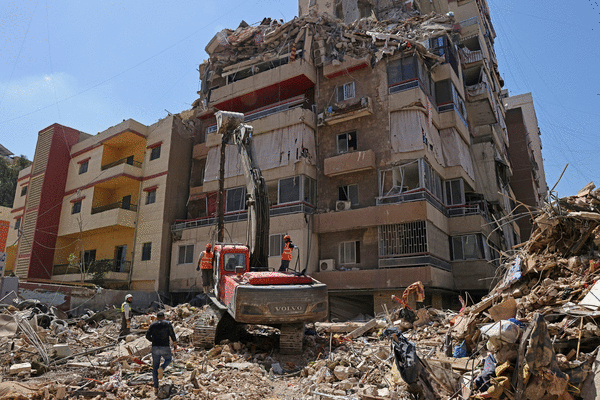
Still, the situation in the region remains tense. Israel said it killed a Hezbollah commander in a southern suburb of Beirut, its first strike on the city since a ceasefire began in Lebanon last month. That demonstrated the fragility of that truce, with paused a parallel war that was hampering peace efforts with Tehran.
The U.S. will start a broader and more intense bombing campaign if Iran rejects the initial 14-point peace plan, Trump said earlier in a social media post, though he’s repeatedly walked back on threats to escalate the conflict. He told "PBS News Hour" he believes there’s “a very good chance” of a deal, possibly before his scheduled summit with Chinese President Xi Jinping in Beijing next week.
Iran’s state-affiliated news agency ISNA said reports on elements of the proposal amount to “media speculation and atmosphere-building,” adding that nuclear enrichment is not part of the current discussions.
Khamenei succeeded his father, Ali, who was killed by an Israeli strike on the first day of the war. He hasn’t been seen in public since. Last week, in a statement, he said Iran would not give concessions on its nuclear program, describing it as a “national asset” that Iranians would protect at all cost.
Other outstanding issues include limits on Iran’s ballistic missile program and its support for allied militant groups such as Lebanon’s Hezbollah.
Those are priorities for Israel, whose officials struck a cautious tone on the latest U.S. push to wind down the campaign against Iran. Ambassador to the United Nations Danny Danon told Army Radio on Thursday that “we need to wait and not come out with declarations and headlines” about a potential deal.
Prime Minister Benjamin Netanyahu said Israel is in close coordination with the United States on peace efforts with “no surprises.”
Also adding to pressure for a deal, Trump is scheduled to meet with Xi on May 14-15, after an earlier meeting was postponed in the early days of the conflict. China on Wednesday added its voice to global pressure to wrap up the conflict and reopen the waterway, telling Iran that a continuation of hostilities is “inadvisable.”
Polls show Americans’ distaste for the conflict is growing — six months from midterm elections where energy costs will be a central focus. Gasoline prices breached $4.50 a gallon for the first time since July 2022, according to the American Automobile Association.
_____
(With assistance from Rakteem Katakey.)
©2026 Bloomberg L.P. Visit bloomberg.com. Distributed by Tribune Content Agency, LLC.




Comments