New findings from La Jolla Institute for Immunology suggest a possible measles treatment
Published in Health & Fitness
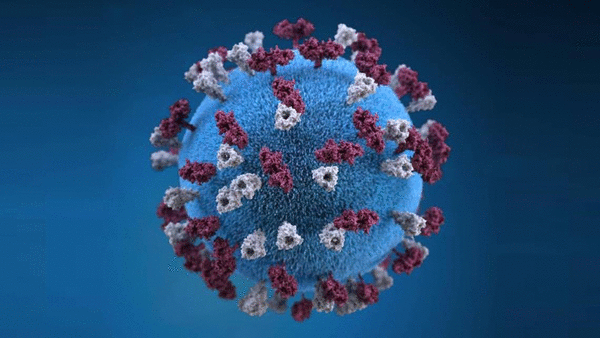
SAN DIEGO — A new study from the La Jolla Institute for Immunology suggests that it is possible to treat measles infections though additional research is necessary to prove that the concept will work in humans.
Published online Thursday in the journal Cell Host & Microbe, the study identifies several Y-shaped proteins called antibodies that a 56-year-old vaccinated La Jolla woman’s immune system made to fight the measles virus. Cloning these proteins in large quantities could create a type of medication called a “monoclonal antibody.”
Structural biologist and immunologist Erica Ollmann Saphire, the paper’s co-first author and LJI’s president, noted that this approach, which has been used successfully to treat COVID-19, respiratory syncytial virus, Ebola and Zika virus, is promising for its simplicity.
“It is a great medicine type because it is a natural human molecule,” Ollmann Saphire said. “It is exactly the same thing your own immune system would have made, had it had a chance.
“That makes it very safe and very well tolerated and unlikely to have side effects.”
LJI structural biologist Dawid Zyla, the study’s co-author, helped capture electron microscope images of the antibodies.
While the U.S. Centers for Disease Control and Prevention notes there is “no specific antiviral therapy that is Food and Drug Administration approved for treatment of measles,” such an option would be quite helpful. The United States is experiencing a significant increase in measles outbreaks, with 1,814 cases confirmed so far this year.
While most cases resolve without incident, rare complications can be deadly. The CDC states that 1 out of every 1,000 measles cases will develop encephalitis, swelling of brain tissue, that can cause permanent brain damage. A condition called subacute sclerosing panencephalitis is perhaps the most tragic rare complication, causing “seizures that generally develop 7 to 10 years after measles infection.”
Such a therapy would be a boon to babies as the nation’s vaccination schedule does not specify a first dose of the measles, mumps and rubella vaccine until children are 12 to 15 months old. While children do receive some protection from their mothers, antibodies transferred through the placenta wane after birth. Children fighting cancer are particularly at risk, as their immune systems are generally too weak for full vaccination.
A monoclonal antibody treatment against measles could also help reduce the chances of infection among those who are exposed to the highly contagious virus, even if they are unvaccinated. The study found that cotton rats infected with measles showed that monoclonal antibody treatment reduced “viral loads up to 500-fold when administered 48 hours after infection.”
Of course, as with any pre-clinical research, promising findings in animal models do not guarantee success in humans.
Richard Plemper, a biochemist and director of the Center for Translational Antiviral Research at Georgia State University Institute for Biomedical Research, noted that cotton rats do not respond to the measles virus in the same way that humans do. While the virus spreads throughout the body, rats have a different infection profile.
“Cotton rats trap the virus in the respiratory tract with transient replication only in lung (tissue),” Plemper said.
Testing in animals with more similar responses to measles infection, such as ferrets or “non-human primates,” would likely help validate the effects observed in rats.
Overall, the researcher said that it is “credible” that treatment with a measles monoclonal antibody could someday be effective. But, he added, such a treatment would face all of the same limitations that other monoclonals do, including refrigeration until use and a need to be infused into the bloodstream rather than taken as an oral medication.
“These challenges may not pose an insurmountable obstacle for use in high-income countries,” Plemper said. “However, the measles problem is a global challenge, and most prominent in low- and middle-income countries.
“Therapeutic solutions must be globally viable if they are intended to contribute to global eradication through support of vaccination efforts.”
Ollman Saphire, whose lab is known for discovering the molecular structures and functions of other deadly threats such as Ebola, said that additional work is underway to fund and perform the pre-clinical work that would be necessary before LJI could approach the FDA to learn how the project could begin clinical trials in humans.
She said that modern tools such as cryo-electron microscopes have made it possible to discover structures that could not be directly observed, but only inferred, in the past. In this case, researchers were able to use a leftover blood sample collected for a COVID-19 study. During collection, she noted, the subject OK’d other scientific uses of the sample and also shared her previous vaccination history.
“This subject, she was vaccinated twice as a child, so 50 years before she gave the sample, and then, for one reason or another, she had a booster five years before collection,” Ollman Saphire said. “We found that 1% of her circulating B cells were against measles.”
Modern “bio chip” technology allowed deeper analysis to pick out that 1% of cells.
“When the measles vaccine was developed in the 1960s, we did not have the scientific tools that we do today,” she said. “The idea that you could look at a person’s immune response and do an individual cell analysis and figure out which of their antibodies was better and what each one was doing, and how you might use that information to make a therapeutic, none of that existed.
“All of the work we’ve done would have been impossible when humanity was developing those vaccines in the ’60s.”
©2026 The San Diego Union-Tribune. Visit sandiegouniontribune.com. Distributed by Tribune Content Agency, LLC.







Comments