Miami archbishop urges diplomacy as Rubio meets with Pope Leo
Published in Religious News
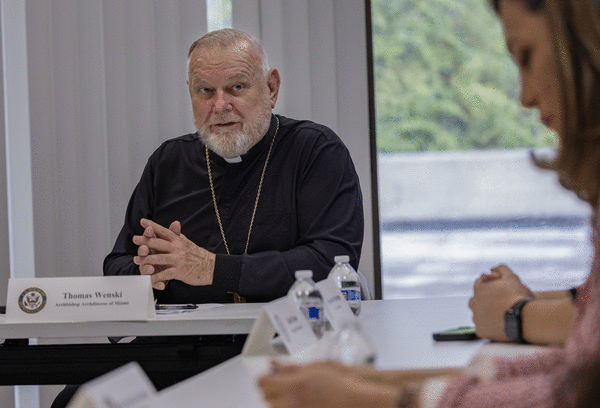
As Secretary of State Marco Rubio meets with Pope Leo XIV this week, Miami Archbishop Thomas Wenski said he hopes the two leaders can move forward on one issue of particular interest to South Florida: humanitarian aid to Cuba.
The meeting came amid an escalating conflict in the Middle East and an increasingly public feud between President Donald Trump and the U.S.-born pope over the war with Iran. But Wenski said the conversation between Rubio and the pope appeared focused on diplomacy — including conflicts abroad and the suffering of ordinary Cubans.
“Everybody could read between the lines, I think they must have been talking about Ukraine, about the Middle East, about Cuba,” Wenski said on Thursday. “These are concerns for the church because the church has an active presence in all of these places.”
According to State Department spokesman Tommy Pigott, Rubio and Leo discussed “the situation in the Middle East and topics of mutual interest in the Western Hemisphere,” in a private meeting that “underscored the strong relationship between the United States and the Holy See.”
While the conversation specifics weren’t immediately clear, Rubio has recently emphasized the Vatican’s role in delivering humanitarian aid to Cuba through the Catholic Church.
“We gave Cuba $6 million of humanitarian aid, but obviously they won’t let us distribute it. We distributed it through the church. We’d like to do more,” Rubio said at a White House briefing on Tuesday.
The potential aid, which would be channeled through Catholic charities, would offer a lifeline to struggling Cubans enduring the effect of an economic collapse.
Wenski said cooperation between Washington and the Vatican is essential because the church remains one of the few institutions able to operate on the island with a degree of public trust and reach.
“The Vatican is not interested in protecting any regime, but it’s interested in the well-being of the people,” Wenski said in Spanish.
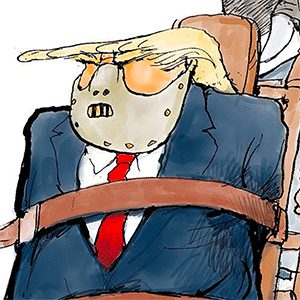
The meeting between Secretary Rubio and the U.S.-born pope comes just days after Trump renewed his criticism of Pope Leo over the war in Iran. The pope has repeatedly called for peace in the Middle East, criticized the war and condemned Trump’s threats to “annihilate” the Iranian civilization.
Earlier this week, Trump told a conservative commentator that the pope was “endangering a lot of Catholics and a lot of people” and “the pope would rather talk about the fact that it’s OK for Iran to have a nuclear weapon, and I don’t think that’s very good.”
The pope has never said that it would be acceptable for Iran to have nuclear weapons.
In fact, the Catholic Church has in the past, “been very, very strong in its condemnation of nuclear weapons,” said Wenski, adding that the Vatican Council has also called out the United States for being the only country to have used them in retaliation.
“The President likes to speak in metaphors and hyperboles ... But I think the pope’s statement put out very clearly that the church is about peace, not about war, and it’s about minimizing the destruction of war when war happens,” Wenski said.
The pope told reporters when asked about Trump’s latest remarks about him that “the mission of the Church is to proclaim the Gospel, to preach peace,” and “if someone wants to criticize me for proclaiming the Gospel, let him do so truthfully.”
Rubio later backed Trump, saying the president “doesn’t understand why anybody, leave aside the Pope” would think “that it’s a good idea for Iran to ever have a nuclear weapon.”
Still, Wenski said the tensions between Trump and the pope did not appear to derail Thursday’s meeting.
“Trump is quite an expert at filling up a news cycle,” Wenski said. “That’s what he’s done, and he continues to do it with great skill.”
Wenski said diplomacy between the Vatican and the United States remains critical to providing aid in places in crisis like Cuba, where the Catholic Church has historically played a key role in distributing aid and easing tensions between Cuba and the U.S.
(This story was produced with financial support from Trish and Dan Bell and donors in South Florida’s Jewish and Muslim communities, including Khalid and Diana Mirza and the Mohsin and Fauzia Jaffer Foundation, in partnership with Journalism Funding Partners. The Miami Herald maintains full editorial control of this work.)
©2026 Miami Herald. Visit miamiherald.com. Distributed by Tribune Content Agency, LLC.



Comments