Stephen L. Carter: There's a bigger debate behind the voting rights case
Published in Op Eds
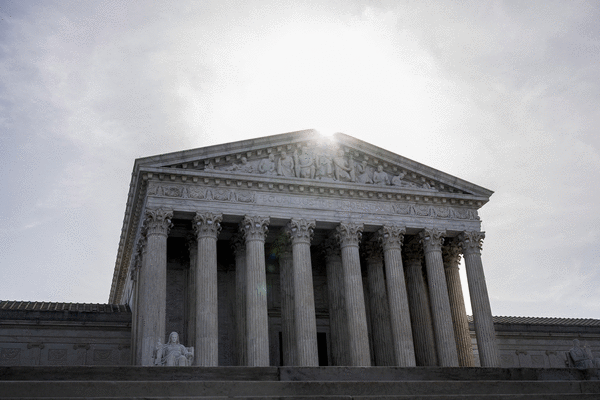
I agree with those who think the Supreme Court made a mistake in narrowing the scope of Section 2 of the Voting Rights Act. But rather than join in the ritual and perhaps overheated condemnation of the decision in Louisiana v. Callais, perhaps we might take the occasion to consider its place in the larger conversation about righting racial wrongs.
To start, although I disagree with Justice Alito’s opinion for the 6-3 majority, let’s be clear about what the Supreme Court didn’t say — and what it did.
The majority did not rule that no legislature may ever create what has come to be known, in a dreadful neologism, as a “majority-minority” district. (1) Rather, the justices ruled that absent an express instruction from a court or Congress, the legislature can’t take race into account in drawing district lines.
Nor may a federal court order a legislature to do so, unless the court has made a factual finding of current discrimination against minority voters — not discrimination in the past, but discrimination now — and has also determined that the discrimination can only be remedied by redrawing district lines with race in mind.
That’s not my view of how voting districts should be drawn, but it’s not a ridiculous interpretation of either the Voting Rights Act or the Constitution, and it’s quite a stretch to call the outcome racist. Instead, the decision should be seen as part of our larger national debate over whether, outside the most egregious cases, there is a role for race-conscious remedies in our continuing effort to build a more just society.
So let’s talk about that.
I’ve long argued for the importance, perhaps the necessity, of taking race into account in particular fields of life. But I would defend only the lightest of touches — a tie-breaker in, for instance, college admission or hiring — after which it is absolutely vital that the new student or employee be treated exactly like everyone else. I think it’s a terrible thing to redo how we test or grade, say, because we don’t think we’re getting the right mix of races. The point of racially conscious practices of any kind shouldn’t be to hit particular numerical targets, but to improve, little by little, the institutions in a wealthy and powerful democracy that has not yet escaped the present effects of a deeply racist past.
The majority disagrees. Key to the majority’s opinion is the notion that the government may classify by race only in the rarest cases, such as racially charged prison riots. Otherwise, racial classifications must be a specific remedy for a recent wrong.
At the same time, the majority is making it harder for courts to decree those wrongs by reading Section 2 to prohibit only those voting barriers that were adopted with a discriminatory purpose. So a state that adopts a law making it harder for Black voters to vote is on safe ground, as long as the legislature acted unthinkingly or ignorantly.
Justice Kagan, in her dissent joined by Justices Sotomayor and Jackson, offers a cleaner, more persuasive account of the legislative history as showing Congress’s intention of barring at least some practices based on their effect on minority voting, whatever their purpose.
Where the dissent goes wrong is in its assumption that if it’s harder to draw majority-minority districts, racist horror awaits. Not every benefit of the Voting Rights Act has come from the creation of majority-minority districts. One swift effect of passage was an alteration of the distribution of state spending in the South, with more money going to areas with heavily Black populations.
Along that line, I’m old enough to remember when serious left-leaning scholars worried that the creation of majority-Black districts would dilute Black voting power, because White officials elected elsewhere could ignore Black interests. The point of this critique, as ably voiced by the late law professor Lani Guinier, was that focusing on the battle for Black faces at the table often ignored the more important struggle “to ensure fairness in the competition for favorable policy outcomes.”
I don’t entirely agree with this analysis, but I believe that Guinier’s work, together with similarly thoughtful arguments by others, should remind us that there are ways to assess the effectiveness of voting rights other than asking whether enough Black candidates have won elections. We might want to try instead measuring, on a variety of scales, whether the lives of members of racial minorities are improving; and whether racial gaps are shrinking. This might include an investigation of why Black voter turnout is so absurdly low in many blue states.
None of this is to suggest that I think the majority in Louisiana v. Callais got the Voting Rights Act right; I just don’t think disaster awaits. Besides, what’s so worrying now might soon matter less. Racial dynamics, including partisan dynamics, are in a state of flux. And wherever they settle, fairer gerrymandering is on the way. AI is going to fix it. (No joke.)
But as long as we fallible humans remain in charge, a degree of vigilance against potential barriers to minority voting is important. Whatever one’s view on exactly the right test to apply or exactly the right remedy when problems are discovered, the one thing on which I hope most of us might agree is that when it comes to race, we’re still a long way from Eden.
____
(1) Wearing my grammar grump hat, I’ve long thought that “minority-majority” would be the better adjective. So far, I haven’t persuaded my editors, or, come to think of it, anybody else.
____
This column reflects the personal views of the author and does not necessarily reflect the opinion of the editorial board or Bloomberg LP and its owners.
Stephen L. Carter is a Bloomberg Opinion columnist, a professor of law at Yale University and author of “Invisible: The Story of the Black Woman Lawyer Who Took Down America’s Most Powerful Mobster.”
_____
©2026 Bloomberg L.P. Visit bloomberg.com/opinion. Distributed by Tribune Content Agency, LLC.














































Comments