Commentary: No Mow May might be the easiest way to help pollinators this spring
Published in Op Eds
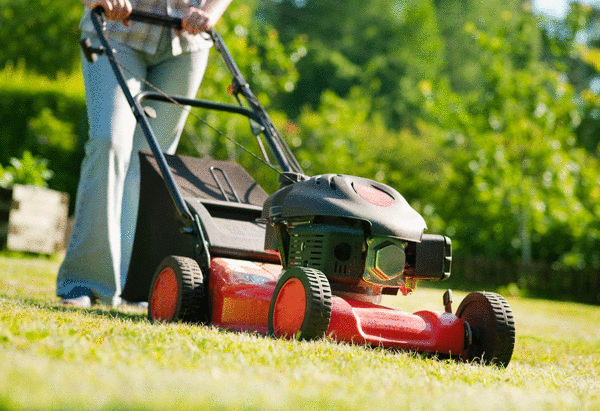
Lawns are everywhere. In the U.S., they cover tens of millions of acres, more land than we devote to many crops grown for food. But unlike those crops, most lawns don’t feed anyone. They demand time, water, fertilizer and fuel—about 9 billion gallons of water every day—and in return, they offer little to wildlife.
For pollinators, a closely mown lawn is like arriving hungry at a table that’s been carefully set, only to have everything cleared away just as they sit down to dine. No Mow May flips that idea on its head.
In early spring, when many native bees are already out and foraging, this conservation campaign asks people to pause before firing up their mower. These bees have survived winter and are urgently searching for nectar and pollen at a time when flowers are still scarce.
Think of No Mow May as a seasonal bridge that helps pollinators cross from winter into summer, when more flowers finally come into bloom.
Letting lawns grow gives small, early bloomers like clover, violets and even the much-maligned dandelion a chance to flower, appearing precisely when pollinators need them most. For a bee searching for food, an unmown lawn can feel like a lifeline.
Research shows that lawns mowed less frequently attract more insects and a greater variety of species. Bees visit flowering lawns, butterflies linger and overall insect activity increases. Even modest changes, like mowing every couple of weeks instead of every week, can help turn an ecological dead zone into something closer to habitat.
There are practical upsides, too. Letting grass grow a bit longer encourages deeper roots, which can help lawns hold moisture and reduce the need for watering. Mowing less often also means using less fuel, making less noise and reclaiming a bit of your weekend. Doing less, it turns out, can accomplish more.
And it doesn’t have to stop there. Plant a variety of native flowers that bloom from early spring through fall to keep nectar and pollen available. Leave stems, fallen leaves or small patches of bare ground to provide places to nest. Eliminate pesticides—even trace amounts can turn otherwise welcoming spaces into dangerous ones. And share what you learn: Pollinators benefit when neighbors compare notes.
In many communities, more natural yards are becoming easier to support. While some cities and homeowners’ associations still set limits on grass height or yard maintenance, those rules are changing as more people recognize the value of pollinator-friendly spaces.
A quick look at local ordinances can help set expectations, and simple signals—like a neatly mown edge or a small sign that says, “Pardon the weeds, we are feeding the bees”—can make it clear that what you’re doing is intentional. Where restrictions remain, sometimes all it takes is a few residents speaking up to help spark change.
The scale of lawns in this country is staggering. If just a fraction of them supported flowers, even temporarily, the impact would be enormous. Replacing 10% of U.S. lawns with pollinator-friendly plants would create millions of acres of new habitat.
No Mow May doesn’t ask you to buy anything or learn something new. It simply asks you to wait. To skip that first mow. To let the lawn grow, and, in doing so, to make a little more room for the life that depends on it.
____
Melissa Rae Sanger is a licensed veterinary technician and a senior writer for the PETA Foundation, 501 Front St., Norfolk, VA 23510; www.PETA.org.
_____
©2026 Tribune Content Agency, LLC.
















































Comments