Hundreds of Minnesota inmates who packaged Disney balloons lose work amid pay dispute
Published in Business News
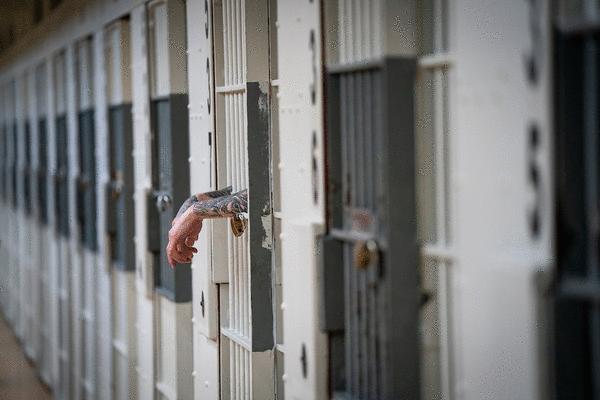
MINNEAPOLIS — Eden Prairie, Minnesota-based Anagram International pulled nearly $3 million of business from work programs at Minnesota prisons, leaving hundreds of inmates without a source of income or the opportunity for more time outside of their cells.
The company employed more than 700 people to package balloons through Minncor Industries, a Department of Corrections (DOC) enterprise that contracts with private businesses for subminimum wage incarcerated labor. Anagram recently told the state that after nearly 30 years of partnership, it would cut production inside corrections facilities, trimming its nearly $8.7 million contract for fiscal year 2026 to less than $6 million.
The change will reduce work hours for about 600 inmates at correctional sites in Faribault, Shakopee, Stillwater and Oak Park Heights. It will eliminate all 160 Anagram jobs at Rush City.
“A lot of us need to have these types of jobs — need to have something,“ said Deandre Craig, a 32-year-old inmate serving more than 29 years for second-degree murder at Rush City. ”We rarely have any programs to rehabilitate ourselves and put us in opportunities. This might not be a huge opportunity for us to get in the world, but something’s better than nothing."
Anagram attributed its decision to “multiple factors affecting its business,” including excess inventory, “market shifts toward overseas production” and “advocacy organization efforts that affected Anagram’s customer relationships,” according to a March 5 DOC memo informing inmates’ family and friends about the change.
Anagram said the decision was unrelated to advocacy efforts from groups in Minnesota and Florida that had recently drawn attention to the company’s contract with Disney. Advocates called on Disney to renegotiate that contract so incarcerated Minnesota workers handling its branded balloons would earn at least state minimum wage, which is $11.41 as of Jan. 1. Minncor jobs pay inmates up to $2 an hour.
Minncor jobs — unlike positions working directly for the Corrections Department, such as in the prison kitchen — are not taxpayer-funded. Under its most recent contract, Anagram paid Minncor about $10 for each hour an inmate worked. Of that, inmates earned between 50 cents and $2 but kept less after deductions for costs such as child support and victim restitution.
“Anagram continues to partner with Disney, and we value our long‑standing relationship with them and are actively engaged on current and future programs,“ Anagram wrote in a statement. ”Regarding Minncor, our staffing needs change every month, and we continuously diversify across our production partners to optimize cost, speed and capabilities.”
Disney did not respond to a request for comment.
Rose Love, whose brother is a Rush City inmate, said she sends him $200 every other week, some of which is lost to fees. His 50-cent hourly wage working for Anagram didn’t come close to covering the basics, she said, including over-the-counter medication he needs to manage pain from a bullet lodged in his hip. Inmates must buy essentials, such as shampoo, laundry detergent and additional food, from a commissary.
The goal of spotlighting Disney’s connection to incarcerated labor was higher pay, not fewer jobs, said David Boehnke, an organizer with the Minnesota Incarcerated Workers Organizing Committee (IWOC).
Because Anagram was already paying Minncor more than $10 an hour, he said, it wouldn’t take much more to reach Minnesota’s minimum wage if the Correction Department was willing to let inmates keep a higher share of their hourly pay.
Corrections inmates losing their jobs was “not the humane response” the organization was looking for, said Jermale Kling, a former inmate who now works with the committee.
“We were looking for a more solid transition into supporting incarcerated workers — people that are doing jobs for our communities," he said. “These products go out into our communities. Consumers buy them.”
Faribault inmate Darryl Brown, 50, was convicted of second-degree criminal sexual conduct in 2015. He has worked his way into a leadership position with Anagram over 10 years and said he hopes to continue working for the company once he’s released next year.
While he’ll keep his job, he’s frustrated others won’t.
“When it came to those protests, there wasn’t a consensus among those of us that actually worked for [Anagram] about any of this stuff. So it really caught us all off guard,” Brown said. “Everybody wants more money, but there’s a way to have those discussions.”
Corrections Commissioner Paul Schnell acknowledged inmates’ wages are meager, even before deductions. But the department is walking a fine line between negotiating job opportunities — which can teach inmates valuable skills and help them transition into the workforce once they’re released — and market conditions.
The Corrections Department doesn’t want to compete with Minnesota companies, Schnell said, and also doesn’t want jobs that would otherwise go to inmates to ship overseas.
The sudden jump in the number of idle inmates is raising security concerns, Schnell said, and officials are rushing to find new opportunities for those who lost their jobs.
“The worst thing that can happen from a corrections standpoint is an idle population,” he said. “The more and longer a person is idle while they’re incarcerated, it has adverse impacts on outcomes. And so it’s in the state’s best interest to make sure that people are active.”
Inmates who work receive extra time outside their cells, a policy the department said it is extending for those who lost Anagram jobs. Those inmates will have four hours a day outside their cell for 60 days, according to the department, and three hours a day after that if they are still unemployed.
But Love said her brother and other Rush City inmates can leave their cells just a couple of hours a day, if at all. On Thursday, the facility was on lockdown.
“He can’t even come out of his cell if he doesn’t have a job, and it’s hard to get jobs now,” she said. “Now that they’re firing everybody — I’m sure it’s going to be another six-, nine-month thing before we even get a job."
Craig, the other Rush City inmate, earned $13.29 an hour under the Prison Industry Enhancement Certification Program, which pays a higher prevailing wage but allows the state to withhold up to 80%. He saw $130 of a recent $620 paycheck, he said.
For now, he has no income and no one on the outside who can support him. He’s trying to find another job, he said. In the meantime, he is considering selling his food.
“I’m just doing my prison time basically by myself,” Craig said. “So if I can’t raise some type of income, I have to figure something out. I have to survive somehow.”
©2026 The Minnesota Star Tribune. Visit at startribune.com. Distributed by Tribune Content Agency, LLC.










Comments