US jobs gain of 178,000 tops forecasts, unemployment falls
Published in Business News
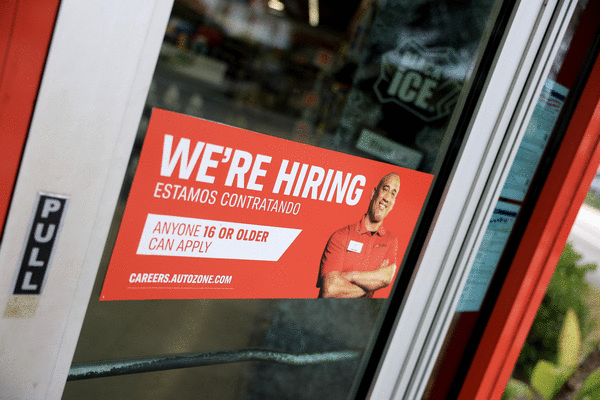
U.S. job growth rebounded in March and the unemployment rate unexpectedly fell, suggesting the labor market was stabilizing as the Iran war began.
Nonfarm payrolls rose 178,000 last month, the most since the end of 2024, after revisions showed a sharper decline in February, according to Bureau of Labor Statistics data out Friday. That was higher than all estimates in a Bloomberg survey.
Economists had widely expected a bounceback in employment in March after a strike by more than 30,000 health care workers and severe winter weather contributed to an outsize decline in February. The solid increase will likely reinforce the Federal Reserve’s focus on inflation risks amid a rapid run-up in energy prices sparked by the war in Iran.
“If the conflict had not happened in the Middle East, I think the stabilization narrative would be gaining momentum,” said Michael Pugliese, a senior economist at Wells Fargo & Co. “The problem though is we now have this new shock working its way through the economy.”
The advance in payrolls was led by health-care employment, which recovered after the resolution of the strike by Kaiser Permanente workers in California and Hawaii. But the report showed gains were widespread across industries, with a measure of the breadth of hiring rising to the highest level in more than two years.
Construction and leisure and hospitality payrolls rose following declines in February, possibly reflecting a weather-related snapback. Hiring in manufacturing was strongest since the end of 2023.
U.S. Treasury yields rose following the release. The stock market is closed for the Good Friday holiday.
The outsize increase in payrolls in March followed a revised 133,000 drop in the prior month, which marked one of the biggest declines since the pandemic. But on average, payrolls rose 68,000 in the first three months of this year, the strongest run in almost a year.
The unemployment rate fell to 4.3%, though that partly reflected Americans leaving the workforce. The participation rate — the share of the population that is working or looking for work — slipped to 61.9% in March, the lowest since 2021. The rate for workers of ages 25-54, also known as prime-age workers, also fell. The number of people working part-time for economic reasons rose.
Economists are also paying close attention to how labor supply and demand dynamics are impacting wage gains — especially with inflation risks heating up again. The report showed average hourly earnings rose 0.2% from February, and 3.5% from a year earlier — the least in almost five years. That may pose challenges for consumers facing a surge in energy costs as a result of the war.
The employment survey reflects the second week of March, just after the U.S. and Israel launched the Middle East conflict on Feb. 28. Economists expect the war to have more of an impact on future jobs reports if the hostilities continue, as companies respond to higher energy prices and potentially diminished demand by delaying hiring or laying off staff.
“I don’t think, as you saw with today’s jobs report, that we should expect that people are going to have to revise their annual forecast very much,” White House National Economic Council Director Kevin Hassett said on Bloomberg Television. “There will be some negative repercussions that will be very short-lived in the Asian economies, and we expect that disruption to be over really, really soon.”
(With assistance from Augusta Saraiva, Julia Fanzeres, Cécile Daurat and María Paula Mijares Torres.)
©2026 Bloomberg L.P. Visit bloomberg.com. Distributed by Tribune Content Agency, LLC.










Comments