Suit filed against McDonald's by Black former execs will head to trial as political winds surrounding DEI shift
Published in Business News
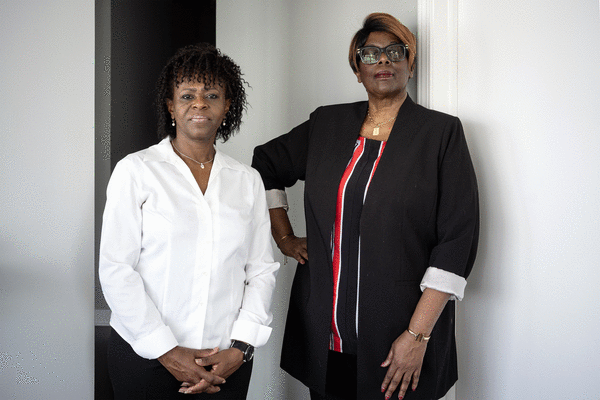
In January 2020, months before the death of George Floyd at the hands of Minneapolis police ignited a national movement toward corporate diversity and inclusion programs, two Black McDonald’s executives filed a racial discrimination lawsuit against the fast-food giant.
This fall, after more than six years of navigating the federal judicial system, Vicki Guster-Hines and Domineca Neal will finally have their day in court.
“It’s been grueling,“ said Guster-Hines, 64. “However, we finally got here, and so now it’s our turn. Now it’s our time to tell our story, and we are ready to tell it.”
In their lawsuit, Guster-Hines and Neal, longtime employees who last worked out of the company’s Dallas office, cited a “hostile and abusive work environment” that included threats, derogatory racial comments and impediments to advancement for Black people within the corporate ranks at Chicago-based McDonald’s.
Last month, a Chicago federal judge dismissed the race discrimination counts but ruled the case against McDonald’s for an alleged hostile work environment, which the plaintiffs claim derailed their careers, can proceed to trial in September.
Both sides are claiming victory.
“This is a pretty big hurdle to get a hostile work environment claim like this against somebody like McDonald’s to trial, because judges have a ton of discretion to get rid of the claims,” said Brian Morris, a Chicago attorney representing Guster-Hines and Neal. “And McDonald’s certainly has worked for six years to get rid of the claims.“
In addition to dismissing race discrimination and disparate treatment counts, the March 17 ruling removed current McDonald’s CEO Chris Kempczinski and McDonald’s Corp. as defendants in the case. But it allowed six counts alleging a hostile work environment and unlawful retaliation by McDonald’s USA, the subsidiary that oversees the chain’s 14,000 mostly franchised U.S. restaurants, to proceed to trial.
McDonald’s claimed a “significant victory” in a March 21 statement posted to its website.
“The Court threw out the overwhelming majority of Plaintiffs’ claims and sharply narrowed this case,” Desiree Ralls-Morrison, global chief legal officer at McDonald’s Corp., said in the statement. “The record will confirm that the remaining allegations against McDonald’s USA have no factual or legal basis.”
The political climate changed in recent years as the case slogged its way through Chicago federal court, with DEI becoming something of an epithet and major corporations rolling back initiatives under Trump 2.0. That makes the Guster-Hines/Neal discrimination lawsuit against McDonald’s, set to go to trial two months before a crucial midterm election, potentially a bellwether case on the current state of corporate diversity, equity and inclusion.
If nothing else, the country’s leading fast-food chain will appear in court to defend its treatment of minority employees.
Guster-Hines, a Michigan native who has an MBA from Indiana Wesleyan University, joined McDonald’s in 1987 as a management trainee. She rose through the ranks to become a regional director of operations, among other roles, but was repeatedly passed over for higher-level executive promotions at McDonald’s by an “unwritten policy of racial discrimination that impeded her rise,” the lawsuit alleges.
Born and raised in Detroit, Neal, 58, who has an MBA from the University of Michigan, joined McDonald’s in 2012 as a director trainee in Chicago. In 2015, she was named director of operations for the Indianapolis region and was promoted two years later to vice president of franchising and operations, according to the complaint.
In July 2018, McDonald’s demoted both Guster-Hines and Neal from vice president to senior director positions as part of a broader corporate restructuring under former CEO Steve Easterbrook, which the lawsuit alleges was a “ruthless purge” of African Americans from the ranks of its senior executives.
The initiative reduced the number of field offices serving the chain’s franchised restaurants. Guster-Hines and Neal were relocated to the company’s Dallas office.
Easterbrook was subsequently fired in November 2019 over an admitted consensual relationship with an employee. He was succeeded by Kempczinski, who formerly served as president of McDonald’s USA, overseeing business operations for the chain’s U.S. restaurants.
Guster-Hines and Neal raised their discrimination concerns in a September 2019 demand letter, and were put on paid leave before filing the lawsuit in January 2020. Neal was fired the following month, while Guster-Hines remained on paid leave for nearly two years before tendering her resignation.
“When we worked to change things on the inside and we raised hostile issues that were happening, no one investigated, and more importantly, we became the target,” Neal said. “That is terrifying.”
Neal’s termination followed a third-party investigation into her workplace conduct implemented by McDonald’s three days after the lawsuit was filed. The court cited the “suspicious timing” in its ruling to allow two counts of alleged unlawful retaliation toward Neal to proceed to trial in September.
Morris called it a “sham investigation” to create a pretext to justify Neal’s termination.
The McDonald’s investigation, which included interviews with several employees who regularly worked with Neal, determined that she had created a “very toxic workplace” that improved after she left, according to court filings. After reviewing the report, the company terminated Neal’s employment on Feb. 28, 2020.
In her statement, Ralls-Morrison defended the decision by McDonald’s to terminate Neal.
“Her dismissal was not for any unlawful reason,” Ralls-Morrison said.
Guster-Hines remained on paid leave until she voluntarily resigned in October 2021. The judge dismissed the retaliation claims she brought against McDonald’s, ruling the company never prevented her from returning to work.
Ralls-Morrison said Guster-Hines was promoted 15 times before deciding to retire and the “door remained open” for her to return to the company. But Morris said McDonald’s had essentially shut down her career at the company by cutting Guster-Hines off from all work-related communications during her nearly two-year paid leave.
“We argue that that is a form of retaliation called sidelining, where you basically prevent somebody’s career from advancing,” Morris said. “You just kind of hold them in purgatory as a form of punishment.”
In addition to the unlawful retaliation claims by Neal, two counts of an alleged hostile work environment under Section 1981 of the Civil Rights Act of 1866 by both plaintiffs against McDonald’s USA are going to trial. Two counts of alleged violations of Title VII of the Civil Rights Act of 1964, which prohibits employment discrimination based on race, color, religion, sex and national origin, also survived summary judgment.
The dismissed counts include two retaliation claims by Guster-Hines, as well as four racial discrimination and two disparate treatment claims by both plaintiffs against McDonald’s.
Instances of harassment cited by the March 17 ruling in allowing the hostile work environment claims to proceed include Kempczinski’s comments during a 2019 meeting with a Black employee leadership group, where he allegedly stated that McDonald’s was not committed to racial diversity and most of the people in the audience deserved to have a lower-ranking position than the ones they actually held.
Those allegations will be part of the harassment claims to be determined by a jury.
“We look forward to presenting evidence at trial that will debunk the few remaining allegations and comments, which were never made in the first place or wholly mischaracterized,” a McDonald’s spokesperson said.
While both Kempczinski and McDonald’s Corp. — the parent company to McDonald’s USA — were dismissed from the case, the burger giant’s CEO will likely be called to testify at the Sept. 14 trial, Morris said.
Meanwhile another racial discrimination lawsuit brought by 77 Black former franchise owners against McDonald’s has been tied up in Chicago federal court for years, with the fast-food chain pursuing a motion to dismiss the case.
The August 2020 lawsuit alleges McDonald’s steered Black franchisees to less profitable restaurants and didn’t give them financial support made available to white franchisees, leading to an exodus of Black owners.
Van Jakes, a former NFL cornerback for the Chiefs, Saints and Packers, became a McDonald’s franchisee in 1992, growing his portfolio to five stores in Georgia and Florida before being “forced out” by the restaurant chain in 2016, according to the lawsuit.
In 2016, after being denied a new store he had positioned himself to open, Jakes sold his remaining McDonald’s restaurants and became a Jersey Mike’s and Denny’s franchisee. He left the restaurant business during the pandemic downturn.
“I didn’t know it was systematic racism until I left the system,” Jakes, 64, told the Tribune. “I just thought it was a market situation. But I saw it clearly when I became a franchisee for other brands.”
Jakes is among a number of the Black franchisees represented by Loevy + Loevy, the same Chicago law firm handling the Guster-Hines/Neal case.
Jon Loevy, founder and managing partner of the civil rights law firm, said there is an obvious synergy between the two cases.
“They’re both making fundamentally the same allegation that McDonald’s has a problem regarding racial discrimination,” Loevy said.
Last month, a Chicago federal judge lifted a lengthy stay of discovery that had been in place while the court weighed an ongoing motion by McDonald’s to dismiss the case. The order requires the parties to discuss the scope of discovery and file a status report within two weeks.
Loevy said the franchisee lawsuit still has a long road ahead to get to trial, but the judge’s unfreezing of the case to begin discovery is a key first step in that direction.
In a statement, McDonald’s expressed confidence that it would prevail in the franchisee lawsuit — if it ever gets to trial.
“Should this case proceed, we are confident the facts will show that McDonald’s did not discriminate against the Plaintiffs,” the company said.
In December 2021, McDonald’s announced a $250 million, five-year initiative to increase the number of minority-owned franchisees across the restaurant chain in the U.S.
At the time, McDonald’s had 39,000 restaurants worldwide, including 14,000 in the U.S., of which 93% were franchised. Asian, Black and Hispanic owners represented 29.6% of its U.S. franchisees, while women accounted for 28.9%.
McDonald’s has since grown to more than 45,000 restaurants worldwide, with the U.S. count remaining at about 14,000, of which 95% are franchised, the company said.
Meanwhile, minority ownership has increased slightly to 34% of U.S. franchisees as of 2024, according to the latest data published by McDonald’s. Black and Hispanic owners represent 13% each, with Asian owners accounting for 8%. About 30% of franchisees are women.
In 2024, McDonald’s recruited the largest number of minority franchisee applicants in its history, the company said.
But DEI initiatives more broadly have been facing headwinds over the past few years.
President Donald Trump has declared war on DEI during his second term, issuing more than a half dozen executive orders seeking to end such programs. Last month, he fired his latest salvo, an executive order eliminating diversity, equity and inclusion practices by federal contractors and their subcontractors.
Under pressure from the Trump administration, major companies from Amazon to Walmart have scaled back their DEI programs.
“There’s this big decline in engaging around DEI,” said Luke Hartig, president of Gravity Research, an advisory firm focused on corporate reputation. “A lot of that is specifically in response to Trump administration actions that are ratcheting up the pressure on companies.”
In a November report, Gravity Research found that 40 large corporations made public DEI changes post-inauguration, with 85% citing the shifting social, political or legal environment as a catalyst. Use of the term “DEI” fell by 98% in communications by Fortune 100 companies between January 2023 and May 2025, the company’s research found.
At the same time, Hartig said companies are making their DEI strategies more internal, but not necessarily abandoning the principles that drove the movement.
For Guster-Hines and Neal, who filed their lawsuit against McDonald’s before the term DEI came and went from the corporate lexicon, it’s been a long, hard road.
When Guster-Hines resigned from McDonald’s in 2021, she took a position as chief operating officer for Make-A-Wish Illinois in Chicago. She left that role in 2024 to move back home to Michigan, where she serves on several nonprofit boards.
But the wounds of her painful exit from McDonald’s after 33 years at the company are still raw.
“I lost every friend because McDonald’s told everyone at McDonald’s — senior leadership, employees, operators — that they could not speak to Domineca and I, and trust me, they haven’t,” Guster-Hines said.
After being fired by McDonald’s, Neal moved back to Chicago, where she runs her own business consultancy. Getting their case to trial, she said, is a moment for reflection and celebration.
“It’s taken six and a half years to get to this point, but we are ecstatic, because the sacrifices have been huge — personal, professional, financial, emotional, psychological,” Neal said. “It’s really tough to go up against a Fortune 200 company. You kind of feel like you’re on an island alone.”
©2026 Chicago Tribune. Visit at chicagotribune.com. Distributed by Tribune Content Agency, LLC.








Comments