Amazon's $11.6 billion Globalstar deal amps up rivalry with Musk
Published in Business News
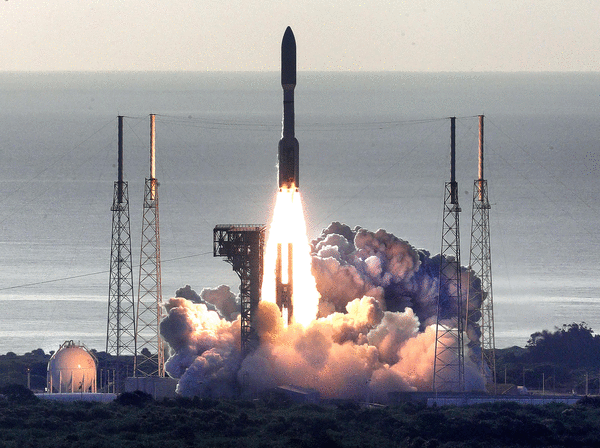
Amazon.com Inc.’s $11.6 billion deal to buy Globalstar Inc. ramps up competition with Elon Musk’s Starlink in satellite communications, a market predicted to double to $200 billion in the coming years.
On Tuesday, Amazon announced plans to buy the satellite operator for a mix of stock and up to $90 a share and said that in 2028 it will launch a direct-to-device service, offering connectivity straight to people’s mobile devices as an alternative to traditional cell towers.
Through Globalstar, Amazon will gain radio frequency licenses that are key to the company advancing its satellite-to-mobile services. The e-commerce giant has been trying for years to break into satellite services to gain new sources of growth beyond its enormous retail and cloud-computing businesses. But its efforts have been hampered by delays from rocket builders and a slow start to its manufacturing operations.
Meanwhile, Musk’s Starlink, a division of SpaceX, has sprinted ahead with a network of 10,000 satellites in orbit serving 10 million people and developing a reputation for reliable internet service in hard-to-reach areas.
With the acquisition, “customers can expect faster, more reliable service in more places — keeping them connected to the people and things that matter most,” said Panos Panay, senior vice president of devices and services at Amazon, in a statement announcing the deal.
Amazon is offering Globalstar shareholders either $90 in cash per share, or 0.32 shares of Amazon stock with a value capped at $90 a share, according to the statement. That represents a nearly 117% premium over Globalstar’s price from late October, before Bloomberg reported that the company was exploring a potential sale.
Globalstar shareholders will get a chance to choose whether they want to receive a mix of cash and Amazon stock. The cash amount will be prorated depending on how many shareholders elect to be paid that way, with no one getting more than 40% cash.
The acquisition, Amazon’s second largest after its Whole Foods takeover, is expected to close in 2027.
Bloomberg News reported earlier that Amazon was in advanced talks to buy Globalstar. The satellite company’s shares jumped 9.6% to close at $79.91 in New York. Amazon shares rose 3.8% to $249.02. AST SpaceMobile Inc., a major competitor in the direct-to-device segment, fell almost 11% to $88.57.
Amazon also said Tuesday that Apple Inc.’s emergency messaging service will transition to Amazon Leo, the company’s recently renamed broadband satellite network. Adding Apple as a customer could be a coup for Leo, which has lagged behind SpaceX’s Starlink unit in signing major partners such as airlines.
Amazon Leo has been primarily focused on providing broadband internet services with its satellite constellation, which requires customers to tap into the system using a personal user antenna. But in recent years, the emergence of the potentially lucrative direct-to-device market has become an attractive opportunity for satellite operators. The technology entails using satellites to provide connectivity to unmodified smartphones on Earth.
SpaceX has already sought to augment its Starlink broadband system with satellite-to-device capabilities by launching satellites geared toward mobile phone connectivity. And in 2025, SpaceX agreed to buy EchoStar’s satellite spectrum — radio frequencies licensed by the Federal Communications Commission to communicate with spacecraft – in a $17 billion deal to boost its offerings in this realm.
Amazon Leo’s roughly 200 satellites in orbit are running limited commercial tests, and the company has a goal of eventually operating more than 7,700 satellites. Earlier this year, Amazon asked the FCC to waive or extend a deadline to have 1,600 satellites aloft by July.
Though Globalstar operates a satellite system in orbit, the company only has a couple dozen active satellites in operation. The real value of the acquisition for Amazon lies in GlobalStar’s spectrum — the radio frequencies it has been licensed by the FCC to communicate with its satellites, said Caleb Henry, director of research at Quilty Space. Such spectrum, distinct from what Amazon already uses for its broadband satellite system, will be necessary in order for the company to move forward with direct-to-device capabilities.
“Amazon has now repeatedly claimed that their satellite system will offer better service than what’s out there now, and so they clearly believe that they are building up a capability that will challenge and beat Starlink,” Henry said. “They’re very bullish on that.” Amazon Chief Executive Officer Andy Jassy “would not be able to make a claim like that without first acquiring spectrum,” Henry added.
Until now, the two leading players in the direct-to-device market have been SpaceX and Midland, Texas-based AST. SpaceX has joined with T-Mobile U.S. Inc. to provide connectivity via Starlink satellites to areas without traditional land-based cell service. AST has partnerships with operators such as AT&T Inc. and Verizon Communications Inc. but is still at the early stage of launching its satellite network.
FCC Chair Brendan Carr signaled an openness to the Amazon-Globalstar deal, saying in an interview with CNBC on Tuesday that the acquisition could potentially bring a new competitor to an emerging market.
Amazon’s satellite business last month signed a deal with Delta Air Lines Inc., with the carrier agreeing to use Leo to provide in-flight Wi-Fi service. Starlink has many more partners, though, including United Airlines Holdings Inc., Southwest Airlines Co., British Airways Plc, Air France and Emirates.
Globalstar, whose chief executive officer Paul Jacobs is a former Qualcomm Inc. CEO, currently underpins satellite service on the iPhone 14 and later editions, as well as the Apple Watch Ultra 3, allowing users to do things like send messages, reach emergency services, request roadside assistance and share their location.
Globalstar had been cash-constrained but Apple’s support gave it a “new lease on life,” Henry said. “Having the backing of Amazon turbocharges their ability to provide direct-to-cell service in a way that might have been too expensive otherwise.”
©2026 Bloomberg L.P. Visit bloomberg.com. Distributed by Tribune Content Agency, LLC.









Comments