Tesla slides as underwhelming Cybercab launch draws US probe
Published in Business News
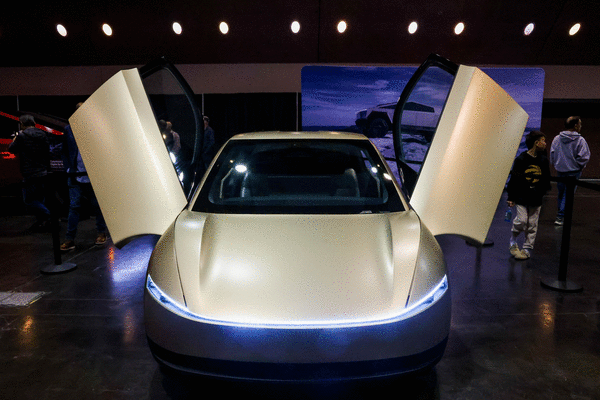
Tesla Inc. shares tumbled the most in six weeks after a formal rollout of the Cybercab driverless car left investors underwhelmed and drew fresh scrutiny from U.S. auto regulators.
The National Highway Traffic Safety Administration on Friday opened a probe into the process and technical data Tesla relied on when the company self-certified the vehicles — which have no steering wheels or foot pedals — as compliant with all federal safety standards. The agency conducts investigations when “certified vehicles appear to not adhere to these requirements,” it said in a statement.
The decision underscored the uncertain path forward for the unorthodox vehicle, which lacks certain driver controls that are typically required by federal standards. The regulatory hurdles are among the many unknowns surrounding the vehicle, alongside technological and market-readiness questions.
The Cybercab, which has been in testing in multiple U.S. cities in recent months, is seen as a key piece of Tesla’s plan to evolve beyond a maker of electric vehicles into a pioneer of artificial intelligence products. Chief Executive Officer Elon Musk has pitched Cybercab as the eventual backbone of a vast robotaxi fleet reaching most of the U.S., vowing to deploy thousands of the cars.
Against that backdrop, the company’s introduction of the vehicle into passenger service late Thursday in Austin was uncharacteristically low-key, with no livestream or media access. The automaker opened a Cybercab-specific webpage earlier in the day and posted on social media that public rides would begin Friday evening.
The “Cybercab event was largely a bust,” Gary Black, co-founder of Future Fund Advisors, wrote on X. “The launch offered little detail and key questions remained unanswered.”
Tesla shares fell 6% at 11:09 a.m. Friday in New York, the biggest intraday since July 23.
Details of the closed-door launch were posted by influencers who were invited. Some Tesla leaders spoke at the event, according to video posted by Tesla fan Sawyer Merritt on X, and attendees were able to take rides in the vehicle.
“Cybercab is here. It’s actually here,” Ashok Elluswamy, Tesla’s head of AI, said in a presentation. “You can go outside and take rides.”
Still, the event left Wall Street underwhelmed.
“We find the lack of direct communication from Tesla as somewhat disappointing, with questions as to why the event was not streamed,” Barclays analyst Dan Levy said in a note. “And without any new incrementals on growth/scaling targets, we believe the event could prove to be less significant a catalyst than some investors had expected.”
Evercore ISI analyst Chris McNally echoed that sentiment, saying in a note that the focus will shift to the extent to which the vehicles operate in regular service in the coming weeks.
Musk’s grand vision of a vast fleet of driverless taxis has yet to materialize. Using versions of its Model Y SUV, Tesla began its long-awaited autonomous ride-hailing service last year in Austin and has since expanded to cities in Texas and Florida. In some instances, the rides include human safety monitors in the vehicle.
The company registered 45 Cybercabs with authorities in Texas just ahead of this week’s launch. That suggests Tesla is preparing for a larger-scale rollout, Andrew Percoco, a Morgan Stanley analyst, said ahead of the event.
With the Cybercabs, Tesla’s Texas fleet stood at 420 robotaxis as of Wednesday, mostly Model Y vehicles. That’s less than half of the nearly 1,000 vehicles that Alphabet Inc.’s Waymo, the leader in the robotaxi market, has registered in Texas.
Tesla investors are looking for a reason to get excited about Tesla’s prospects, with its core auto manufacturing business broadly stagnant. The company’s shares fell 16% this year through Thursday, while the S&P 500 Index was up 13%. The company’s shares have rallied somewhat in the weeks leading up to the event, rising 26% since July 29.
Regulatory issues
The probe by auto safety regulators poses a potential complication to the rollout. While the vehicles used for testing and validation contain steering wheels, the Cybercabs that Tesla has put on the road for robotaxi use appear to lack those controls.
Federal rules typically require all vehicles to have several human-centric design features such as a brake pedal and side mirrors. Although U.S. auto safety regulators have proposed changes to remove unnecessary barriers for autonomous cars, those plans have not been finalized. NHTSA said Friday that existing standards remain in force until that work is completed.
“NHTSA fully supports the safe development and deployment of automated vehicles,” Jonathan Morrison, the agency’s top official, said in a statement. “But as the federal regulator, we need to ensure that all of our laws are followed.”
Tesla didn’t immediately respond to a request for comment.
Tesla also hasn’t followed the same path as Zoox, Amazon.com Inc.’s autonomous vehicle unit. The company in July secured an exemption from several federal safety standards to allow the commercial deployment of its own purpose-built robotaxi. The exemption was granted after Zoox faced issues attempting to self-certify its vehicle as compliant with federal motor vehicle standards.
(With assistance from Jordan Fitzgerald, Amy Stillman and Peter Vercoe.)
©2026 Bloomberg L.P. Visit bloomberg.com. Distributed by Tribune Content Agency, LLC.



Comments