Michael Hiltzik: The NBA report on the Ballmer/Clippers scandal shows it was even worse than you thought
Published in Business News
One rule I've developed in years of writing about financial scandals is that, as bad as a scheme appears at first, it's more likely than not that the facts will turn out to be nastier than they appeared at first.
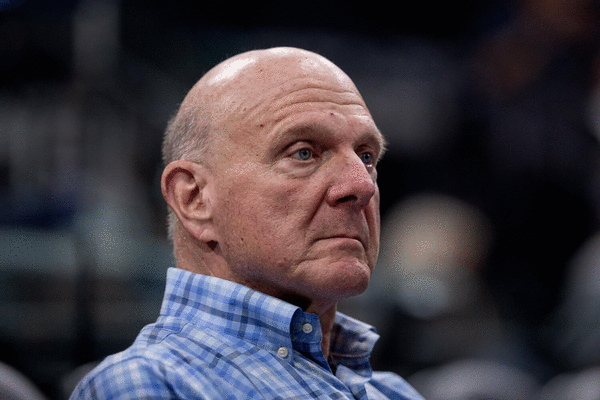
Case in point: The scandal swirling around the Los Angeles Clippers of the National Basketball Association and their billionaire owner, former Microsoft Chief Executive Steve Ballmer.
The story was initially broken one year ago by sports podcaster Pablo Torre, who reported on a suspect endorsement deal between a sustainability company named Aspiration and All-Star forward Kawhi Leonard that smelled like an attempt to circumvent the NBA's strict salary cap. (Torre won a Pulitzer Prize for his reporting.)
By Sept. 2, when the NBA issued a series of nuclear sanctions against the team and Ballmer, it had become much bigger. The team, according to an investigative report the league released, actually orchestrated endorsement deals for Leonard with four companies that had been angling for business arrangements with the team, not just one, and took steps to hide the deals from public view.
Because of the extent to which these deals violated league rules and perhaps because the Clippers are repeat offenders (they were fined $250,000 in 2015 for a similar endorsement scheme involving then-free agent DeAndre Jordan), the league hit the team with its maximum penalties.
It fined the team $30 million and took away its first-round draft picks for five years, 2029-2033 (the team already had ceded its first-round picks for the next two years in trade deals). It suspended Ballmer from any league or team activities for one year and imposed a one-year suspension on Gillian Zucker, the team's president of business operations, and a six-month ban on Lawrence Frank, its president of basketball operations.
The Clippers said they "vehemently reject" the accusations and called them the product of a "heavily biased investigation." They said they would appeal the sanctions, though it's unclear how they could do that.
Leonard, who appears to be on his way back to the Toronto Raptors, from whence he came to the Clippers in 2019, issued a statement accepting "full responsibility for lapses in judgment by people within my inner circle." That's an apparent reference to Dennis Robertson, his business manager and uncle, who the investigators said was a key figure pushing the Clippers to find "off-court income" for Leonard.
The report released by the NBA's investigators at the law firm of Wachtell, Lipton, Rosen & Katz portrays Ballmer and the team as treating the league's salary cap rules not as strict mandates, but as obstacles to be evaded, like traffic cones. And it describes efforts at subterfuge that seemed to reach a Gilbert & Sullivan-esque level of absurdity.
Ballmer is called out to an extent that one almost never sees when applied to the millionaires and billionaires who own most professional sports teams. That's even more remarkable given his status in the NBA: With a reported net worth of more than $150 billion, he is the richest team owner by an enormous margin, outranking the next-place owners, the Adelson family, owners of the Dallas Mavericks, by about $115 billion.
The other NBA owners were reportedly stunned by the sheer arrogance of the Clippers' behavior. That's saying something, since one would expect that those in the billionaire class have had plenty of rannygazoo paraded past their eyes in the course of their business careers. Ballmer, who can often be seen bouncing around like a hyper-caffeinated party animal in the Clippers' home arena, Intuit Dome, is no shrinking violet — he was known as a ferociously hard-charging, hands-on leader at Microsoft. The NBA faults him for being "knowingly" engaged in the team's dealings with Leonard and creating its anything-goes culture.
The NBA values its salary cap as a key to a competitive balance, enabling even mid-market teams to reach the Finals — over the last 10 seasons, eight teams have reigned as champs. Its rules bar teams from initiating endorsement deals or other such arrangements for players by interpreting them as an underhanded breach of the cap; if teams are approached by a potential endorsement partner for a player, they can refer the partner to a player's representatives but can't participate in the dealmaking. They're also required to report any such overtures to the league. The Clippers violated those rules, the investigators say.
The investigators say the team tried to circumvent the initiation clause via emails Zucker sent to three companies in 2020, implying that she was responding to their requests for introductions to Leonard.
The investigators found "no documentary evidence" that the companies genuinely initiated the requests. They viewed the emails merely as efforts to "create the appearance" that the Clippers were complying with the rules. The companies were Boingo, a wi-fi company at which Zucker's husband was then chairman; Daktronics, a maker of scoreboards and video displays; and Lockton, an insurance brokerage.
All three were seeking to launch business relationships with the Clippers. The investigators asserted that the team implied to them that participating in its scheme to make illicit payments to Leonard by signing him to endorsement deals would help them win the contracts. They also found that the Clippers essentially assured the companies that it would cover their payments for the endorsement deals via their other contracts.
The investigators called these multi-year, multimillion-dollar endorsement deals, totaling $18 million, "peculiar." None of the companies had ever signed an endorsement deal "of remotely the same financial magnitude" as these, nor have they done so since.
None of the deals was publicly announced, even though the whole point of signing a pro player to represent your company is to shout it from the rooftops. In any case, Leonard was nothing like a big, popular star—the investigators charitably referred to his "relatively insubstantial endorsement profile." That hardly mattered, since the deals didn't require Leonard to actually do anything for the money.
The key deal was with Aspiration, which was guided by the Clippers into paying Leonard $48 million over four years. When Joseph Sanberg, Aspiration's co-founder and a board member, presented the deal to top executives, they were dumbfounded. "I have no idea why we'd do this," one wrote in an email, according to the investigators.
But Sanberg assured them that the Clippers would adjust their contract with Aspire to cover the expense. Seeing that the deal was "cashflow neutral," as an executive observed, they agreed.
Inside the Clippers' front office, the contract for Aspiration to provide environmental services was seen as "super shady," according to a text from one executive to another cited in the report.
Ballmer maintained in at least one interview that the endorsement deal was initiated by Aspiration: "They were off to the races on their own," he told a television interviewer. "We weren't involved."
In fact, the investigators say, the Clippers initiated the contact with Aspiration, put the firm in touch with a business agent who was already a team contractor, and provided the agent with proposed deal terms. The investigators found that the endorsement deal was such a departure for Aspiration that Sanberg needed to be educated about what it should require from Leonard in return for his fees. Sanberg "doesn't really know what to ask for," the agent told his associates.
Ballmer maintains that he was the victim in this arrangement. He points the finger at Sanberg, who he says enticed him into investing $60 million in his failing firm, thereby causing him "reputational harm." But Sanberg might be viewed as a target of convenience, given that he pleaded guilty last year to federal fraud charges associated with the collapse of Aspiration and has been sentenced to 14 years in prison. (The NBA investigators told the court in a pre-sentence letter that Sanberg "substantially assisted our investigation"—though in the investigative report they said they "remained cautious in relying on Mr. Sanberg's information" unless it was "corroborated by other evidence.")
Where does this leave the Clippers? Nowhere good. Ballmer's acquisition of the team in 2014 was seen as a major step toward ending its years-long record of futility, dating to its origin as the Buffalo Braves in 1970. The team still has never played in the NBA Finals. Leonard hasn't lived up to expectations — injuries have kept him off the court for nearly half of his games as a Clipper, as my colleague Mirjam Swanson notes.
Basketball mavens see the NBA sanctions as condemning the Clippers to as long as 10 more years in John Bunyan's Slough of Despond. For a brief moment, Ballmer got Southern California fans excited about the team. Ten years from now, will anyone even remember they exist?
©2026 Los Angeles Times. Visit at latimes.com. Distributed by Tribune Content Agency, LLC.






Comments