Millions of Americans get discount prescriptions from Canada. That back-door arrangement is about to close
Published in Business News
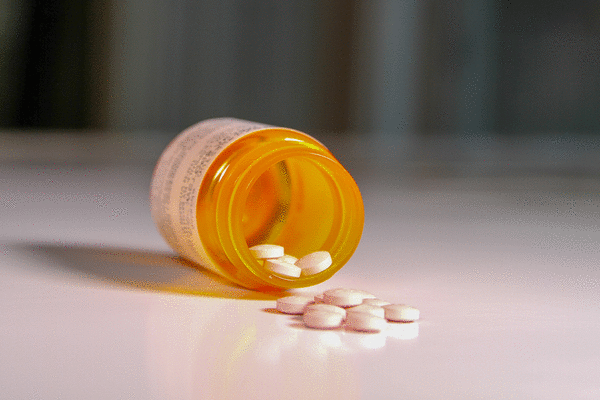
A back-door discount pharmacy arrangement that millions of Americans use to fill prescriptions in Canada and other international drugstores will close next month.
Effective Oct. 22, the Trump administration will tighten trade rules, which will make filling low-cost prescriptions at foreign pharmacies all but impossible for Americans, experts say. Buying prescriptions at discount rates from other countries will require tariffs, prepaid duties and customs paperwork.
For decades, millions of Americans have turned to Canada and other foreign countries for low-cost prescriptions.
“Every year, millions of prescriptions are sent across the border,” said Ken Hunter, executive director of the Campaign for Personal Prescription Information, a nonprofit patient advocacy outfit based in Hillsborough, N.J. “You’re going to have thousands of people in Pittsburgh who can’t order their prescriptions.
“It’s just a sorry situation,” he said.
In a statement, the nonprofit Canadian International Pharmacy Association said the “arrangements used to deliver most personal prescription orders to U.S. patients will no longer be workable.
“Unless those arrangements change, Americans should expect that virtually all routine personal prescription orders mailed from licensed Canadian and international pharmacies will be unable to reach them,” the trade group wrote.
In July 2025, President Trump signed an executive order eliminating the so-called de minimis duty exemption, which allowed low-value imports worldwide to enter the U.S. without the headache and cost of customs review. A new U.S. Customs and Border Protection policy governing international mail shipments will end the duty-free exemption Oct. 22.
The Trump administration said the de minimis exemption was being exploited to facilitate illegal drug shipments and evade tariffs, which hurt domestic businesses. For certain countries, the number of these shipments nearly tripled to 309 million by June 2025 from 115 million in all of 2024, according to the White House.
The shutdown means Americans will have to pay higher, domestic prices for prescriptions. In some cases, the prices will be much higher.
A study by the Campaign for Personal Prescription Information identified average savings of 65% for American consumers on 10 commonly prescribed drugs. An August survey by the group found that a three-month supply of the popular blood thinning drug Eliquis cost $566 from Canadian pharmacies, but $1,017 from Amazon and $1,029 from GoodRx.
“We clearly already have a problem with access and price of prescription drugs,” said primary care physician Natalie Gentile, co-founder of Direct Care Physicians of Pittsburgh in Shadyside. “Why do we have to go to other countries to get our prescription drugs?”
The policy change comes as the Senate Health, Education, Labor and Pensions Committee conducts a hearing Thursday on President Trump’s nomination for Food and Drug Administration commissioner. In a post on his Truth Social platform in August, Trump said Dr. Heidi Overton was expected to make good on his promise of lower drug costs at the FDA.
But Connellsville area resident Denise Litman said she is already facing problems filling her prescription for apixaban, the generic name for the anticoagulant Eliquis, which she takes for a heart condition.
Eliquis is the most commonly prescribed anticoagulant; about 5.35 million Americans took the drug in 2024, according to ClinCalc, a clinical decision platform based in Arlington Heights, Ill.
Since the customs change, her primary care doctor told her he can no longer forward her prescription to the Canadian pharmacy where she’d been getting it filled for years.
She’s awaiting word from her cardiologist about whether he will write the prescription for the Canadian drugstore.
“It was very convenient and very easy and it saved me a lot of money,” said Litman, 72, who works in an insurance office.
Now though, she said she’s facing having to pay $500 domestically for a one-month supply when she had been paying about $83 for a three-month supply of generic Eliquis — which is only available outside the U.S.
Although the FDA has given tentative approval to the generic version of Eliquis, domestic manufacturer BMS/Pfizer’s patent protection for the brand name version in the U.S. lasts until at least 2028, holding generic competition and lower prices at bay until then.
“It’s going to take a big chunk out of my income,” Litman said. “It’s terrible what people have to go through.”
©2026 PG Publishing Co. Visit at post-gazette.com. Distributed by Tribune Content Agency, LLC.




Comments