In the age of AI, analog is having a renaissance
Published in Business News




Technology keeps promising to do more. A growing number of consumers want it to do less. Even as artificial intelligence becomes more powerful and pervasive, Google search data show a 5,000% increase year over year in queries for “analog hobbies” — like knitting, water coloring or playing an instrument — and an 850% increase in searches for “offline living” relative to other prompts on the search engine.
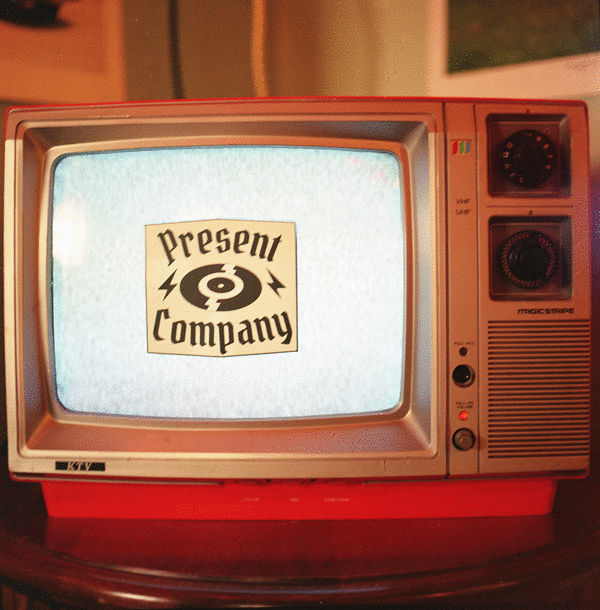
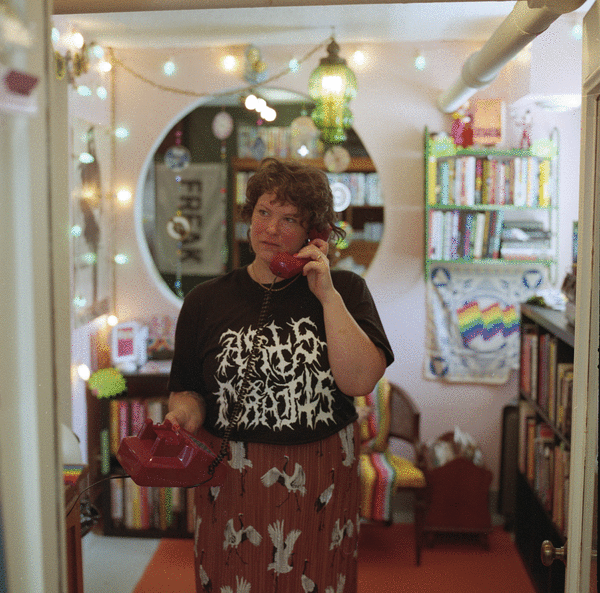
St. Paul, Minnesota-based Present Company is one in a growing set of entrepreneurs that are turning that desire into businesses built around vintage technology, phone-free gatherings and face-to-face connection.
It’s not so much a rejection of technology as it is a desire for more control over when and how they use it.
“There’s such a missed opportunity when people use a phone, at whatever age, as a distraction rather than just being bored for a second,” owner Megan “Mick” Grotzke said. “There’s something radical right now about rejecting that and saying, ‘Actually, I’m going to look up, and I’m going to live my life on my own terms and not broadcast every single thing.’”
Large retailers including Target, Best Buy and the Mall of America are also banking on it being more than a passing mood.
Mall of America in Bloomington, Minnesota, is staging drive-in movies, and Fun 101 — Target’s newly renamed category for sports merchandise, pop culture, toys and trading cards — was the Minneapolis-based retailer’s fastest-growing major product group in both of the year’s first two quarters.
Setting boundaries with technology
Makeup artist Andra Johnson spent a recent Thursday night at Present Company offering pay-what-you-can consultations for customers’ “burning beauty questions” and demonstrating techniques in person.
Neighbors stopped by the St. Anthony Park neighborhood spot. Children wandered in after school. A bride-to-be asked about wedding makeup and hiring an artist. In the background, kids played a retro video game while the adults talked.
Johnson, 32, briefly pulled out her phone to take a few photos she could use to promote her makeup business. Otherwise, phones stayed tucked in pockets or in individual plastic boxes, dubbed phone “jails,” behind the door of a wooden chest.
It was the kind of gathering she had been looking for since moving to Minnesota about 18 months earlier.
Johnson grew up watching YouTube beauty creators and learning from them. But as social media became more immersive, it increasingly came with stress.
“The online space has been valuable in certain ways, but with the rise of social media and TikTok and doomscrolling, it’s become less and less helpful for me and more stressful and anxiety-inducing,” Johnson said.
Fifty-three percent of U.S. adults said they spend too much time on their phones in a recent Pew Research Center survey, including 70% of adults ages 18 to 29.
Forty-five percent said they tried to cut back in the previous year, but only a quarter were successful.
Similar frustrations motivated Grotzke to create Present Company. The shop opened in the Milton Square complex in late 2025. It has two spaces: a retail shop and what Grotzke calls the Dead Zone Lounge.
Visitors can browse vintage technology and music, read, make crafts, play games or gather with friends.
Interest in analog experiences is often packaged in nostalgia: flip phones, film cameras, vinyl records and hobbies associated with a time before every idle moment could be filled by a feed.
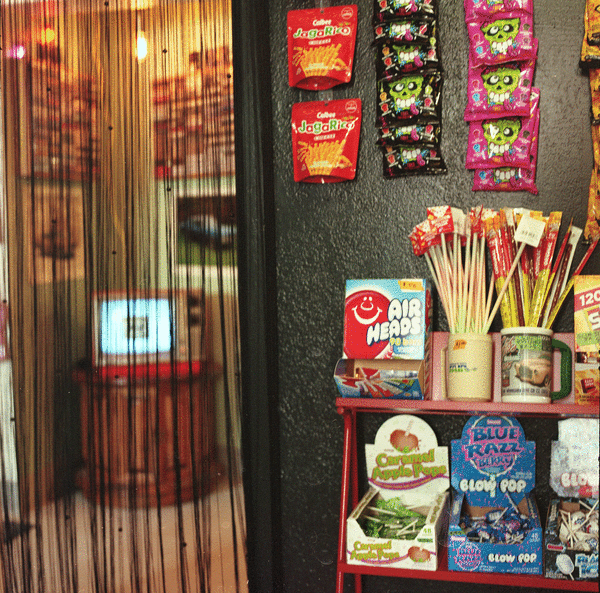
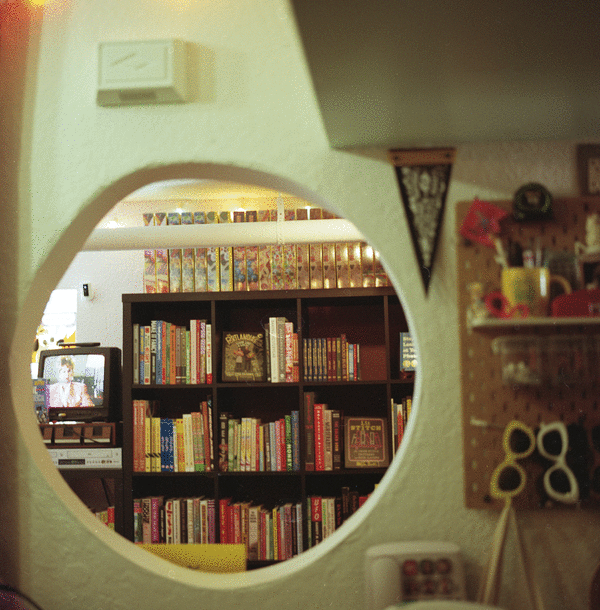
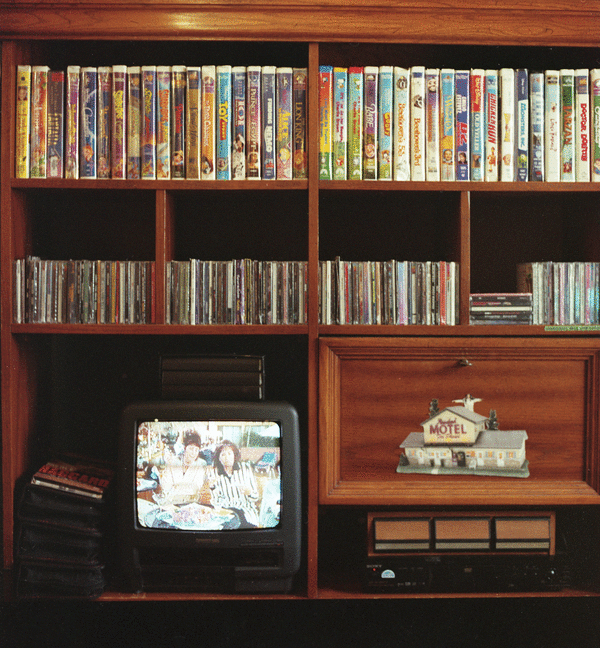
Stepping inside the lounge can feel like entering a big sister’s bedroom in the 1990s. The shelves hold vinyl records, CDs, VHS tapes and books. Retro candy — Fun Dip, candy bracelets, gummy hamburgers and Big League Chew — offers another portal to childhood.
In the Dead Zone Lounge, visitors can use a 2009 iMac for select tasks, including burning CDs like at a recent Metal Night where metal enthusiasts shared music, stories and memorabilia with one another. The computer is also set up to play Solitaire and Minesweeper and Microsoft Paint.
On some Saturday mornings, the lounge has hosted cartoons and cereal, or meetups for people organizing their weekly planners or doing other everyday tasks.
Grotzke has also worked to connect with local groups that offer in-person experiences, including Blind Date with a Book Club.
Among the shop regulars is 13-year-old Siri, who first visited Present Company with friends after seeing an advertisement in the Park Bugle. The group sat around a table covered in craft supplies, made collages and talked.
Siri, whose mother asked that her last name not be used to limit her digital footprint, now stops in to browse, read or decompress after school. She and her friends play cards and board games in the lounge. She also crochets, sews, makes jewelry and burns mix CDs for friends, complete with handwritten track lists and decorations.
“Before this, we would usually hang out at the library,” Siri said. “But I feel like you have less freedom there. It’s more structured, and you have to stay quiet because you don’t want to disrupt other people. This is more like a free space to just hang out.”
Retailers chase the analog appetite
Present Company isn’t the only Twin Cities business betting on the public’s low-tech appetite. A nonprofit video store is preparing to open in Minneapolis, and Thesis Coffee Collective operates without Wi-Fi, encouraging in-person conversation over screen time.
Incoming Best Buy CEO Jason Bonfig said the consumer electronics retailer is seeing those trends play out across its product lineup. It is stocking some of the latest technology, including Meta glasses and next-generation TVs that promise better color. But the retailer is also balancing those offerings with the screenless Fitbit Air and Nothing phones, as well as “retro” items and collectibles like Lego sets and Pokémon cards.
“You’re finding some customers who are saying, ‘I would like devices that are a little simpler in nature.’ Sometimes that could be something like a more simplified phone,” Bonfig said in an interview with the Star Tribune. “But you’re also seeing trends that are more physical and a little more tactile.”
Bonfig pointed to vinyl record sales and interest in products such as the reMarkable tablet. Unlike a multipurpose tablet, the device is designed primarily for reading and taking handwritten notes on a paperlike screen, minimizing the distractions of a laptop and the waste of a spiral notebook.
Looking backward to move forward
Nostalgia doesn’t necessarily mean people want to retreat into the past, said Clay Routledge, an existential psychologist who studies nostalgia and is the chief operating officer of the Archbridge Institute in Washington, D.C.
“Nostalgia doesn’t keep us in the past,” he said. “Really what’s going on is we’re trying to figure out the present, and find the resilience and motivation to move forward.”
A 2023 Harris Poll survey conducted with Routledge’s research team found that 60% of Gen Z adults wished they could return to a time before everyone was “plugged in.”
That doesn’t make them anti-technology, Routledge said. Many still rely on it for routine tasks, such as navigation or checking the weather. But they also seek tactile objects, face-to-face interactions and experiences that aren’t mediated through a screen.
The rapid development of AI could be adding urgency to that search. Routledge said young people are confronting questions about what they should study, whether jobs will exist for them and how AI could be used or misused.
Johnson, the makeup artist, shares some of those concerns and said she associates the predigital era with greater privacy and clearer boundaries around which parts of life were recorded. AI has heightened her worries about artists’ livelihoods and the speed at which people are being asked to adjust to new technology.
“There’s no roadmap to this,” she said. “I feel very often like a guinea pig.”
©2026 The Minnesota Star Tribune. Visit at startribune.com. Distributed by Tribune Content Agency, LLC.










Comments