Is Congress on the right track with its proposed EV tax?
Published in Business News
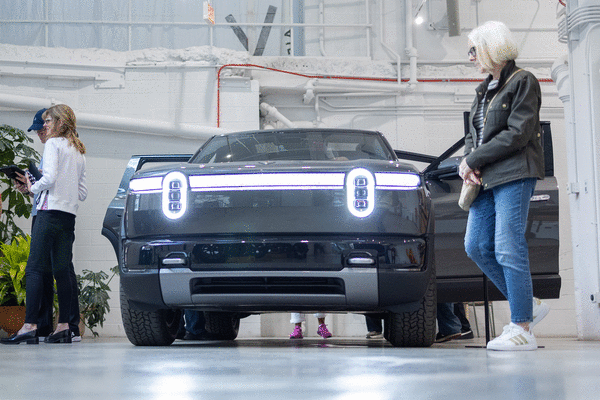
A bipartisan bill in Congress could add a new tax for electric vehicles just as there is a renewed push to move away from gas-powered cars.
The proposed EV fee would start at $130 annually and is considered an attempt to make sure all drivers pay their fair share. The federal government collects 18.4 cents per gallon on every U.S. gasoline purchase to help pay for road and transit construction projects. EV drivers traditionally don’t pay anything at the federal level.
Previous attempts to collect EV fees in San Diego, and other parts of the U.S., through per-mile road charges proved to be politically impossible, so the bill is seen as an alternative.
Meanwhile, the run-up in oil prices and environmental concerns have caused criticism of the bill. The Sierra Club called the tax “irresponsible,” and other pro-EV groups argued the fee would likely be higher than what drivers of gasoline-powered vehicles pay. California has the most EV drivers per capita among all states, and already has an annual road improvement fee for newer EVs.
Question: Is Congress on the right track with a proposal to tax EV drivers annually?
Economists
James Hamilton, University of California-San Diego
NO: If you want to discourage something, you tax it. I do not want to discourage electric vehicles. They are one of our best hopes for slowing the rate of global warming and reducing our reliance on fossil fuels. American-made electric cars are an American success story and are one reason why disruption of oil shipments through the Strait of Hormuz has not been as damaging to the U.S. economy as some had feared.
Caroline Freund, University of California-San Diego School of Global Policy and Strategy
NO: User fees make sense in principle, but it is too early for EVs. They are 7% of new U.S. car sales, compared with 25% globally. In Norway, nearly every new car sold is an EV. In China, over half are new energy vehicles. Both got there by cutting taxes and offering rebates, not by adding new charges. The U.S. just removed the $7,500 credit and EV sales fell. An annual tax now would push the transition backward.
Alan Gin, University of San Diego
NO: Electric vehicles reduce negative externalities, such as pollution and the security risk of using oil. Economic theory says that EVs should not be taxed but instead should be subsidized. An argument can be made that they should be taxed to reflect their use of roads, but the proposed fee of $130 is much more than gasoline-powered cars pay. The average driver of a gasoline-powered car pays about $75 a year in gasoline taxes.
Ray Major, economist
YES: In addition to not paying their fair share to maintain critical transportation infrastructure that they regularly use, EVs can have a high upfront manufacturing impact on the environment from mining and refinement of raw materials like lithium. The proposed $130 offsets EVs’ impact on infrastructure, which is by every measure a fair fee for owners to be paying.
David Ely, San Diego State University
YES: This is a bipartisan bill, noteworthy in a partisan environment. It is a poor time to impose a new tax given the stress that many are feeling from high prices. The fee would not be aligned with miles driven or the per-gallon federal gas tax. But while far from perfect, this legislation helps shrink the Highway Trust Fund structural deficit and is designed to raise revenue from drivers who benefit from well-maintained roads.
Executives
Phil Blair, Manpower
YES: As a family who has been driving electric for many years, I watch the price of gasoline go up and am thankful I do not buy that product. But I do get a twinge when I realize I am not paying for the roads I am driving on. We should pay our fair share or stipulate it is a perk to encourage electric cars.
Gary London, London Group Realty Advisors
NO: The costs of upkeep of our transportation systems should be borne by users. This involves a marriage between a “vehicle miles traveled” concept and a technology interface to track it and charge for it. And it should be equally applied to both EV and liquid fuel vehicles. The state and federal governments should collaborate. And they should all try harder to make this far more equitable approach work. It’s not politically impossible.
Jamie Moraga, Franklin Revere
NO: Proponents of the bill aren’t considering the full picture. Gas drivers pay federal fuel taxes at the pump, so their contribution rises or falls with fuel use. EV owners would instead face a flat annual fee starting at $130 and increasing over time, exceeding what the average gas driver pays annually in federal fuel taxes. EV owners also often pay more upfront and face state and local taxes, fees and annual registration costs. These costs could discourage consumers from switching to electric vehicles.
Mark Kersey, San Diego County Taxpayers Association
YES: However, this annual EV road tax should be pegged to the average annual amount paid in gas taxes by non-EV drivers, so if the proposed $130 exceeds that amount, it should be reduced. A principal goal of taxation should be fairness. EV drivers (like me) utilize roads and highways and should help contribute to their upkeep. This annual levy would be preferable to the proposed, much more invasive, vehicle miles traveled tax.
Bob Rauch, R.A. Rauch & Associates
NO: The Highway Trust Fund is structurally broken, as Congress has had to transfer $275 billion over the past 17 years. EVs do create a funding gap, so Congress is right that they should contribute to road funding. But the proposal structure, high flat fees, disproportionate burden relative to gas vehicles, minimal fiscal impact, and simultaneous cuts to EV programs suggest the policy is not well‑aligned with long‑term transportation or electrification goals.
Austin Neudecker, Weave Growth
NO: We should encourage, not penalize, the transition to cleaner vehicles. EV drivers should contribute to road maintenance, but singling them out for a new tax is the wrong approach. Congress should reduce reliance on gasoline surcharges and move all vehicles to a common road-use fee, ideally approximating mileage and weight without invasive tracking. This solution could more fairly fund infrastructure while preserving incentives to adopt cleaner transportation.
Chris Van Gorder, Scripps Health
YES: However, I say that reluctantly because I am worried about constant increases in taxation. We need to move to electric vehicles or hybrids — but moving away from gas taxes will reduce funds for road maintenance, which all vehicles need. The federal government and states must balance their tax needs with motivation to move toward clean energy. That means more state and federal collaboration, not less.
©2026 The San Diego Union-Tribune. Visit sandiegouniontribune.com. Distributed by Tribune Content Agency, LLC.










Comments