As diesel prices soar, truckers struggle while keeping America moving
Published in Business News
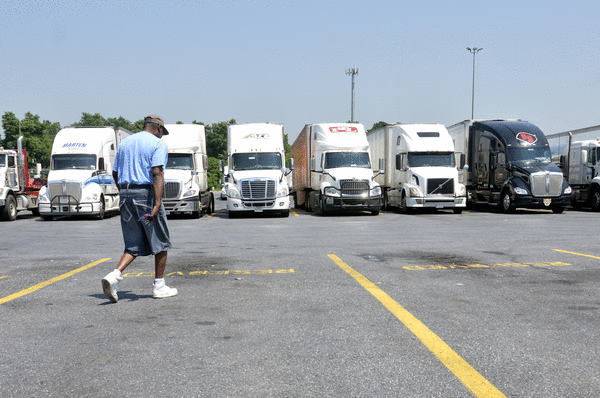

BREEZEWOOD, Pennsylvania — The asphalt prairie-sized TravelCenters of America truck stop here is an oasis for truckers, featuring a hot dog roller grill crowded with wieners, shelves of spam, Sriracha, the rooster-labeled hot sauce, and jumbo bags of cheese curls.
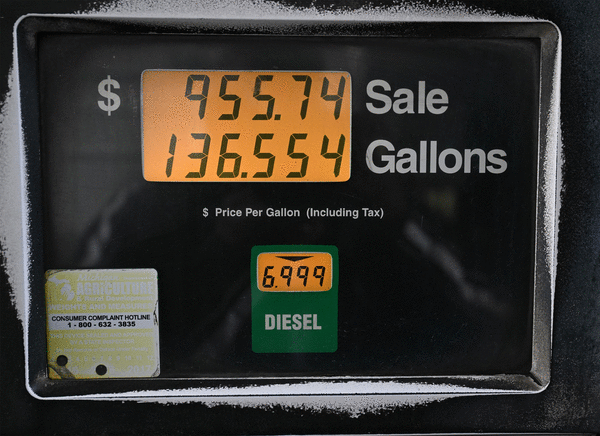
The big concern lately has been the price of diesel fuel — $6.79 a gallon, up 16 cents in just two weeks at this truck stop, where drivers can fill up at nine diesel fueling lanes.
Trucking oils the new click-and-ship consumer economy and nearly 1 million rigs get off the Pennsylvania Turnpike at this commercial freight gateway every year, according to the turnpike commission. In all, rigs carry some $818.6 billion in goods through Pennsylvania each year.
Drivers employed by fleet carriers who can leverage deals say they are insulated from spiraling fuel prices, but they’re jockeying the fuel islands next to the little guy owner-operators who feel the sting with every fill-up.
And trucking is a little-guy business: 52% of the drivers on the road have just one rig, said Lewie Pugh, executive vice president of the Owner-Operators Independent Drivers Association in Grain Valley, Mo.
“This is a huge small business industry,” he said. “They don’t have the volume or buying power to arrange for fuel discounts.”
In the days before the U.S. attack on Iran in February, the average cost per gallon of diesel in the six-state Atlantic region that includes Pennsylvania was $4.10, according to the U.S. Energy Information Administration.
By the week of Oct. 26, the price had jumped 58% to $6.49 a gallon — a 10-year high and nearly 150% higher than the $2.61 average gallon price in the region a year ago.
During the same period, regular gasoline prices were also spiking, up nearly 44% to an average $4.26 from $2.96 per gallon.
‘Everybody’s going to pay for it’
Diesel and gasoline are both crude oil distillates; diesel is a heavier, less volatile product, while gasoline is lighter and ignites far more easily.
Truckers can top 100,000 miles on the road each year, with diesel costs now running about $1 per mile, Pugh said.
That’s more than double the average fuel expense of 48.1 cents per mile for motor carriers in 2024, according to the Washington, D.C.-based American Transportation Research Institute.
“Nobody saw this fuel thing coming,” Pugh said. “It makes money tight for everybody.”
The little guys, numbering between 350,000 and 400,000 owner-operators in the U.S. and Canada, include Chris Garner of Russia, Ohio, who fueled up at a TA fuel island on his way to Minnesota in late October, pulling a trailer full of frozen chicken.
Higher diesel prices, he said, mean less take-home pay, and that, in turn, is rippling through the U.S. economy.
Every consumer will be seared, he said.
“I look for it to top out at $8 a gallon, just how everything is going on over there with the war,” said Garner, 54, who drives a “reefer,” a refrigerated tractor-trailer that guzzles diesel to keep goods frozen as it travels the highways. “I got to run like hell just to try to make a living.”
How much of the price increases get passed along to consumers depends on whether some of the additional expense will be absorbed by businesses, provisions in the freight contracts and other factors. But independents like Garner have grown obsessed with conserving a commodity that has become more precious with every passing week.
“All of this is a big circle,” he said, “Everybody’s going to pay for it.”
Garner, a trucker for 20 years, says his Peterbilt isn’t the most fuel-efficient machine on the road. So, he often slows down to conserve fuel — sometimes driving no more than 64 miles an hour on the highway so his rig will sip rather than guzzle diesel.
Even with the slowing, Garner said he was “barely breaking even this year” because of fuel costs.
Here’s another reason for trucker stress: Fuel surcharges — which are part of many contracts to account for rising diesel prices — are paid to truckers 30, 60, even 90 days after shippers ink the agreements. By that time, price increases at the pump have outpaced the extra money that was baked in to cover the rising costs.
So far, government efforts to tamp down prices at the pump have not panned out.
The average price of diesel in the U.S. ticked up 2.6%, or 16 cents a gallon, to $6.35 from $6.19 between Oct. 5 and Oct. 26 — the period before President Donald Trump waived the U.S. embargo on buying Russian diesel and after the deal was announced, according to the U.S. Energy Information Administration.
As evidence of the added stress on truckers, Chattanooga, Tennessee-based FreightWaves, an industry news and data organization, identified at least 16 carriers that filed for bankruptcy between Sept. 18 and Oct. 21. It was unclear whether the number of truckers going belly up was tied directly to diesel prices or part of other economic trends.
‘Truckers won’t be able to survive’
At the TA truck stop in late October, New Jersey owner-operator Xavier Crippen, 37, was looking for diesel prices to hit the low $7 per gallon range before he thought they might start to fall.
Adapting to the shock of higher prices meant that Crippen, who was hauling merchandise for online retailer Amazon, pushes the limits on the federal rules regarding driving time to increase time behind the wheel and lift earnings. The limits generally restrict driving time to 11 hours before a required 10 hours of rest.
“It has to go down,” Crippen said urgently about diesel prices. “I have to run harder, fighting the ELD (Electronic Logging Device), pushing the ELD” to maintain earnings.
A few lanes away, idling in a pickup truck at a fuel island, was Michael Smith, until recently an automation engineer for a pharmaceutical company in Indianapolis, where he lives. When the company recently downsized, he was laid off at 57 years old.
Smith said he’d had a part-time gig towing recreational vehicles with his pickup to various places around the country, but that all changed when he lost his day job after 30 years.
“Now, I’m looking to do it full time,” he said, getting ready to pull back out onto the highway with a mini-bus-size camper in tow.
Saving on diesel means no more trips out west, where fuel prices have risen much faster than on the East Coast, he said. In the past year, he’d only received a fuel surcharge of an additional 2 cents per mile while the gap between East and West Coast diesel reached $1.25 a gallon.
Meanwhile, 130 miles away in Westmoreland County, tractor-trailer trucks — like lumbering steel behemoths on wheels — exited Interstate 70 and eased around the fuel islands at the Flying J Travel Center in Smithton, a truck stop featuring showers and a laundromat.
Junior Jen, 39, of Boston, used his credit card to cover a $1,500 fill-up.
Filling his tank a year ago cost $1,000, he said.
“Right now, I’m losing money,” Jen said, his trailer empty after a Walmart grocery delivery run.
“Before, I made good money. Not now,” he said, adding that he was just holding on.
A few minutes later at the fuel island, independent trucker Tyrone Davis, 36, of Atlanta, said his weekly earnings had taken a 40% hit since the summer spike in diesel prices.
Weekly take-home earnings have fallen to $3,000 from $5,000 for Davis, who said he has hauled everything from carpeting to fabric softener sheets.
“July was good, the rates were good. But it just went downhill in September and October,” he said.
Back at the TA truck stop in Bedford County, Pennsylvania, 34-year-old Grant Lee was fueling a flat-bed tractor-trailer on his way to Baltimore to pick up an excavator for a return trip to Canada.
“I’m hoping for a break,” said Lee, who lives in Winnipeg. “Truckers won’t be able to survive another six months.”
A full tank of diesel fuel cost him $1,500, triple the cost in the past, he said, while contract shipping rates have lagged.
“You kind of have to eat most of it,” he said about rising fuel prices.
©2026 PG Publishing Co. Visit at post-gazette.com. Distributed by Tribune Content Agency, LLC.










Comments