Evan Ramstad: The Trump and Huang bubbles burst. Your money could benefit
Published in Business News
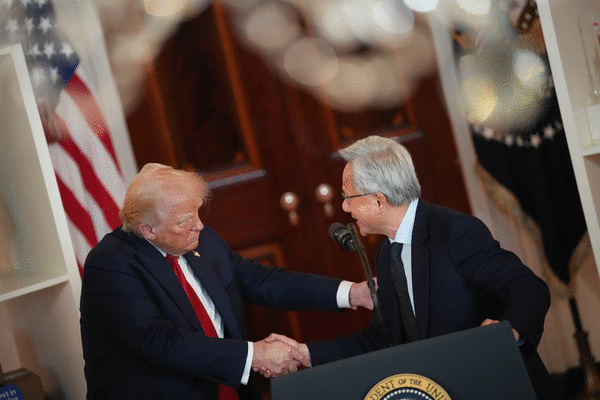
President Donald Trump is a lame duck. Jensen Huang is out at Nvidia.
The most powerful man in the world and the most powerful man in technology were laid low in an almost-unbelievable confluence of events over just 10 days.
These are victories for economic populism and for dealing with the world truthfully and squarely, and they should be great for you and your money.
Because in both the midterm election’s outcome and the rapid dispatch of Huang following scandalous revelations, people rejected the air of unreality, to put it nicely, spun out of Washington and Silicon Valley over the last few years.
Now, newly elected members of Congress should recognize Americans are done with being told one thing about their money when they are experiencing just the opposite. I hope Minnesota’s new legislators come to the same realization as their ambitions collide with fiscal realities in coming weeks.
Similarly, Huang’s downfall, coming so soon after voters registered their anger about data centers, should lead technology executives and their financial backers to tone down their own hype and, often enough, weirdness.
Huang’s company, Nvidia, burst from seemingly nowhere less than a decade ago to become the world’s most valuable company because its chips were seen as the backbone of artificial intelligence.
And AI, he and other techies told us, was not just the next big thing. It was bigger than anything else in our lives.
But his downfall came from trying to maintain a fiction: that Nvidia’s hyper-fast growth could exist without selling to China, the world’s second-largest market for AI development and a rival that scares Trump and many Americans.
The company created less-powerful chips to get around U.S. restrictions on sales to China but always argued that selling its chips to the Chinese preserved America’s world-leading role in AI.
Perhaps blinded by the hubris of immense fortune, Huang wound up working with a company in Singapore that may have diverted chips to China, and he developed a relationship with a woman who U.S. officials suspect may have been acting on behalf of China’s government.
In the face of personal humiliation and the potential threat to American national security, Huang at least had the decency to apologize in an open letter to Nvidia employees on Sunday. “I take full responsibility for what I did and the hurt I caused, and I accept the criticism that comes with it,” he wrote.
Of course, we’ve known for decades Trump is a serial exaggerator. But so often he just lies outright about the things he’s associated with, whether it’s the success of his businesses, the health of the U.S. economy, the size of his crowds, and so much more.
It’s entertaining sometimes. But mostly it’s exhausting when, for instance, Trump insists that the U.S. won the war in Iran when we are clearly stuck there, that other countries pay tariffs when actually American businesses do and that the country’s enormous pile of debt is diminishing when it is growing faster than ever.
Trump sees apologies as weakness and very rarely expresses them. But his interview with the conservative commentator Ross Douthat on “60 Minutes” last weekend was one of the rare times when Trump mostly stuck to reality with a journalist rather than spinning off into fantasies and grievances.
Writing in the Wall Street Journal last week, investment executive Jeff Yass explained how the media and many investors misunderstand so-called market “bubbles,” an economic form of unreality.
The common perception is that stock prices burst when investors stop believing the hype around a company or an industry. Yass wrote that there is actually never a “true price to lose sight of” because investors are constantly guessing about possible futures for a company. And investors have varying levels of certainty about their guesses.
“When prices fall, that isn’t delusion correcting,” Yass wrote. “It’s uncertainty resolving.”
With the departure of Huang from Nvidia, investors now know that the uncertainty of whether the chipmaker could maintain its high-wire act with China is over. It can’t.
That gives investors, including average Americans with retirement accounts, security that Nvidia’s valuation is grounded in reality rather than a bet on volatile relations between the U.S. and China.
America’s play in AI has been to spend heavily to build immense computing power, far beyond what the market has yet demonstrated demand for, and with little regulation. It’s the Wild West model, and it created enormous distortion in the U.S. stock market and diverted capital from other businesses.
China’s play in AI has been to follow America’s lead, developing its own AI chips and content that offer users slightly less value at a much lower price. In contrast with Washington, the Beijing government asserts enormous control over how Chinese citizens use AI.
Huang, the leading proponent of the Wild West model, is no more. There’s new clarity about the limits of what Nvidia and America’s other AI companies have been trying to do with the money, land and other resources they have sought from Americans.
The next clarifying event comes in less than a week, when Anthropic attempts an initial public offering.
———
©2026 StarTribune. Visit at startribune.com. Distributed by Tribune Content Agency, LLC.






Comments