'Dead last': KC passes ordinance to overhaul ineffective approach to homelessness
Published in News & Features
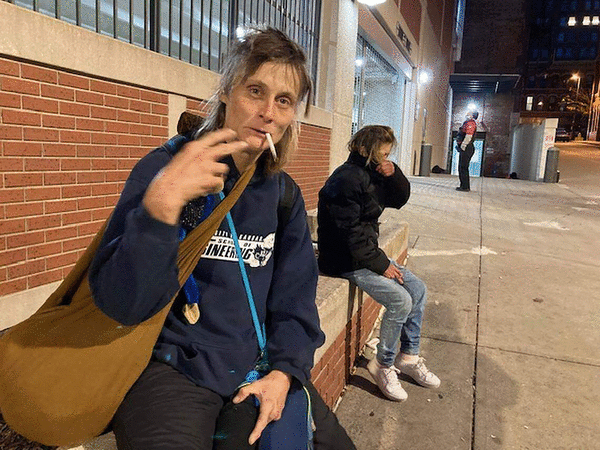
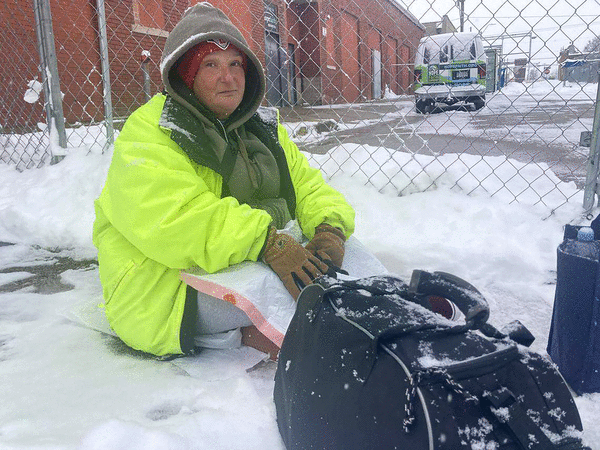


Anyone who has lived long in Kansas City — a city proud of its fountains, parks, first-rate sports teams and barbecue — could not help but see that it has also become a city with a burgeoning population of people experiencing homelessness.
Huddling downtown against the cold and heat. Raising sprawling, and, in some cases, dangerous encampments in the woods along the railroad and Missouri River. Sleeping beneath bridges, at traffic medians and in parks.
On Thursday, in a tacit acknowledgment that the loose, uncoordinated system it has relied upon for decades has largely been ineffective in reducing homelessness, the Kansas City Council voted to pass an ordinance to put $1 million toward kickstarting a public-private strategy as a better response to the crisis.
“I just want. . .to say that we know we rank near dead last for major cities when we deal with homelessness,” said 6th District Councilman Johnathan Duncan, who co-sponsored the ordinance with Mayor Pro Tem and 5th District Councilwoman Ryana Parks-Shaw. “Folks who are in shelters, of which we do not have enough, are still homeless. . . This is the first step to adequately addressing this problem.”
The ordinance calls on the Kansas City Manager to establish a “Kansas City Housing Gateway Program,” the details of which are to be determined, but which is expected to be patterned on successful public/private programs that have been established in cities such as Houston and Milwaukee.
In Houston, the use of a “Housing First” model — one that prioritizes providing immediate, permanent housing in combination with significant wrap-around mental health and other services — has reduced homelessness by 60% since 2012. In Milwaukee, a similar approach has reduced homelessness by 90% since 2015.
The $1 million is not a new appropriation. It had been budgeted previously as part of the city’s Property Owners Mitigation Fund. It was a fund that offered money for housing repairs or upgrades to landlords who rented to tenants who use Section 8 housing vouchers. In 2023, an ordinance banned landlords from discriminating against prospective tenants based on their source of income. That money has become available as the ordinance is now being challenged in court.
On Tuesday, the Housing Gateway ordinance rose to the City Council after being discussed and voted on by the Neighborhood Planning and Development Committee, chaired of Parks-Shaw, earlier this week.
The three individuals who spoke before the committee included Mary Owens, the city’s deputy director of Housing and Community Development, Josh Henges, who was hired in 2022 to be Kansas City’s first homeless prevention coordinator, and Kevin Barth, the chief executive officer of Commerce Bank in Kansas City.
Owens said the initial city money will be used to provide immediate rent assistance to people at risk of homelessness, but also to act as a “catalytic investment,” to help raise $10 million from both public and private sources for the program to house 600 people in its first year.
“This is an ambitious undertaking to transform our homeless response system,” Owens said Tuesday.
A bleak situation
Data on Kansas City’s homeless population paints a dire picture.
More than 2,000 people are homeless in Kansas City at any one time, according to the city. In the last seven years, that population has risen 170%.
And among those who are chronically homeless in Kansas City, 95.7% are living outside without any kind of shelter, according to the U.S. Department of Housing and Urban Development. That’s the highest percentage of any major city In the United States. Owens said that one of Kansas City’s major problems is that the community-wide approach to helping homeless people is currently splintered.
“Our system is incredibly siloed,” she said. “We have 214 providers and 333 programs serving our homeless population. And all of those programs are serving independently to one another.”
They are all working separately, she said.
“Our funding is not aligned around outcomes,” she added. “Our funding is aligned around programs. So instead of the goal of these programs being to end homelessness, they all have different goals — whether it is to feed as many people as they can, or to house as many people as they can. But it’s not to end homelessness.”
Owens enumerated other problems: The lack of affordable housing. Too few low-barrier shelters. Too little transitional housing.
“We’ve put an outsized focus on permanent supportive housing,” she said, “And we’ve disinvested, or haven’t been investing enough, in that temporary housing intervention for our temporarily homeless.”
Another problem, she said, is data. The city tries to maintain a database, a homeless information management system of homeless people in Kansas City, that helps to chart their names, the place they generally call home, what services they receive, where they receive them, and anything else they might need to help them find and keep stable housing.
Owens said that currently, only 63 of the 214 organizations that provide services to homeless individuals are required to report their data through the city’s system.
“So we don’t have a complete picture of our homeless population,” she said, “or who’s serving our homeless. So in order for us to really make a strong difference in homelessness, we have to get better data.”
‘A humanitarian issue’
The ordinance establishing the Housing Gateway program, Parks-Shaw said, was the result of about nine months of work with city staff, nonprofit providers, churches, consultants and business leaders including Barth of Commerce Bank.
On Tuesday Barth spoke of witnessing the “steady increase” of homeless people in Kansas City, particularly downtown.
Barth’s experience was partially responsible for the ordinance and its call for a more effective approach.
“I thought of it first as a humanitarian issue,” Barth said. “And it’s still a humanitarian issue of helping the homeless.”
“But over the last few years, it’s become more of a comfort and even a safety issue, with the number of homeless people congregating downtown. . . .We’ve had several employees assaulted, or even experienced just very uncomfortable incidents in just one year. While I believe this is a very small percentage of the homeless population, it’s still an issue. And, as a result, (we) have a number of people that are reconsidering whether they want to work or live downtown.”
As part of doing business in Houston, Barth said he spoke to colleagues and leaders who told them of Houston’s success in reducing homelessness. He was introduced to and began talking to Mary Chapman Semple, an expert on homelessness who is credited with Houston’s transformation and who now consults with numerous other cities.
Barth said he also entered into conversations with city staff and other leaders, including Stephanie Boyer, the chief executive of reStart Inc., a Kansas City nonprofit that provides shelter and services to people experiencing homelessness.
“I called on about 15, 16 business and landowners downtown,” Barth said. “Every single one of them — every single one of them — said, ‘We would like to be part of the solution.’ We realize this isn’t about taking the homeless and busing them to the next city over. This is about helping them here with, not just housing, but also with other services.”
Barth held another meeting with a dozen Kansas City chief executives, which led to some of those business leaders paying to have Chapman Semple come to Kansas City to consult. They held two, two-day working sessions with stakeholders and other advocates for homeless people.
A public-private partnership
In specific, the ordinance calls for the city manager to establish the Kansas City Housing Gateway Program in partnership with the business community.
“What we’re trying to solve here,” Henges said, “is the difference between becoming homeless and remaining homeless. If you become homeless, we don’t want you to remain homeless. And if you are currently homeless, we want to intervene on that.”
The ordinance calls for the city manager, in the initial phase, to address unsheltered and chronic homelessness by identifying funding sources, reaching out to stakeholders, engaging with landlords and implementing strategies that are geographically diverse in approach.
The ordinance calls for the $1 million to be used to help provide “rapid, needs-based” financial assistance to people at imminent risk of homelessness because of, but not limited to, problems with rent, deposits, utility payments, transportation, or difficulties obtaining safe and stable housing.
The city manager is also to establish an advisory board composed of representatives from the Houseless Advisory Committee, the city staff, city council, designated businesses and philanthropic leaders.
The city manager is to report back to the City Council within six months to provide a comprehensive review of the response system and recommendations for addressing unsheltered and chronic homelessness.
“As we’re looking through this,” Henges said, “One of the bigger picture goals is we need a unified system, and under that unified system, unified language and unified data. We need a public, private partnership. This is what, wherever we see cities success, that is a huge element of it.”
©2026 The Kansas City Star. Visit at kansascity.com. Distributed by Tribune Content Agency, LLC.






Comments