UMass Amherst likely violated suspended student's First Amendment rights, Massachusetts judge rules
Published in News & Features
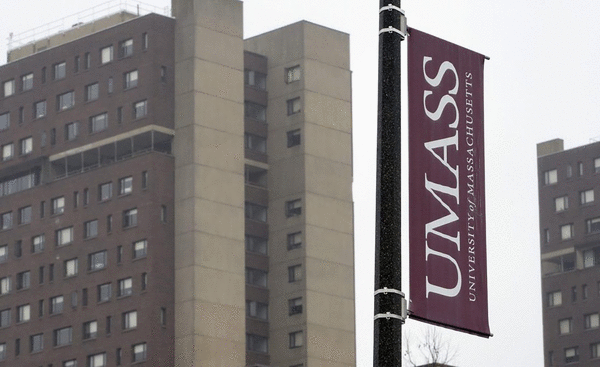
UMass Amherst likely violated a student’s First Amendment rights when the campus suspended the pro-Palestine protester for a year, a judge has ruled.
The school was ordered to lift the suspension for the student and let him return to campus while his lawsuit moves forward.
The third-year student, Kivlighan de Montebello, last fall helped organize a protest by Students for Justice in Palestine against Raytheon’s participation in a career fair held by the Isenberg School of Management in the Campus Center.
University officials ended up ruling that Montebello during the protest violated three policies in the Code of Student Conduct: creating disturbance; disruptive behavior; and failure to comply. Taking into account his prior Conduct Code violations, the school imposed a year-long suspension until Dec. 31, 2026.
But now, a Hampshire Superior Court judge has ruled in favor of Montebello and ordered UMass Amherst to terminate the suspension.
“After oral argument on February 11, 2026, and review of the parties’ submissions, the court concludes, based on the record presently before the court, that Plaintiff has met the standard for a preliminary injunction with regard to his claim that the suspension violates his right to free speech under the First Amendment and Article 16 (of the Declaration of Rights),” Justice Jeffrey Trapani wrote in the ruling.
The judge granted Montebello’s emergency motion for a temporary restraining order and preliminary injunction.
While this case continues, the judge said UMass Amherst is banned from: dismissing Montebello; preventing him from taking classes or otherwise fulfilling academic requirements; and further sanctioning the student.
“This is a huge victory for student free speech,” said Urszula Masny-Latos, executive director of the National Lawyers Guild-Mass Chapter. “The court confirmed what we argued from the start: UMass cannot suspend a student for exercising his constitutional right to peaceful protest. Universities that silence dissent should take notice.”
As the protesters last fall marched to the Campus Center, Montebello used a bullhorn to engage in a call-and-response with other protesters. Then before the group entered the center, school officials told Montebello to not use amplified sound in the building.
The protesters continued into the Campus Center to the registration area. There, a university official — Associate Vice Chancellor Jeff Hescock — told protesters to stop using the bullhorn, and to limit their physical presence to a marked area next to the registration area.
Although protesters moved to the designated area, they continued to chant, and the university staff closed the doors to the auditorium where Career Day was taking place. Hescock again told protesters to stop using the bullhorn, and the group stopped chanting.
Montebello walked around and spoke with students who were checking into the career fair. He then again began leading protesters in a call-and-response chant. Hescock directed the protesters to leave. In all, students from SJP spent about two hours at the Campus Center.
UMass Amherst submitted several videos of the protest. Although Hescock described the chants as, at one point “loud yelling and screaming,” he noted that “there were no disruptions inside the Campus Center auditorium, and the event proceeded as planned.”
When the university hearing board ruled that Montebello violated policies, the board said, “Kiv acknowledged leading the protestors in call and response style chants in the immediate vicinity of the Career Fair, which could be clearly heard inside the space where student attendees were meeting with prospective employers.”
“Kivlighan did not immediately comply with the directive given by members of the DRST (Demonstration Response and Safety Team) to cease leading the group in call and response style chants conducted at loud volume within the building,” the board added.
A student can be punished if their conduct causes a substantial disruption, according to the Hampshire Superior Court judge.
“Considering the evidence submitted by the parties, the court concludes that the Plaintiff will likely succeed on the merits of his First Amendment claim,” the judge wrote in the ruling. “… Hescock’s statement that ‘there were no disruptions inside the Campus Center auditorium, and the event proceeded as planned’ is particularly helpful to Plaintiff’s case as a contemporaneous assessment by the University of the impact of the protest on the career fair.”
The protesters’ chants being heard at the career fair “does not describe a substantial disruption of that event,” the judge added.
Montebello was also arguing that he’d suffer “irreparable harm” from the suspension. The judge agreed.
“The University appears to argue that issuance of a preliminary injunction to allow Plaintiff to attend the University during the pendency of this litigation could ‘disrupt all of the University’s day-to-day business’ by causing repeat protests involving loud indoor chanting,” the judge wrote. “The University’s prediction is speculative. The risk of harm to Plaintiff from the gap in his educational record that the suspension would certainly create outweighs any risk of harm to the University should he be permitted to attend the University during the pendency of this litigation.”
The Herald reached out to UMass Amherst about the ruling. A UMass Amherst spokesperson said in a statement, “While the university, as always, respects the outcome of the judicial process, it will not comment on active litigation.”
_____
©2026 MediaNews Group, Inc. Visit at bostonherald.com. Distributed by Tribune Content Agency, LLC.





Comments