Baltimore County bill would ban masks for on-duty officers, mandate ID
Published in News & Features
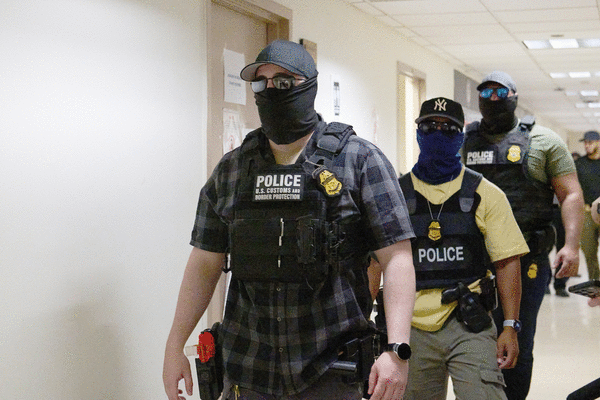
On the heels of the Baltimore County Council approving protections for noncitizens and a ban on private detention facilities, one Democratic councilman is seeking to prohibit law enforcement officers from wearing masks in most circumstances and require them to clearly display their identity and agency.
Councilman Izzy Patoka, a Pikesville Democrat who’s running for county executive, said U.S. Immigration and Customs (ICE) agents are the main culprits in wearing masks or other face coverings. To him, ICE agents wearing face coverings “create a sense of fear and a sense of terror to the people that they are engaging with,” Patoka told The Baltimore Sun, adding: “I think it has no other function.”
The legislation introduced Tuesday would prohibit federal, state and local law enforcement officers from wearing masks, personal disguises and face coverings while they’re interacting with the public on duty.
Patoka’s plan to introduce this bill isn’t new — he’s been eyeing it since November when he said at a rally that he wanted to discourage “masked individuals with heavy weapons” from entering schools, places of worship and public buildings. At the time, he opted against introducing it alongside his two-bill package known as the Trust Act, thinking that it might not garner support from his council colleagues.
“I think, as you saw from last night, sentiment has shifted a bit,” he said, referring to the council’s 6-0 vote, which included two Republican members, to ban private detention centers amid concerns that an ICE facility could be coming to Hunt Valley.
However, all three council Republicans voted against Patoka’s immigration bill package. And Councilman David Marks, an Upper Falls Republican, told The Sun on Wednesday that he would not vote for the bill.
Detailing some exemptions
There are several exemptions to the proposed mask ban. It would not apply to a clear mask or translucent face shield that doesn’t conceal the officer’s identity, for instance. It also doesn’t apply for medical masks or breathing apparatus worn to protect officers from airborne diseases, smoke exposure, and biological or chemical agents.
Officers would still be allowed to wear them to protect themselves from physical injury in high-risk situations like a shootout or hostage situation, and they could also still use helmets or needed eyewear. SWAT officers could also use gear to protect their faces. The measure also would require law enforcement to wear and visibly display identification that shows their name or badge number, as well as the full name or initials of the agency that employs that officer.
But the requirement also has several exceptions for officers who have to conceal their identities while doing their jobs, such as those who need to hide their identity for investigations or evidence gathering, those in imminently dangerous situations or those who are handling protective operations for dignitaries.
Earlier this month, the Maryland State Senate approved a prohibition on all law enforcement officers, including federal agents, from wearing face coverings in most situations. The bill largely passed along party lines, though Sen. Mary-Dulany James, a Harford County Democrat, voted against it after voicing concerns that the ban could elevate tensions between local law enforcement and the federal government. That measure now heads to the House of Delegates for review and discussion.
A questions of constitutionality
The sponsor of the cross-filed House bill, Del. Nicole Williams, a Prince George’s County Democrat, requested a letter of advice on the constitutionality of the ban from the Maryland Attorney General’s Office.
While the letter states that the mask ban itself is “not clearly unconstitutional,” it would be “difficult and likely unconstitutional” for the state to enforce a mask ban against federal officers like ICE agents or to require them to adopt anti-masking policies.
Patoka, when asked whether federal agents would have to comply with a local law like his proposed mask ban or if federal policy would supersede it, said he would do everything he could to ensure communities aren’t afraid to engage with law enforcement officers. The bill itself also states that to any extent that any provisions in it conflict with state or federal law, regulation or policy, the bill should not control them, but rather be interpreted as “complimentary to the intent of open and transparent policing.”
“With the bizarre behavior of the federal administration, we have to take whatever actions that we can at the local level to be strong, and to present that we are strong and that we’re not going to just be spectators in terms of what the federal government wants to do,” Patoka said.
The bill will be discussed at two council work sessions on Feb. 24 and March 10. The council is expected to vote on it March 16.
_____
©2026 Baltimore Sun. Visit baltimoresun.com. Distributed by Tribune Content Agency, LLC.





Comments