Maryland hotels accused of enabling sex trafficking in lawsuit spanning 2013-16
Published in News & Features
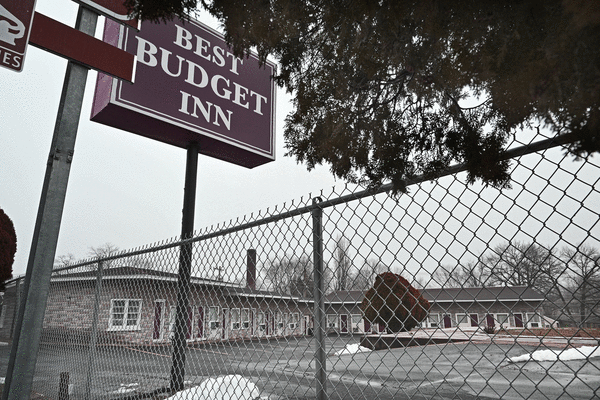
BALTIMORE — The routine, as outlined in court records, was simple, brazen, and repeated over and over for years, at a cluster of Maryland hotels on major thoroughfares some 30 miles northeast of Baltimore: A sex trafficker forced a woman to book hotel rooms in her name, and handed her cash to pay for them.
Dressed in a “seductive” manner, the woman would check in, walk to her alleged trafficker’s car to inform them of the room number, then return to the hotel to wait for clients the trafficker arranged, people who were paying for sex, according to a federal lawsuit filed in U.S. District Court in Baltimore. The civil action accuses seven hotels in Maryland and one in Pennsylvania of enabling human trafficking.
From 2013 through 2016, the woman was trafficked repeatedly in the hotels, according to the 66-page lawsuit filed by the law firm Andreozzi and Foote, based in Harrisburg, Pennsylvania. Though she had visible bruises — injuries inflicted by her traffickers — and “showed signs of (poor) hygiene, health and nutrition,” none of the hotel operators or employees called police or tried to help the woman, according to the lawsuit. At the direction of her trafficker or traffickers, she declined housekeeping services but made multiple requests per day for additional towels and sheets.
An employee at one hotel, a Travelodge in Aberdeen, knew the woman was being trafficked, and used that knowledge to force the woman to have sex for money, the lawsuit alleges.
The lawsuit alleges that hotel operators and workers at the hotels knew, or should have known, that the woman was being trafficked. The Maryland hotels are in Aberdeen, Havre de Grace and Edgewood. The woman’s alleged traffickers were never criminally charged.
‘Terrified of her trafficker’
The woman, who is now in her early 40s, was terrified during the time she was trafficked, and remains afraid of her alleged tormentors, which is why she is unnamed in the 66-page lawsuit, said Alex Marcinko, one of her attorneys. Marcinko and fellow attorneys originally filed the lawsuit in December, but they filed an amended complaint on Wednesday.
“To this day, she’s terrified of her trafficker,” Marcinko told The Baltimore Sun.
Operators and employees of the hotel where the woman was trafficked ignored evidence she was being trafficked in the sex trade, Marcinko said. “There were obvious signs of sex trafficking that the hotels overlooked.”
The Budget Inn hotel in the 900 block of Pulaski Highway in Havre de Grace is among the Maryland hotels named in the lawsuit. The man staffing the front desk identified himself as Dipak Patel and said he owns the hotel.
Patel told The Sun he was unaware of the lawsuit. Patel said surveillance cameras provide a panoramic view of the barracks-style hotel, adding that he has never observed suspicious activity. Regarding guests, “I don’t know who the people are,” he said.
A man who identified himself as the manager of another hotel in the lawsuit, the Super 8 motel, also in the 900 block of Pulaski Highway, said he was unaware of the suit.
The other hotels named in the lawsuit are the Budget Inn in the 1100 block of South Philadelphia Boulevard in Aberdeen; the Days Inn in the 700 block of West Bel Air Avenue in Aberdeen; the Super 8 hotel in the 1000 block of Beards Hill Road in Aberdeen; the Motel 6 in the 1700 block of Edgewood Road in Edgewood; and the Travelodge in the 800 block of West Bel Air Avenue in Aberdeen; and the Motel 6 in the 300 block of Arsenal Road in York, Pennsylvania.
Millions awarded
Owners or managers at the Maryland hotels did not immediately respond to phone messages or emails seeking comment. The phone system for the Motel 6 in York for reaching the front desk did not work, so The Sun was unable to leave a message there.
The lawsuit is part of a raft of civil litigation nationwide in recent years targeting hotels for their role in human trafficking.
Last July, a federal jury in Decatur, Georgia, ordered an Atlanta area hotel, the United Inn & Suites, to pay $40 million to a child trafficking victim who was forced to provide sex for money at the hotel. The jury awarded the plaintiff $10 million in compensatory damages and $30 million in punitive damages.
The hefty verdict has a dual effect on hotel operators, said Joseph McNally, a former federal prosecutor who is director of emerging torts and litigation at the Los Angeles law firm McNicholas & McNicholas.
“Like any area of the law, once entities see liability exposure, and that they’re being held accountable, two things happen,” McNally said. “One, they’re more inclined to settle cases because they know the exposure. Two, and I think this is really important for victims and for society, they changed their practices. The goal in any civil action is not just to make victims financially whole, but also to really change behavior and change conduct.”
Civil actions can be an effective way to hold hotel operators who look the other way at human trafficking accountable, McNally said.
Criminal prosecutions of hotel operators are rare and unusual because prosecutors would need to prove direct involvement in trafficking and would need to convince a judge or jury beyond a reasonable doubt. The standard of proof in a civil case is whether the “preponderance of evidence” shows that a plaintiff proved his or her case.
A raft of hotels has paid millions of dollars in recent years to settle lawsuits alleging they knew, or should have known, human trafficking was occurring at their businesses.
Among the settlements, according to multiple published reports:
•In July 2025, following the $40 million verdict, a hotel in Georgia that was once a Super 8 agreed to pay $6 million settle a lawsuit brought by a child trafficking survivor.
•Four months earlier, in March 2025, three hotels in Philadelphia settled lawsuits by three human trafficking survivors for $17.5 million.
•In February 2023, eight human trafficking victims settled a lawsuit against a Philadelphia Days Inn for $24 million.
Anti-human trafficking law enhances protections for victims.
Civil actions against hotels for looking the other way at human trafficking are based on a section of the Trafficking Victims Protection Reauthorization Act (TVPRA), which President Bill Clinton signed into law in 2000 after Congress passed it with bipartisan support. Lawmakers have amended and reauthorized the TVPRA multiple times, enhancing protections for trafficking victims.
Under the relevant section of TVPRA, trafficking victims can sue not only direct perpetrators, but hotel operators — who knowingly benefit “financially or by receiving anything of value from participation in a venture that the person knew or should have known” about the trafficking venture.
“Lawsuits against hotels tied to human trafficking reflect how courts are evaluating responsibility today. It’s not about the hotel committing the crime,” said Monica Washington-Rothbaum, chief operating officer and senior attorney at J&Y Law, a California law firm. “The legal question, in some jurisdictions, is whether the host knowingly ignored clear warning signs and failed to act. That’s where negligence comes into play. Did the property have policies in place? Were staff trained to recognize red flags? Did management receive complaints or observe suspicious activity and do nothing? Those are the issues that determine liability.”
A greater willingness on the part of human trafficking victims to bring legal actions accounts for some of the increase in such cases, said David A. Muncy, a partner with the Maryland-based firm Plaxen Adler Muncy, P.A.
“They feel like they can come forward and make their voice heard,” Muncy told The Sun. “Also, unfortunately, this is just becoming a larger problem in society. You’re getting people from overseas and other people who are vulnerable being taken advantage of by sex traffickers, and you’re having these hotels and motels really just turn a blind eye to what seems like obvious activity.”
_____
©2026 Baltimore Sun. Visit baltimoresun.com. Distributed by Tribune Content Agency, LLC.






Comments