Minnesota Gov. Tim Walz decries 'targeted retribution' as Trump administration seeks to claw back Medicaid funds
Published in News & Features
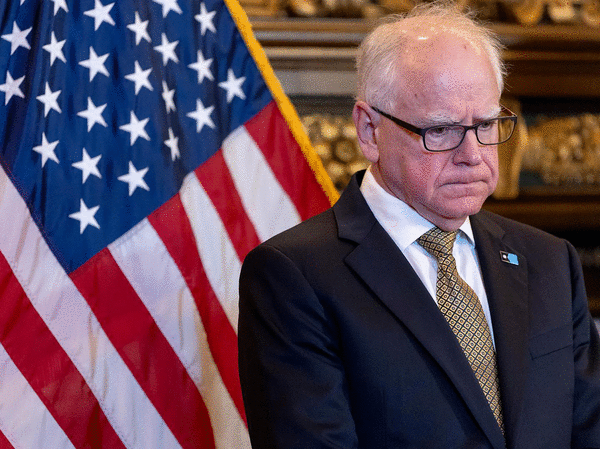
MINNEAPOLIS — Gov. Tim Walz lashed out at the Trump administration for clawing back a quarter-billion dollars in Medicaid funding from Minnesota over its handling of fraud, calling it a “ransom note” and saying it would only hurt the vulnerable.
Speaking at a news conference Feb. 26. Walz said the Centers for Medicare and Medicaid Services’ announcement that it would halt $259 million in payments to Minnesota amounts to “targeted retribution against a state that the president doesn’t like.”
He said the federal government has failed to recognize steps taken by state leaders to tamp down on fraud in the state’s social services programs.
“No state has experienced this before,” Walz said as he rolled out a new suite of fraud prevention proposals at the Capitol. “How does taking and punishing children and [the] elderly have anything to do with fighting fraud? It does nothing.”
Republicans at the State Capitol rebuked Walz’s remarks as “indignation theater,” saying Minnesota Democrats “are feeling the heat over the fraud they’ve enabled for years, and now they’re trying to do damage control.”
“Governor Walz would rather talk about President Trump than the culture of fraud in his agencies, which he’s allowed to continue unchecked for his entire seven years in office,” GOP House Speaker Lisa Demuth and Floor Leader Harry Niska said in a joint statement.
The state has been grappling with how to address one of the largest social services fraud scandals in its history. Federal prosecutors have documented hundreds of millions of dollars’ worth of alleged fraud in state autism services, housing and meals programs, among others.
The federal government has cited the crisis to demand huge swaths of data from the state and send thousands of immigration agents to Minnesota for an unprecedented crackdown. Walz said the federal government’s efforts are “absolutely not serious.”
Minnesota’s Medicaid Director John Connolly said CMS’s announcement on Feb. 25 amounts to a “new threat above and beyond” the federal government’s previous efforts to withhold $2 billion annually, which the state has appealed. He said CMS could “defer” up to $260 million quarterly.
“Our concern is that this could go on for several quarters, which would be catastrophic for the Medicaid program, for children, for people with disabilities, for seniors, for hospitals, for rural Minnesotans, for nursing facilities,” Connolly said, adding that CMS’s announcement “feels just punitive at this point.”
Connolly said CMS is attempting to defer payments starting with those received at the end of 2025, meaning Minnesota has to pay that money back to the federal government. He said CMS’s threat “exacerbates” the state’s existing budget challenges.
Federal prosecutors have estimated the fraud in the state’s Medicaid program could top $9 billion, though Connolly said state officials “don’t have evidence to suggest” the fraud is that large. He declined to share an estimate of his own, saying the state’s investigations are ongoing.
Walz noted that President Donald Trump cited, in his State of the Union address, an unproven claim the fraud amounted to $19 billion.
“Misinformation doesn’t help us fix fraud,” Walz said. “Saying false numbers like this doesn’t get to the reality of this.”
The state has cut off payments to 540 providers and referred more than 300 cases of suspected fraud to law enforcement, said James Clark, inspector general for the Minnesota Department of Human Services, which administers the state’s Medicaid program.
Minnesota Bureau of Criminal Apprehension Superintendent Drew Evans and Walz both expressed concern about an exodus of dozens of staff from the U.S. Attorney’s Office slowing down federal prosecutions of fraud.
“No office could replace quickly that number of people, regardless of the rationale for them leaving,” Evans said.
Walz and his administration have taken more aggressive steps to fight fraud in recent months, from freezing payments to providers in more than a dozen Medicaid programs to ordering a third-party audit and appointing a state fraud czar. He noted that Minnesota’s Medicaid payment error rate is below the national average.
The governor rolled out more than a dozen new anti-fraud proposals on Thursday, including measures to create a new Office of Inspector General, impose tougher criminal penalties for the theft of public funds and expand existing fraud-fighting resources within state agencies and the Attorney General’s Office.
“This is it. This is my top priority,” Walz told reporters. “When I leave next January, I do want that designation that Minnesota’s programs have the best program integrity, the best safeguards.”
The action Walz takes on fraud in his final year could shape his political legacy. The Trump administration put a national spotlight on Minnesota’s fraud crisis late last year and sought to make Walz the face of it. The scrutiny prompted Walz to drop his bid for re-election in early January.
Walz said the state is now “at a crossroads” when it comes to fighting fraud. He said Republicans at the State Capitol can either continue to use the issue as a partisan attack or work with him to do something about it.
“I’m not running,” Walz said. “If you’re serious about fighting fraud, you can help us work on this package, get this package passed.”
©2026 The Minnesota Star Tribune. Visit at startribune.com. Distributed by Tribune Content Agency, LLC.





Comments