How the Minnesota Capitol became ground zero for the debate over law enforcement masks
Published in News & Features
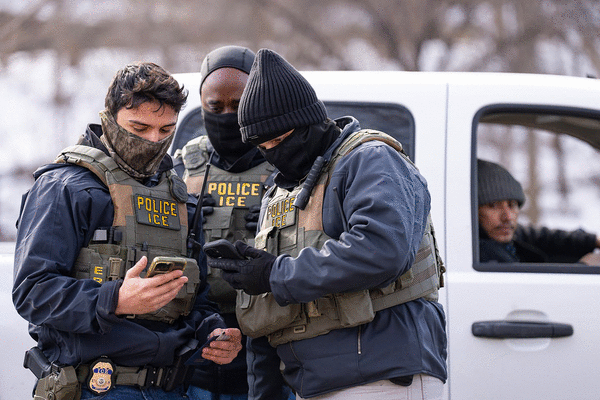
MINNEAPOLIS — The image of masked agents in plainclothes and tactical gear, now inextricably linked to the federal immigration crackdown in Minnesota, is prompting Democrats — here and around the country — to push to bar law enforcement from covering their faces.
In Washington, congressional Democrats have introduced bills to ban the practice and are negotiating new limits on face coverings as part of a demand for reforms to the Department of Homeland Security. Proposals have cropped up in state legislatures across the country to prohibit masked agents.
The issue has taken on particular urgency at the Minnesota Capitol, where the federal government’s crackdown in the state, Operation Metro Surge, led to the deaths of two U.S. citizens and violent confrontations between masked agents and protesters. Months before the surge, a masked man pretending to be law enforcement shot and killed former House Speaker Melissa Hortman and her husband, Mark Hortman, and injured another lawmaker and his wife.
Senate Majority Leader Erin Murphy, DFL-St. Paul, said she’s talked with colleagues across the country and they recognize “that we’re not just fighting for ourselves here.”
Though recent polling shows masked agents are broadly unpopular in Minnesota and nationally, the effort to ban masks is facing resistance in Minnesota’s evenly divided House, with Republicans arguing that uncovering agents’ faces could lead to threats and harassment. The proposal has already been voted down by House Republicans, making its path uncertain this session.
“ICE officers are being doxxed, assaulted, harassed,” Rep. Elliott Engen, R-Lino Lakes, said in a recent House committee hearing. “Opening them up to that, more of that — it’s not a smart bill.”
Democrats say the legislation will provide greater accountability, noting officers from other federal, state and local law enforcement agencies do not shield their identities. The legislation includes exceptions for undercover officers or individuals wearing masks for medical or religious purposes.
“When agents hide who they are, there is no accountability,” said Cat Salonek Schladt, who testified at a recent Senate hearing in support of the masks-prohibition bill. “Victims cannot file complaints; attorneys cannot pursue justice. Our constitutional rights cannot be upheld.”
Salonek Schladt said her wife, a civil rights attorney, was at a south Minneapolis park with the couple’s children when she tried, from a distance, to ask the names of three young people being detained by masked agents.
An agent, whose face was partly concealed, sprinted at her and fired a chemical weapon at such close range it whipped her head back and gave her a concussion, Salonek Schladt told a Minnesota Senate committee on Feb. 20. The couple were unable to identify the agent.
The bill hasn’t found support among Republicans in Minnesota. An effort to bypass a House committee and bring the bill to the floor failed on a party-line vote March 2, and GOP House leaders have backed agents’ use of masks. The Senate hasn’t taken action.
House Republican Floor Leader Harry Niska, R-Anoka, called the bill “political theater.”
“No one’s fooled by the party of defund, demonize and dox,” Niska said, referring to Democrats, “that suddenly you’re in support of law enforcement.”
Rep. Paul Novotny, R-Elk River, a former sheriff’s sergeant, wasn’t satisfied by the exceptions meant to allow law enforcement to cover their faces for tactical reasons, such as to protect them from chemical irritants or other hazards.
“I don’t think this is very well thought out,” Novotny said. “I don’t think that this will solve anything.”
In the Senate committee hearing, Sen. Michael Holmstrom, R-Buffalo, proposed an amendment to the unmasking bill to increase penalties for those who dox law enforcement officers, saying an “organized insurgency” had tracked immigration authorities and doxxed them.
“This is not what Minnesota stands for,” Holmstrom said. “We do not force agents to put their families in danger simply because they wanted to help keep Minnesota safe.”
Following the hearing, Sen. Lindsey Port, DFL-Burnsville, who sponsored the Senate bill, said she was disappointed by the reception it got in committee.
“Among Minnesotans, I think it’s a pretty shared idea that we don’t want secret police, that we don’t have secret police and we shouldn’t,” Port said. “But I guess what is bipartisan in Minnesota is not always bipartisan at the Legislature.”
Federal immigration agents’ use of masks drew widespread condemnation from the public and was unpopular with Minnesotans who responded to the NBC News Decision Desk/KARE 11/Minnesota Star Tribune Poll powered by SurveyMonkey.
Sixty-two percent of Minnesotans who responded to the survey strongly or somewhat disapproved of federal agents wearing masks. That number was even higher for people who identified as politically independent, with 71% saying they strongly or somewhat disapproved.
Minnesota DFLers are also pushing legislation that would allow individuals who feel their civil rights were violated by federal agents — whether through a wrongful or violent arrest or retaliation — to sue and prohibit schools from allowing federal agents inside without signed judicial warrants.
They are also pushing a suite of proposals to help protect themselves after the Hortmans’ assassinations and have drawn parallels between the masked ICE agents and the man who came to her door in the middle of the might impersonating an officer.
The same man also allegedly shot Sen. John Hoffman and his wife, Yvette Hoffman, who survived their injuries.
“We have no idea anymore if somebody approaching you is actually who they say they are or not,” said Sen. Bonnie Westlin, DFL-Plymouth, “and the idea that somehow having them in our state has made us more safe is nonsense.”
©2026 The Minnesota Star Tribune. Visit at startribune.com. Distributed by Tribune Content Agency, LLC.






Comments