Iran's Navy in crosshairs as US strikes warship with submarine
Published in News & Features
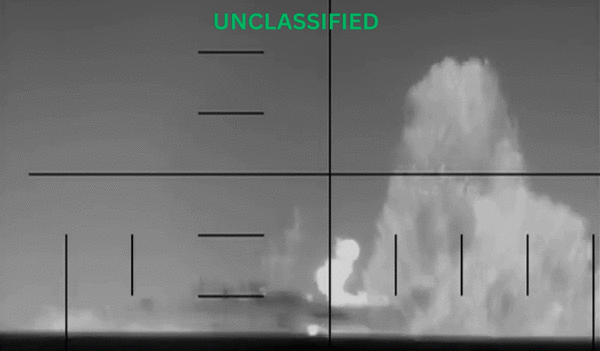
The Iranian warship IRIS Dena was in the Indian Ocean when a Los Angeles-class U.S. attack submarine fired an MK-48 torpedo, setting off a massive explosion that lifted the ship’s stern out of the water before sinking the vessel.
The U.S. Defense Department highlighted the attack — releasing black-and-white video footage that showed the USS Charlotte’s strike — to draw attention to a key element of its campaign against Iran: eliminating the country’s navy to keep the country from impeding the flow of crude oil and natural gas in the region.
U.S. officials said Wednesday the campaign has struck or sunk about 20 ships and hit naval facilities and characterized it as evidence of the U.S. military’s reach and ability to decimate Iran’s ability to fight back four days since launching its campaign with Israel. The Dena was far from the conflict zone.
“The Iranian navy rests at the bottom of the Persian Gulf,” Defense Secretary Pete Hegseth said in a briefing on Wednesday morning. “It is no more.”
Secretary of State Marco Rubio was explicit when he said the U.S. wanted to eliminate “the threat posed by their navy to global shipping.”
But oil prices have soared since the conflict and the vital Strait of Hormuz — which connects the energy-rich Persian Gulf to the wider Arabian Sea — is nearly empty over fears of Iranian attacks.
President Donald Trump has now pledged U.S. escorts for ships transiting the crucial waterway and ordered a U.S. agency to provide political risk insurance “at a very reasonable price” as commercial rates soar.
While the U.S. hasn’t given a full accounting of its attack on the Iranian Navy, prior assessments suggest the country has many more vessels and assets left. A U.S. Defense Intelligence Agency report from 2019 — the latest unclassified U.S. assessment available — lists more than 200 weapons-carrying vessels for the Islamic Republic of Iran Navy and the Islamic Revolutionary Guard Corps Navy, which primarily operates within the Persian Gulf.
“The exact numbers for many Iranian small boat types are unknown, but the IRGCN has hundreds of small boats throughout the Persian Gulf,” the DIA report said.
That estimate includes three fast attack submarines, one coastal sub and 15 midget submarines, as well as around eight corvettes and 100 fast attack and patrol craft armed with anti-ship missiles and torpedos that have previously harassed tanker traffic in the region.
The U.S. also struck — but didn’t sink — the Iranian “drone carrier” Shahid Bagheri — essentially a converted container ship with a launch ramp, according to U.S. Central Command.
The U.S. is repeatedly stressing its all-out assault on Iran’s fleet. U.S. Central Command commander Admiral Brad Cooper said in a video on X this week that the U.S. was “sinking the Iranian Navy — the entire Navy.”
“For decades, the Iranian regime has harassed international shipping,” Cooper said. “Today there’s not a single Iranian ship underway in the Arabian Gulf, Strait of Hormuz or Gulf of Oman. And we will not stop.”
Hegseth also mentioned on Wednesday that U.S. forces also sank “their prize ship, the Soleimani” — likely a reference to one of an estimated four Shahid Soleimani guided-missile catamarans named after the Iranian military leader Qassem Soleimani that Trump assassinated in his first term.
Still, traffic through the Strait of Hormuz has reached a near standstill, with ship-tracking data compiled by Bloomberg showing traffic has plummeted by over 95%. Iran attacked three ships near the mouth of the Persian Gulf on Sunday.
The strait’s effective closure has prompted countries like Iraq to shut production, helping to send oil prices up by about 14% since the weekend and natural gas to the highest since Russia’s 2022 invasion of Ukraine.
“It will be important to see progress on the Iranian Navy as it retains the ability to harass vessels attempting to transit the Strait,” said Rebecca Babin, a senior equity trader at CIBC Private Wealth Group. In addition to the navy, however, she added that land-based drone threats “capable of targeting commercial shipping remain equally significant.”
____
With assistance from Charles Gorrivan.
_____
©2026 Bloomberg L.P. Visit bloomberg.com. Distributed by Tribune Content Agency, LLC.





Comments