Israel expands war on Hezbollah in Lebanon as crisis grows
Published in News & Features
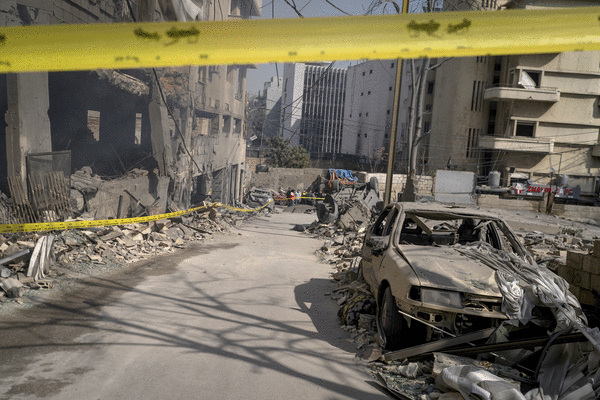
Israel said it’s preparing to expand an incursion into southern Lebanon to fight Iran-backed Hezbollah militants, an escalation that threatens a humanitarian crisis and regional repercussions amid the ongoing Iran war.
Lebanese authorities have called for a ceasefire and offered to directly negotiate with Israel, but have acknowledged their failure to disarm the militant group since a November 2024 truce.
Israel said Thursday that given Beirut’s failure, it would expand the campaign, which has so far killed hundreds and displaced nearly one million people, following a night of intense attacks by both sides on Wednesday night.
“I told the Lebanese government they were playing with fire, and if they don’t take their fate into their own hands, we will do so,” Prime Minister Benjamin Netanyahu said Thursday night in his first press briefing since the Iran war began. He added that Israel is “holding very serious discussions on what to do next in Lebanon, not for the sake of discussions but for the sake of action.” The country has said that it is mounting a defensive effort.
Israel launched a wave of attacks overnight, including striking the Zrarieh bridge over the Litani River to cut off a key crossing used by Hezbollah militants. The attack raised fears in Lebanon that Israel would target infrastructure across the country, reminiscent of the 2006 war when Israel hit bridges, the airport and power plants. Israel avoided all civilian infrastructure in the 2024 round.
“This is just the beginning,” Defense Minister Israel Katz said in a statement on Friday. “The Lebanese government, which misled and failed to fulfill its commitment to disarm Hezbollah, will pay increasing costs in damage to national infrastructure and loss of territory - until its key commitment of disarming Hezbollah is fulfilled.”
Israel launched its latest campaign in Lebanon after Hezbollah began firing hundreds of missiles and rockets at the country shortly after the U.S.-Israel war on Iran began almost two weeks ago. The militant group’s reemergence on the front lines this month, along with its sustained attacks on Israel, exposed Lebanon’s failure in disarming the group.
Hezbollah, in coordination with Iran, fired its biggest barrage of rockets and drones at Israel on Wednesday night, according to Israel Defense Forces spokesman Nadav Shoshani. Israel responded with a large-scale attack an hour later.
The United Nations’ top humanitarian official warned on Wednesday that Lebanon faces “a moment of grave peril” and “mass displacement is accelerating” across the country as a result of Israeli attacks.
European allies of Israel are urging it to show restraint, with growing fears that it could turn into the next Gaza, according to a senior European official who requested anonymity to discuss internal deliberations. More than 70,000 people were killed and much of Gaza was reduced to rubble by the Israeli response to the Hamas attack from the Palestinian territory in October 2023.
In a statement on Wednesday, French President Emmanuel Macron criticized Hezbollah for “dragging Lebanon into a confrontation with Israel,” while calling on the Jewish state to “renounce any ground offensive.”
Lebanon proposed to the U.S. that it oversees direct negotiations with Israel but has yet to receive a response, according to a Lebanese official familiar with the offer, who asked not to be identified by name because the matter is private.
“The only country capable of managing a negotiation process is the United States, but it is preoccupied with the major conflict with Iran and views Lebanon as a secondary arena in the larger confrontation with Tehran,” Lebanese Deputy Prime Minister Tarek Mitri told Bloomberg earlier this week.
Israel has significantly expanded its presence inside Lebanon with the aim of creating an additional layer of security to protect its northern communities from Hezbollah. Israel holds five positions along the border with Lebanon as a result of the late 2024 ceasefire deal.
After ordering residents of more than 50 towns in south Lebanon to move, the IDF issued a similar warning for areas south of the Zahrani river, about 44 kilometers (71 miles) from the border with Israel, saying it will act against Hezbollah.
Israel has carried out attacks on over 70 targets in Beirut in the past week by air and sea after ordering residents of the southern suburbs to leave. Wednesday night was the most intense. The IDF said forces struck 10 sites within 30 minutes, hitting intelligence and command centers belonging to Hezbollah’s elite force, Al Radwan.
The IDF also struck a building in a Beirut neighborhood, killing eight people and injuring 31 others, according to the Lebanese Health Ministry. Lebanese local media affiliated with Hezbollah listed over 50 southern villages that were hit on the same day, as well as a dozen others in the Bekaa Valley.
Hezbollah, once Iran’s most formidable proxy militia, said it launched 38 operations against Israel including five inside Lebanon and has suggested in the last few days that it clashed directly with Israeli soldiers.
Almost 3,000 people in Israel have been wounded as a result of Iranian or Hezbollah missile and drone attacks in the two-week-old war. Of 2,975 people treated for wounds, 85 remain hospitalized and nine are in serious condition, the Health Ministry said. Twelve civilians and two soldiers have been killed.
There’s also growing concern that the conflict could draw in other countries, after Hezbollah earlier this week fired artillery shells at army positions outside Syria’s capital, Damascus.
Diplomatic calls
In late 2024, Israel decapitated Hezbollah’s leadership during a fierce campaign, and said it destroyed most of its arsenal. But it’s continued near-daily attacks on the group in Lebanon since.
The U.S. and Israel have repeatedly warned that Hezbollah was rearming and regrouping, even as the Lebanese government said it finalized a plan to seize the border area from the group.
Lebanese officials argue that Hezbollah’s reemergence following a truce in 2024 was not entirely their fault.
“I would say that those who are criticizing us should ask themselves if they have been helpful to the Lebanese government in implementing its commitments,” Ghassan Salame, Lebanon’s culture minister and a former diplomat, told Bloomberg TV on Thursday.
Salame said Israel’s occupation of the five outposts inside Lebanon and its daily attacks have made it much harder to disarm the group. He also said western countries were slow in equipping the army to assert itself against Hezbollah.
Lebanon has always argued that it’s army is outnumbered and ill-equipped to face Hezbollah.
U.S.-backed President Joseph Aoun and Prime Minister Nawaf Salam have called for direct negotiations with Israel as the only way to end the current hostilities.
Aoun said Lebanon is “ready to discuss something more than a ceasefire but something like a treaty of non belligerence or security agreement,” Salame said on Thursday.
--------
—With assistance from Ellen Milligan and Galit Altstein.
©2026 Bloomberg L.P. Visit bloomberg.com. Distributed by Tribune Content Agency, LLC.



Comments