'We're in shock': Farmworkers grapple with Cesar Chavez sex abuse allegations
Published in News & Features
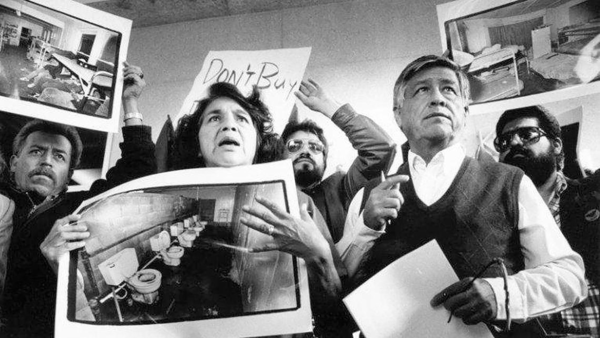
FRESNO, Calif. — Explosive allegations that Cesar Chavez abused girls and sexually assaulted his fellow labor activist Dolores Huerta decades ago are roiling the farmworker community, leaving many stunned at the revelations.
Teresa Romero, president of United Farm Workers, condemned the acts that Chavez was accused of committing in the 1960s and 1970s when he led the union.
“It’s unforgivable,” Romero said in an interview. “Any abuse of a woman or a child, anything like that, is unforgivable. ... We don’t justify it. We don’t accept it. That’s not who we are.”
The UFW wants to be supportive of the victims, Romero said.
“The victims, what they went through, we could not imagine,” she said. “We need to understand that they were very courageous to speak out.”
As farmworkers held a union rally in Fresno, some said they doubted the accusations or didn’t know what to believe. Others said they worried the scandal might hinder their fight to gain fair wages and better working conditions.
“He was our great leader,” said Marta Montiel, speaking in Spanish. “It’s a strategy of the devil. It’s a lie.”
She was among about 150 farmworkers gathered under the intense afternoon sun on Wednesday outside the federal courthouse in Fresno. They were rallying ahead of a court hearing on a wage theft case filed by the United Farm Workers and UFW Foundation, along with 18 farmworkers. They are fighting a new Trump administration rule that makes it cheaper for farmers to hire foreign workers by lowering their wages.
The workers waved red UFW flags and held signs reading “Protect my wages.”
Yet they were there against the backdrop of the news about Chavez. A report by the New York Times published Wednesday said Chavez, a co-founder of the storied union, had sexually abused two minors, and co-founder Huerta said he had raped her in the 1960s.
Many in the crowd outside the Fresno courthouse declined to speak about the allegations against Chavez. Some farmworker advocates said they were reeling from the news about Chavez, who became a defining figure in the movement for farmworker rights.
Montiel, 62, said Chavez’s legacy continues to reverberate as the union has pushed for improved working conditions for people laboring in extreme heat, at times without adequate breaks or water.
“He helped improve our lives as farmworkers,” Montiel said. “It’s sad what we’re going through.”
She said she wondered why accusers had come forward so many years later.
Huerta, who stayed silent about the assaults for 60 years, said in a statement that she had “believed that exposing the truth would hurt the farmworker movement I have spent my entire life fighting for.” Yet the 95-year-old said she felt she had to speak out: “My silence ends here.”
In Oxnard, Arcenio López and his team at MICOP, the Mixteco/Indigena Community Organizing Project, began receiving messages on their radio show about people expressing sadness about the news of Chavez. But he said the allegations could increase visibility of the sexual harassment that women often face in the fields.
“This is going to be an opportunity for all these types of conversations,” he said.
Hazel Davalos, co-executive director of the group Central Coast Alliance United for a Sustainable Economy, said her organization stands behind the survivors. She said she worries about the long-term impact of the allegations on the fight for farmworkers.
“The great hurt and fear for folks that steward the farmworker movement now is that this news will deflate the struggle that is so essential and is so hard,” she said. “Farmworkers are continuing to face grave injustices in the workplace and in their daily lives, and that’s being amplified under the Trump administration.”
Still, she said, her organization would work to organize and highlight the collective effort. Next month, she said, organizers plan to honor the Japanese-Mexican Labor Assn., a union formed by sugar beet workers in 1903 that conducted a 48-day farmworker strike 123 years ago, long before Chavez.
“The farmworker movement did not start with Cesar Chavez,” Davalos said, “nor has it ended with him.”
At the rally in Fresno, Carolina Sánchez, a farmworker from Delano who brought her 4-year-old son, said she did not want to believe the allegations.
“We’re in shock,” Sánchez said.
“I feel sad and let down by her,” Sánchez said, referring to Huerta. “Because she has always supported us. And now, bringing this up, I think it’s going to affect us as farmworkers.”
Others said they support Huerta. Lisa Alvarado came to the rally wearing a purple T-shirt with Huerta’s face and name.
“I didn’t want her to be forgotten,” said Alvarado, who is not a UFW member but said she supports the movement. “She was sexually assaulted. ... I think she speaks to what women endure every freaking day.”
“The most selfless thing for her was to still center the movement, and that meant at the cost of her own silence,” Alvarado said. “There were so many other champions that built the movement, and honoring women’s labor is honoring every single one of those people.”
Romero, who started working with the union several years after Chavez died in 1993, said she first learned details of the accusations in the New York Times article.
“I want to make sure that we respect the courage of these women who came forward to share these difficult stories,” Romero said. “And I want to make sure that we respect them and give them the space for them to talk about it.”
She spoke after attending Wednesday’s court hearing. As part of the lawsuit, the plaintiffs filed to reverse a Labor Department rule that lowers the wages paid to foreign workers hired through the H-2A program.
The union argues in the lawsuit that the rule — which cuts the wages of these workers by $5 to $7 per hour — is “unlawful” and will “put downward pressure on the wages of U.S. workers” who are in similar jobs, often on the same contracts as those with visas.
“The work that is happening right now is still very needed to protect the people that put food on the table,” Romero said.
---------
—Times staff writer Brittny Mejia contributed to this report.
©2026 Los Angeles Times. Visit at latimes.com. Distributed by Tribune Content Agency, LLC.





Comments