Trump administration must temporarily unfreeze Chicago Transit Authority's Red Line funds, judge orders
Published in News & Features
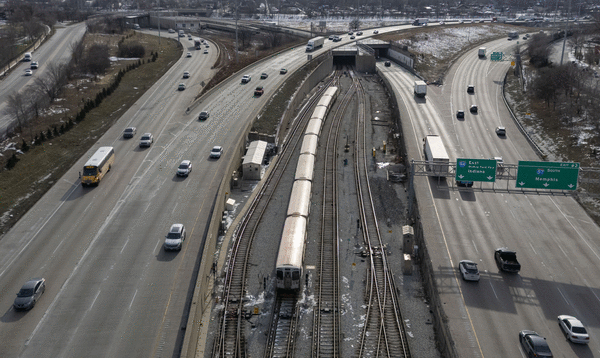
CHICAGO — The Trump administration must temporarily unfreeze almost $2 billion in federal funds for the Chicago Transit Authority’s Red Line Extension project, a federal judge ruled Tuesday.
Ruling from the bench, federal judge Thomas M. Durkin granted the CTA’s request for a temporary restraining order in a case the mass transit agency filed last week against President Donald Trump’s Department of Transportation and Federal Transit Administration.
The order will be stayed until Friday, leaving time for the federal government to file an appeal if it chooses to do so.
The case hinges around $2.1 billion in federal grant dollars the CTA says the Trump administration is holding “hostage” in violation of federal law and the U.S. Constitution. The majority of those dollars are supposed to help fund the agency’s Red Line Extension, a massive project intended to extend CTA rail access to the city’s Far South Side. The CTA had intended to break ground on the project — for which site preparation work is already underway — early this year.
But the federal government froze those dollars in October, meaning the CTA has not been able to get reimbursed for costs associated with the massive project. Over the last several months, the CTA said in court filings, it has taken “extraordinary measures” to continue work on the project, including by issuing new bonds and extending new lines of credit.
But the CTA said it’s now running out of options and warned that without intervention from the court, it would have to start taking steps to wind the project down as early as Friday.
“CTA will have to begin demobilizing work and notifying employees and contractors that they will soon be out of work, causing a cascade of immediate and irreparable harms to both CTA and the broader public,” attorneys for the CTA said in court filings.
On Tuesday, Durkin said he believed the CTA was likely to succeed on the merits of its case against the federal government. He would issue a written order later in the day, he said.
The CTA secured federal funding for the Red Line Extension, which is now expected to cost $5.75 billion in total, in the waning days of President Joe Biden’s administration. The long-awaited project is expected to extend the CTA’s Red Line from 95th to 130th St., through neighborhoods that have long lacked access to CTA rail service. Former CTA president Dorval Carter described the project at the time as one that would “undo nearly 60 years of racial inequity in transit.”
But in October, the U.S. DOT put those funds — along with a smaller set of federal funds for a CTA modernization project on the North Side — on ice over what the feds said was an investigation into racial preferences in contracting.
“The American people don’t care what race or gender construction workers, pipefitters, or electricians are,” the U.S. DOT said at the time. “They just want these massive projects finally built quickly and efficiently.”
On the same day, the feds published an interim final rule that removed the consideration of race and sex-based preferences for businesses seeking to be certified as “disadvantaged.”
The CTA argues the U.S. DOT singled it out to retroactively apply the new contracting rules in an act of “political retaliation.”
“Of the hundreds of grants nationwide affected” by the interim final rule’s new requirements, the CTA’s lawsuit read, “only four had their funding frozen under [its] authority.” Those grants include two belonging to the CTA and two grants for projects in New York and New Jersey, the CTA said.
“You changed the game,” Durkin told attorneys for the federal government, who also argued that the investigation into the CTA’s contracting preferences was separate from the interim rule change.
Durkin also focused on the argument that the CTA and Chicago had been treated differently than the vast majority of other transportation department grant recipients.
“This would be a different case,” if the rules had been applied evenly throughout the country, Durkin said from the bench. “I thought it was still 50 states, treated the same.”
At a City Hall news press conference Tuesday morning, Chicago Mayor Brandon Johnson echoed the “political retaliation” argument the CTA made in its lawsuit last week.
“This is political retribution at its finest, and I’m not gonna put up with it, not gonna stand for it,” he said. “And I’m gonna use every single tool available to me to ensure that the people of this city, whether you’re on the north side of Chicago, the South Side of Chicago, that you receive the federal funds that are necessary for our economy to continue to grow.”
In court filings, attorneys for the federal government had argued that the Northern District of Illinois lacked jurisdiction to hear the case because it centered around a contract dispute.
The FTA and U.S. DOT did not immediately respond to a request for comment Tuesday.
Acting CTA president Nora Leerhsen called Durkin’s ruling a “major victory” for Far South Side residents in a statement Tuesday. “CTA promised the community that it would fight for RLE, and this ruling is a massive step toward restoration of funding for this historic project,” she said.
In a court filing last week, attorneys for the CTA wrote that “a city’s infrastructure is its lifeblood; it is what makes a city a city.”
“That is nowhere truer than Chicago, whose iconic network of elevated and underground trains—the “L,” for short— dates to 1892 and is recognizable the world over.”
----------
—Chicago Tribune’s Alice Yin contributed.
____
©2026 Chicago Tribune. Visit at chicagotribune.com. Distributed by Tribune Content Agency, LLC.




Comments