Minnesota lawmakers appear ready to clamp down on homeowners associations
Published in News & Features
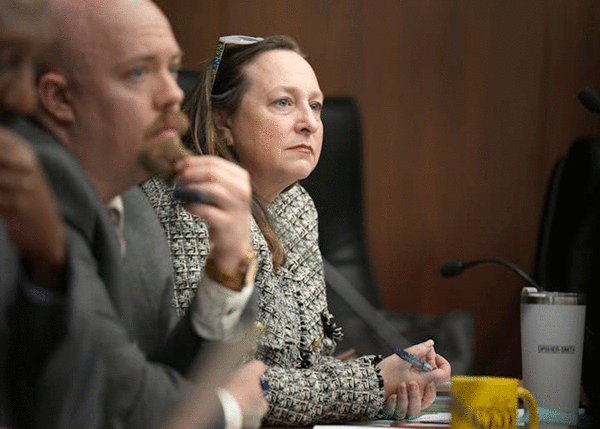
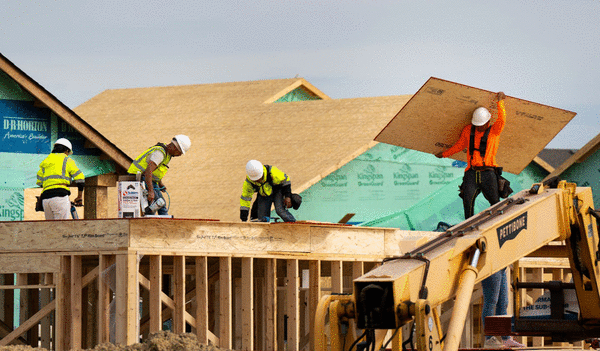


MINNEAPOLIS — Spurred by residents’ stories of foreclosures and sky-high fines, a bipartisan group of legislators is nearing the finish line of a yearslong push to curtail the power of homeowners associations in Minnesota.
Legislation that would require more transparency from HOAs, which act as quasi-governments that collect fees, provide services and enforce rules for more than one million residents across the state, is nearing a final vote in the state House after clearing the Senate last year.
If successful, it could become a rare moment of agreement in what’s otherwise been a largely unproductive session.
“We have Republicans and Democrats standing shoulder to shoulder, arm in arm and saying it’s time that we do something to protect consumers,” Rep. Kristin Bahner, DFL-Maple Grove, said in an interview.
The “HOA Bill of Rights” still faces stiff opposition from some property management companies, HOA lawyers and residents who argue the legislation could drive up legal costs for the associations and, in turn, their members.
Those advocates say HOAs collect dues and levy fines to remain solvent and provide necessary services that local governments are increasingly outsourcing. One recent study estimated about 8,000 HOAs across Minnesota cover more than 600,000 housing units and about 1.5 million residents. Many of those HOAs already operate well, advocates say.
“The HOA is not this big bad corporation. We are simply a group of neighbors,” Linda Dingbaum, a longtime board member of her St. Louis Park HOA, told a House committee in February.
But legislators appear motivated by stories told by people like Jolene Johnson, a homeowner in the Heritage Park neighborhood on Minneapolis’ North Side.
Members of an HOA there tried to dissolve it, saying it provided few services but issued fines for what they saw as small infractions like leaving garbage cans out too long. The association started foreclosure proceedings over unpaid fees under $500, Johnson told lawmakers.
But Johnson and other members of that association have failed so far to terminate their HOA. Existing state law makes it extremely difficult to do so, requiring agreement from at least 80% of unit owners and lenders.
“We are trapped in an organization that provides zero benefits,” Johnson told legislators earlier this year.
One of the bill’s many provisions would change that, making it easier to dissolve some HOAs.
A 2024 law convened a group of legislators, HOA members, attorneys, business interests and other stakeholders that settled on more than three dozen policy recommendations that formed the backbone of the bill.
The proposals are aimed at boosting transparency, limiting conflicts of interest and otherwise protecting homeowners. One provision would require HOAs to provide homeowners with a list of fines for violations and would cap them at $100 per incident. Another would refer intractable disputes to a new ombudsperson office at the state Department of Commerce. A third would prohibit foreclosures over minor fees.
Others would prevent board members from voting on contracts that could financially benefit them or their family and require property managers or HOA boards to get at least three bids for maintenance or other construction projects.
Some HOA advocates argued that such rules would make the jobs of volunteer board members more difficult. Legislators should focus on education, not regulation, Mark Luis Foster, co-owner of the HOA Leadership Network, told legislators last month.
“If you’re looking to encourage future board leaders to join a board with enthusiasm, this is not the bill,” he said.
But in the bill’s last few committee stops, lawmakers from both parties have complimented the work done through months of debate and amendments. Continued criticism from some in the HOA industry shouldn’t be taken as a bad sign, said Republican Rep. Walter Hudson of Albertville.
“In terms of stakeholder consensus, sometimes we don’t get to have that,” he told a committee last month. “Because sometimes, the imbalance of the status quo is such that certain stakeholders are going to lose something. They’re going to lose control. They are potentially going to lose some money.”
Not all in the HOA industry are opposed to the bill. Patrick Hynes, a lobbyist for the Minnesota chapter of the Community Associations Institute, said while the bill is not perfect, it’s improved greatly since its introduction last year.
“I don’t know if it’s at prime time yet,” he said. “But it’s close.”
©2026 The Minnesota Star Tribune. Visit at startribune.com. Distributed by Tribune Content Agency, LLC.





Comments