Expected indictment of ICE agent accused in Minneapolis shooting remains in limbo
Published in News & Features
MINNEAPOLIS — A federal indictment appeared imminent last week against an ICE agent accused of shooting a Venezuelan immigrant in north Minneapolis and later lying about it. But it never materialized, according to people with knowledge of the situation.
According to an attorney and a second person familiar with the case, federal prosecutors were considering charging the agent, Christian Castro, with making false statements and civil rights violations — the same crime that former Minneapolis police officer Derek Chauvin pleaded guilty to in the killing of George Floyd.
But the charges that were expected as early as Tuesday, Aug. 25, have still not come.
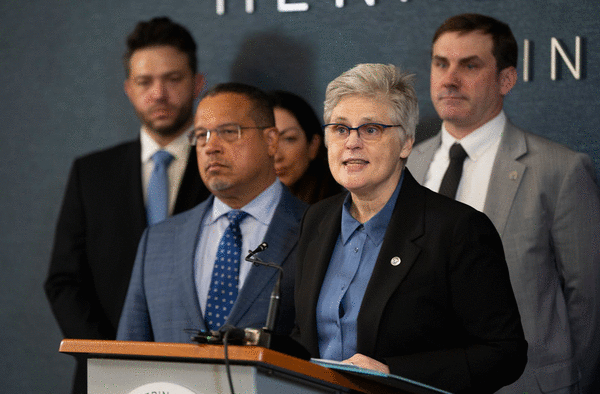
Castro had been held for months in Texas on state assault charges filed in Minnesota. But Texas Gov. Greg Abbott did not grant Castro’s extradition to Minnesota, and last week he walked out of jail “a free man,” as described by Hennepin County Attorney Mary Moriarty, due to a Texas law that limits holding fugitives for more than 90 days. Moriarty raised concern over Castro fleeing to Mexico if he was let go.
While a federal case could still move forward, it’s unclear when Castro will have to appear in court again for his alleged actions in the Jan. 14 shooting of Julio Cesar Sosa-Celis.
Frederick Goetz, an attorney for Alfredo Alejandro Aljorna, one of the men charged and detained along with Sosa-Celis before their cases were tossed out, confirmed in a statement that as of early last week, he believed Castro’s federal prosecution was “imminent and would proceed without fear or favor.”
“Sadly, I believe this is no longer the case,” Goetz said. “Despite the hard work and dedication to the rule of law shown by front line federal prosecutors and law enforcement in Minnesota, it appears that political considerations by high level government officials in Washington have derailed the federal prosecution.”
A federal civil rights charge requires approval from top officials in Washington, D.C. The federal charge has been used successfully in high-profile cases where law enforcement injured or killed someone, including the killings of Breonna Taylor and Walter Scott.
It was used unsuccessfully against eight members of the Ohio National Guard after they opened fire on protesters at Kent State University in 1970, killing four unarmed students and injuring nine.
A Justice Department official said in a statement that the “Department has not yet reached a conclusion on this matter and will never rush an investigative process and the thorough review of all evidence.” The official added that U.S. Attorneys’ offices must consult with the civil rights division in any case that may trigger a civil rights charge.
The division is currently being led by Harmeet Dhillon, who has targeted Minnesota and other left-leaning states for policies surrounding diversity in hiring and election monitoring. Locally, Dhillon has also called out directives for Hennepin County prosecutors to consider race during plea deals.
The Minnesota U.S. Attorney’s Office declined to comment.
A person familiar with the situation said that on several occasions last week the U.S. Attorney’s Office in Minnesota seemed poised to announce charges against Castro, but it never happened.
A day after Castro was released from custody, Kristian Weir, the head of the Criminal Division of the U.S. Attorney’s Office in Minnesota, announced he was resigning, with his last day in office on Sept. 11.
Weir wrote in an email to staff, obtained by the Minnesota Star Tribune, that “no immediate concern or issue precipitated this decision; it is simply the right personal decision for me at this time.”
Weir’s resignation continues what has been an exodus of top prosecutors from the office this year, with several resigning over the office’s handling of Operation Metro Surge.
After being arrested in Harlingen, Texas, in May, Castro walked out of Cameron County jail last Thursday after Abbott did not sign his extradition paperwork during the 90 days Castro was in jail.
Abbott’s delay was highly unusual and led the state of Minnesota to sue him in federal court in an attempt to force Castro’s extradition. Abbott argued it was unclear if Castro was a fugitive because an initial investigation by Texas Secretary of State Robert Howden showed Castro didn’t flee Minnesota but had been ordered to work in Texas by ICE.
While U.S. District Judge Fernando Rodriguez Jr. rejected Minnesota’s request, finding there was no enforceable timetable for Abbott’s investigation of Castro’s extradition, he also said Abbott’s argument that Castro was not a fugitive wasn’t legally sound.
Ethan Lowens, an expert on interstate extradition, said Rodriguez was right to side with Texas, but there didn’t appear to be any reason the investigation by Abbott was taking so long.
“What is it that Texas needs so much time to look into?” Lowens said. “There is not really a basis in law or in common sense to say that the issue that Texas flags — which is whether or not Castro is a fugitive — holds water.”
Minnesota officials have argued that Abbott’s delay is a political stunt that is undermining the U.S. Constitution. Abbott said publicly that he wouldn’t sign the extradition paperwork until Gov. Tim Walz apologized for his role in the social services fraud that has taken place in Minnesota over the last several years.
Lowens said it appeared unlikely Abbott could be held to a timeline to either sign or refuse to sign the extradition paperwork. Abbott had argued the proper venue for the case was the U.S. Supreme Court.
The combination of Castro’s release from prison and the lack of federal charges served as a serious blow to law enforcement in Minnesota who view the shooting as one of the most high-profile crimes of Operation Metro Surge, alongside the killings of Renee Good and Alex Pretti.
The Hennepin County Attorney’s Office had charged Castro with four felonies and a misdemeanor for shooting into the duplex where Sosa-Celis and two other families lived.
Sosa-Celis was struck in the leg. The bullet lodged into the wall of a child’s bedroom. Several people, including women and children, were inside the duplex at the time of the shooting.
Castro’s statements at the time led federal officials to charge Sosa-Celis and his roommate, Aljorna, with assaulting a federal officer. Trump administration officials widely publicized their mug shots and former Department of Homeland Security Secretary Kristi Noem accused them of “attempted murder.”
The charges were dropped when video evidence of the shooting directly contradicted the story given by federal officers.
_____
©2026 The Minnesota Star Tribune. Visit startribune.com. Distributed by Tribune Content Agency, LLC




Comments