On the 25th anniversary of 9/11, States Newsroom editor remembers the heroes of Flight 93
Published in News & Features
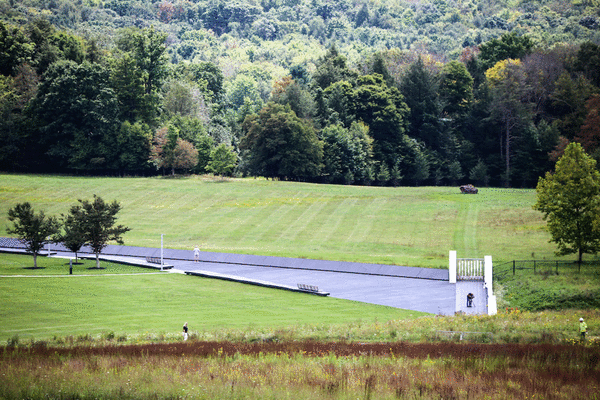
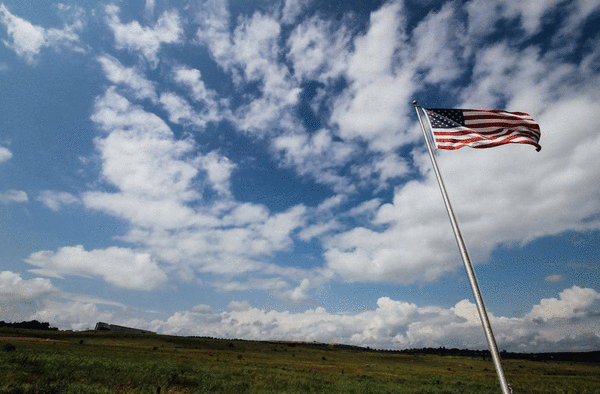
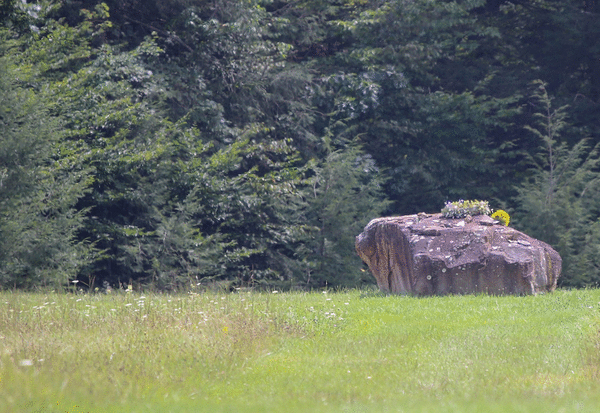
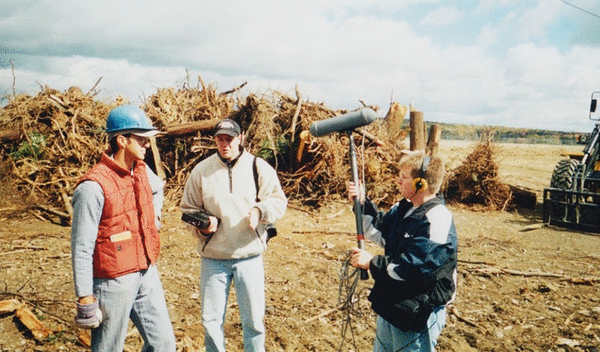




On a rural stretch of land in Somerset County, Pennsylvania, an open meadow filled with bright wildflowers, a memorial grove of trees and a giant boulder marks the spot where United Airlines Flight 93 crashed on Sept. 11, 2001.
States Newsroom’s Pennsylvania Capital-Star Editor-in-Chief Tim Lambert recently revisited the national memorial on this field — where he happened to own a piece of land that was part of more than three dozen acres that made up the crash site.
“It’s always hard to come back here, but it’s always a chance to remember the sacrifices made by the passengers and crew of Flight 93 on that day,” Lambert said. “I think it’s important 25 years later to remember what they did and why they did it. They decided to act on a day that America was under attack.”
On that day, al-Qaida terrorists hijacked four commercial planes. They slammed two into the World Trade Center towers in New York City and another into the Pentagon in Arlington, Virginia. The fourth — Flight 93 — crashed in an open clearing near Shanksville, Pennsylvania.
The 40 passengers and crew are remembered for sacrificing their lives when they tried to wrest control of the plane from the hijackers and stop them from hitting what was believed to be their intended target: the U.S. Capitol.
Nearly 3,000 people were killed in what is the deadliest terror attack on U.S. soil. Forty-four people, including the four hijackers, died aboard Flight 93.
At the time, Lambert worked as a reporter for a public radio station in Harrisburg, Pennsylvania.
“It was around 4:30 in the afternoon — among the chaos of the newsroom — and I looked up at this TV that was on a cabinet, and the reporter from one of the national outlets was standing at the corner of the Lambertsville (and) Shanksville Road,” Lambert recalled. “And it was at that moment, I stopped and thought, ‘Wait, we still own land near Shanksville, and it’s awfully close to that intersection.’”
The next morning, Lambert said, he listened to a voice message on his home answering machine from his dad, who recognized the crash site on television, realizing that it was their family property.
Lambert was in a unique situation. While reporters across the nation and around the world were covering the tragic event, he was the only journalist who had access to the Flight 93 crash site. He realized he had a huge responsibility.
“I was well aware that history was at the door, and I wanted to do things the right way,” he said.
Lambert not only reported on the crash, but also assisted first responders and met with the families of the passengers and crew. He remembered what the land looked like that day. The plane had plowed into the ground at a high rate of speed, with the aircraft disintegrating into tiny bits and pieces, leaving a large crater.
Although the majority of the plane shattered and few bodies were recovered, authorities were able to identify the passengers and crew. More than 1,500 response members under the direction of the Federal Bureau of Investigation recovered fragments of the plane: twisted pieces of metal, tires, seat frames, luggage, clothing — most of which were no larger than a notebook.
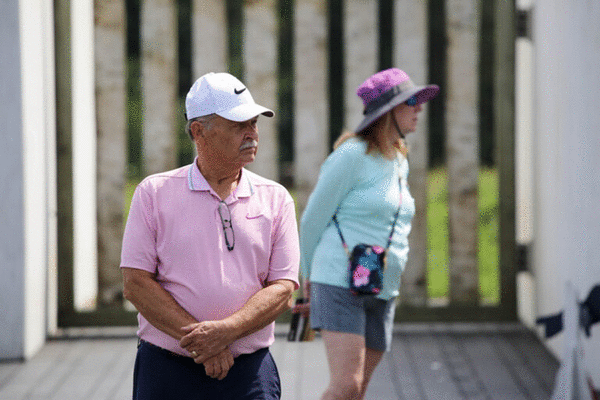
The field was essentially a cemetery, and family members wanted to protect it. Only family members and some park rangers can visit the actual crash site. But the public can walk along the tall concrete walls of the nearby memorial, etched with the names of people who perished in the crash. Visitors can also go to a museum and walk through parts of the field to an overlook to view the crash site.
Through the years, Lambert has visited the site to pay his respects.
“It’s been a while since I’ve been here, so it’s almost like a little homecoming to visit with old friends, even if it’s just looking out on the field and remembering those who gave their lives that day,” he said.
The museum features photos of family members of passengers and crew, with details about their lives and memorabilia, including photographs, jewelry and uniforms. For example, the husband of flight attendant Lorraine Bay donated her United Airlines ID and one of her uniforms, along with a wine bottle corkscrew she used for in-flight service.
“You know, with these exhibits, I want to take something that’s very large and abstract and offer different avenues for different people to come in and relate to it,” said Betsy Keene, curator for the National Parks for Western Pennsylvania, which includes the Flight 93 National Memorial.
“Families say they want their loved one to be remembered as an individual person, as more than just this one day.”
She said there are about 9,300 objects collected from the crash site and from families that are cataloged at the memorial, including 800 pieces of the aircraft curated over the years.
“We want to have these objects to help people relate and to pull them into the story and to help them understand who these people were, what happened here, and what it meant to the world at the time,” Keene said.
Memorial Superintendent Stephen Clark said more than 400,000 visitors annually come to the park, owned and operated by the federal government and managed by the National Park Service.
“I think that this memorial, albeit 25 years, it’s still a glimpse. It’s still a blink of an eye in our nation’s history,” Clark said. “But I still think that even as the years roll on, this story will continue to be told.”
Through the years, Lambert said he’s had many chances to meet families whose loved ones died that day. As the 25th anniversary approaches, he said he plans to reflect on their stories.
“The memorial is beautiful. The memorial is very fitting. It’s a great tribute, and it’s a respectful tribute to the passengers and crew of Flight 93. But for me, I think about watching the land heal over the 25-year period,” Lambert said.
“To watch them sort of heal as the site heals through nature, and watch that sort of in tandem, is something that I will always think about anytime I look over that field.”
____
Pennsylvania Capital-Star reporter Peter Hall contributed to this report. Stateline reporter Shalina Chatlani can be reached at schatlani@stateline.org.
©2026 States Newsroom. Visit at stateline.org. Distributed by Tribune Content Agency, LLC.






Comments