Inside the Walz administration's fraud response: Missed warnings and a late reckoning
Published in News & Features
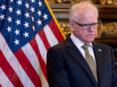
MINNEAPOLIS — Minnesota Gov. Tim Walz was finally taking decisive action.
It was summer 2025. Federal agents had just raided businesses tied to the state’s Medicaid programs for the second time in eight months, this time investigating a “massive scheme” to defraud a program that helped people at risk of homelessness.
Walz and his advisers met privately with acting U.S. Attorney Joe Thompson to discuss “how to tackle fraud, especially in Medicaid programs,” according to Chris Schmitter, the governor’s longtime chief of staff.
Thompson, who was the state’s top federal prosecutor, gave a blunt assessment: Housing Stabilization Services was so “riddled with fraud” that it was difficult to distinguish legitimate providers from fraudulent ones. He recommended that Walz shut the program down.
Walz did.
“The governor’s direction to me, as I recall afterward, was, ‘We will do what Joe said as fast as humanly possible,’” Schmitter later told congressional investigators.
The meeting, which was never previously disclosed, put the state’s fraud problem into sharper focus for Walz and his team.
But it also raised a troubling question: Why had it taken them so long to see it?
By then, warning signs had been accumulating for several years. The Feeding Our Future scandal revealed that alleged fraudsters were involved in multiple taxpayer-funded programs.
State spending on autism services, housing assistance and other Medicaid-funded programs had skyrocketed. Providers were warning about potential abuse. Media outlets, including the Minnesota Star Tribune, published numerous stories.
Yet no one at the top of the Walz administration appeared to examine whether those red flags pointed to a broader problem.
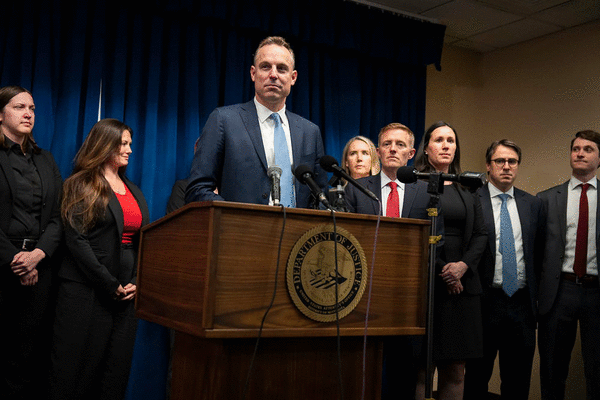
Federal prosecutors ultimately sounded the alarm on what they described as “staggering, industrial-scale fraud,” estimating that billions of dollars may have been stolen from more than a dozen Medicaid-funded programs.
It would become one of the largest government fraud scandals in Minnesota history, derailing Walz’s reelection campaign and threatening to inflict lasting damage on his political legacy. Now the scandal hangs over the race to choose Walz’s successor.
Interviews with more than a dozen people familiar with the administration’s response and a review of more than 1,000 pages of testimony from a congressional investigation into the state’s handling of social services fraud provide the clearest picture yet of how Walz and his team failed to connect warning signs across state government.
Officials overlooked alarming spending growth in some programs, wrestled with whether to stop payments to known fraud defendants, bristled at fellow Democrats who voiced concerns and did not grasp the scandal’s political significance until it became a major threat to Walz’s reelection.
The breakdown was compounded by Walz’s leadership style. Former aides and advisers to Walz, who were granted anonymity to speak candidly, describe a governor who heavily delegated to his commissioners and senior staff, rarely immersing himself in the details of programs his administration oversaw.
Yet some of the governor’s top advisers also appeared to be out of the loop at times, and Walz did not take a substantially more direct role in the state’s fraud response until 2025.
The governor’s office declined to make Walz available for an interview. The office also did not respond to an extensive list of written questions and details about the Minnesota Star Tribune’s findings. Instead, a spokesman issued a statement.
“As with any issue, hindsight is 20/20 — and there are many things we would do differently knowing what we know now,” Walz’s spokesman Teddy Tschann said. “Updating antiquated government systems to stop modern criminals from committing fraud is akin to turning an oil tanker. Agencies were too trusting, and their policies and state laws prevented them from moving quickly. We should’ve made changes in agency leadership sooner to shake things up and get to the root of the problem faster. And we needed federal, local, and legislative partners to be equally committed to solving problems.”
The threshold for alarm
When Walz took office in 2019, state officials were already aware of problems in two programs administered by the Department of Human Services (DHS).
DHS had been trying to stop fraud in a program that helps low-income families pay for childcare for years before Walz took office. The state’s nonpartisan legislative auditor had also flagged insufficient oversight of nonemergency medical transportation, a program that pays for people’s rides to medical appointments.
Walz’s first DHS commissioner, Tony Lourey, told congressional investigators that he informed Schmitter of problems in the two programs in 2019.
Schmitter testified that he was aware of issues with the programs but could not recall specific conversations. He said agencies did not typically inform him of individual fraud allegations because “that’s not the level of granularity that the office generally can get into.”
“It’s not … like I’m going to (the) governor and saying, ‘Oh, here are these allegations today,’" Schmitter said.
That approach shaped how the Walz administration handled the sprawling fraud case involving Feeding Our Future, a nonprofit that led a scheme to steal $250 million from a federally funded meals program for children.
Senior leaders at the Department of Education were aware of irregularities with Feeding Our Future in 2020 but did not yet know if they amounted to fraud, Assistant Education Commissioner Daron Korte testified.
The department stopped payments to Feeding Our Future amid concerns about its explosive growth, but resumed them after the nonprofit sued and a judge said it could not withhold payments without first taking steps to address questionable conduct, such as reviewing receipts and verifying other records.
The department began regularly briefing lawyers in the governor’s office after Feeding Our Future’s lawsuit was filed in November 2020, Korte said.
It’s unclear how much of the information reached Walz directly.
Schmitter told congressional investigators he believed the governor’s office was aware of Feeding Our Future’s lawsuit in 2020. But he described the federal raids of the nonprofit’s offices in early 2022 as an “inflection point.”
Most of the people charged in the Feeding Our Future scheme were of East African descent, and the nonprofit used allegations of racial discrimination to put pressure on state regulators.
Three state education employees told federal law enforcement that their managers discouraged aggressive oversight because they were afraid of lawsuits. One believed the agency’s leadership feared accusations of racism from Feeding Our Future.
Korte told congressional investigators that the accusations made education officials uncomfortable but did not alter their decisions.
The notion that the state pulled its punches due to racial sensitivities would surface again and again as more fraud cases emerged.
“Nobody likes to be called racist or Islamophobic,” Korte said. “So, I mean, we didn’t like it. But again, I think we all knew what it was, that it was a strategy for them.”
Walz had said the state did what it could in the Feeding Our Future case, trying to stop payments and cooperating with federal authorities. Taken on its own, the pandemic-era scandal did not necessarily suggest that fraud had taken root in an array of other state programs.
Nevertheless, Walz’s office ordered state agencies to search for connections between the 48 people initially charged in the Feeding Our Future investigation and other public programs.
‘The blueprint for uncovering fraud’
In searching for the same offenders in different programs, the Walz administration had stumbled onto a potentially powerful way to trace fraud across state government.
But the state’s review was narrowly focused on finding and removing those 48 defendants from other programs. It did not appear to examine the programs themselves for broader signs of fraud.
The state found that some of the people implicated in Feeding Our Future were also involved in DHS programs. However, the 2023 review concluded there was “zero fraud in DHS by the people that had been indicted in Feeding Our Future,” former DHS Commissioner Jodi Harpstead testified.
The lack of a fraud finding ignited an internal debate in the Walz administration: Should DHS cut off payments to people charged in the Feeding Our Future case without evidence of wrongdoing in human services programs?
Walz’s legal team pushed for the agency to quickly shut off payments to the indicted individuals.
DHS had previously waited until someone had been criminally convicted to stop payments, Harpstead said.
“There’s the issue of innocent till proven guilty,” Harpstead said.
DHS ended up disqualifying the indicted individuals from its programs for 15 years and stopping some payments based on a “preponderance of evidence” from the Feeding Our Future case, Harpstead said.
The state’s probe largely stopped there. Meanwhile, federal authorities had begun examining the programs where the defendants had surfaced.
Thompson, the lead prosecutor in the Feeding Our Future case, found that half of the original 48 defendants owned or received money from autism centers in Minnesota. He asked federal agents to pull claims data for the state’s autism program. They found that “spending had grown exponentially — just as it had in the federal child nutrition program,” Thompson said.
“What we learned from Feeding Our Future became the blueprint for uncovering fraud across other government programs,” Thompson said in a statement to the Minnesota Star Tribune. “We followed the explosive growth and the same bad actors into other programs, including Housing Stabilization Services, and realized we were seeing a pattern of fraud that stretched across the system.”
Red flags everywhere
By 2024, the state’s autism program had experienced astonishing growth.
The number of providers increased tenfold in only six years. The growth of payments to those providers was even more remarkable, surging from $6 million to $341 million, according to data provided by DHS.
That did not immediately set off alarms within DHS, however, even after a news report revealed an FBI investigation into the program.
Former DHS Assistant Commissioner Natasha Merz told the Minnesota Reformer in June 2024 that the autism program’s expansion had been “pretty consistent” with other programs administered by the agency, including Housing Stabilization Services.
“I don’t think we are surprised or particularly disturbed by the rate of growth,” Merz said.
Harpstead told the U.S. House Oversight Committee that such growth was just “one possible indicator” of fraud: “You have to have more than that to decide to put out a full-on investigation.”
Inside Walz’s office, some senior staffers were unaware of the autism program’s rapid expansion. Schmitter testified that he heard about allegations of fraud in the program in either 2023 or 2024 but said he “generally would not get reports of growth and numbers in programs, just because there’s so many of them.”
“That would be sort of an impossible thing to track,” he said.
Similarly, Schmitter could not recall whether he knew about the growth of Housing Stabilization Services. Payments to providers in the housing program had spiked from $3 million in 2020 to $108 million in 2024, according to DHS data.
“It is not sort of in the chief of staff’s roles and responsibilities to be tracking growth in each individual program across state government,” Schmitter said.
By fall 2024, DHS started to view rapid increases in both programs as a possible warning sign, Harpstead testified. The agency jointly decided with the governor’s office that it would begin making site visits to autism providers.
The DHS public relations team flagged suspicious autism centers to staff in the governor’s office almost weekly, according to a former Walz aide, who spoke only on the condition of anonymity. But the conversations mostly centered on how to respond to press inquiries rather than what the mounting allegations suggested about the program’s integrity.
DHS soon put together an anti-fraud package for Walz to bring to the Legislature that following spring. At the time, Walz was traveling the country as the Democratic Party’s vice-presidential nominee. When he returned to Minnesota after the party’s bruising loss to Donald Trump, he appeared to be unaware of fraud allegations in the autism program.
At a news conference that December, Walz attributed a looming projected budget deficit to “growing costs in an aging population and more people accessing services, especially around autism.”
When a reporter mentioned reports suggesting fraud was driving some of the autism program’s growth, Walz seemed puzzled.
“As far as autism being, people not claiming (to) have autism?” Walz asked.
Eight days later, the FBI raided two autism centers in Minnesota, announcing that investigators had found “substantial evidence” of millions of dollars in fraudulent claims.
The response changes
Those raids marked a turning point for the Walz administration’s approach to fraud.
In January 2025, Walz signed an executive order creating a fraud investigation unit within the state Bureau of Criminal Apprehension. He also proposed several legislative fixes, such as allowing agencies to stop payments to suspected fraudsters and creating a licensing system for autism providers.
Walz’s team met with Harpstead and emphasized the need to “fix the fraud problem and make that the only priority that we really cared about,” Schmitter testified.
Harpstead stepped down after telling Walz’s team she did not have the fraud-fighting background needed to lead a more aggressive response. She testified that no one asked her to resign and that Walz’s team told her the governor preferred that she stay.
Walz appointed Shireen Gandhi as DHS’ new temporary commissioner in February 2025. Gandhi, who had served as deputy commissioner, testified that she had never spoken to Walz about fraud before her appointment.
In their first meeting, Gandhi said Walz gave her a clear command: Be aggressive.
“He knew that we would face some pushback from the provider community and that I had his support to take the action I thought I needed to,” she said.
With the autism and housing programs on her radar, Gandhi began briefing Walz directly about fraud.
Walz also sought outside advice.
He met privately with former U.S. Attorney Andy Luger, who stepped down from his position at the start of the year. Luger’s office prosecuted 70 defendants in the Feeding Our Future case.
Schmitter said Luger stressed empowering state employees to raise fraud concerns.
In an interview, Luger said he also encouraged Walz to appoint a state fraud czar, which the governor did later in the year.
“The governor was fully on board and very interested,” Luger said.
Walz’s meeting with Joe Thompson, Luger’s temporary successor, was more revelatory. Schmitter said the governor’s office had heard concerns about fraud in the Housing Stabilization Services program, but “not to the extent and scope that Joe laid out so clearly.”
“I don’t think somebody had captured it quite that way,” Schmitter said.
The state announced in August 2025 that it was terminating the troubled housing program.
The reckoning arrives
Despite the escalated fraud response, some of Walz’s advisers initially dismissed the scandal’s political potency.
A senior adviser to Walz, Teddy Tschann, told other Democrats and reporters that fraud wasn’t showing up as an issue in political polling.
Leah Montgomery, Walz’s deputy chief of staff for legislative affairs, referred to fraud as a Republican talking point in conversations with two DFL state legislators.
One lawmaker pushed back: That did not mean the issue wasn’t legitimate.
The other legislator said Montgomery chided them for publicly discussing their fraud concerns.
In October, Walz paused payments to providers in 14 Medicaid programs that the state identified as “high risk” and ordered a third-party audit of their billing. Nonemergency medical transportation — the program Lourey said he flagged six years earlier — was among them.
At this point, fraud was both a governing and political crisis.
By November, a group of DFL state senators expressed reservations about Walz’s reelection bid to the Minnesota Star Tribune. The governor and his team were not happy, and Walz’s advisers tried to get some of the senators to retract their statements.
Some of Walz’s advisers privately expressed frustration that state lawmakers weren’t sharing culpability for the fraud crisis. They argued the Legislature set the parameters for the programs that were defrauded.
Democrats across the state began to feel the heat when President Trump put Minnesota’s fraud scandal under the national spotlight. Trump blamed Somalis for the fraud and announced a series of investigations. The governor remained mostly quiet as national scrutiny intensified.
In December, Thompson made a stunning prediction about the scope of fraud in Minnesota after six more people were charged with stealing taxpayer money. He said the 14 Medicaid-funded programs identified as “high risk” by the state had cost $18 billion since 2018. At least half of that, he said, may have been lost to fraud.
“Every day we look under a rock and find a new $50 million fraud scheme,” Thompson said. “The magnitude of the fraud in Minnesota cannot be overstated. Staggering amounts of money have been lost.”
Walz held a news conference the next day criticizing Thompson’s estimate as speculation that lacked evidence.
Top Democrats called the governor, with some encouraging him to abandon his reelection campaign. One high-ranking Democrat who spoke to Walz said the governor expressed regret about not taking ownership of the fraud problem sooner.
The criticism escalated after Christmas, when conservative YouTuber Nick Shirley posted a video that reignited concerns about fraud in the Child Care Assistance Program. The video garnered several million views.
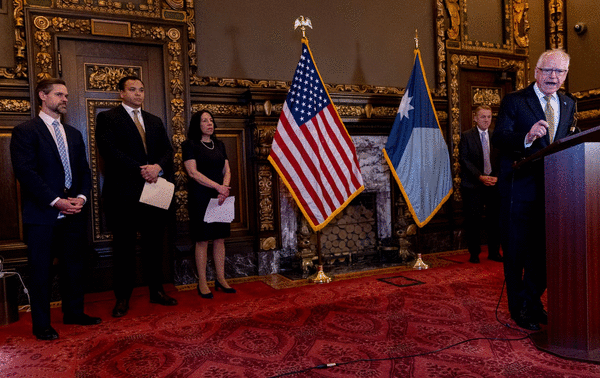
On Jan. 5, Walz called an impromptu news conference at the Minnesota Capitol. With his wife, Gwen, by his side, Walz stepped to the podium and announced he was dropping out of the governor’s race. He said he would dedicate his final year in office to tackling the issue of fraud instead of “defending my own political interest.”
The cost of failure
Minnesota’s fraud fallout continued despite Walz’s exit from the governor’s race.
Federal officials have withheld hundreds of millions of dollars in Medicaid funding to the state, citing concerns about fraud.
The Trump administration also invoked fraud as part of the rationale for Operation Metro Surge, a monthslong immigration enforcement operation that brought thousands of federal agents into Minnesota. But the operation resulted in little immediate action on social services fraud, instead leading to mass resignations of top federal prosecutors, including Thompson.
State agencies have acted more aggressively to purge potential fraudsters from Medicaid programs amid the Trump administration’s continued threats to withhold federal funding. The Department of Human Services has undertaken a massive review and disenrollment of social services providers.
Some providers say that process has caused major anxiety for people with disabilities and sometimes resulted in gaps in care, however.
Walz worked with legislators earlier this year to enact more anti-fraud measures, from increasing the ranks of Medicaid fraud investigators in the Attorney General’s Office to modernizing IT systems used to administer Medicaid services.
He also signed a bill creating an independent Office of Inspector General to investigate fraud in state programs, a proposal his administration had previously resisted.
Walz and his advisers continue to argue that Minnesota was unfairly singled out as part of a coordinated Republican attack. Minnesota Republicans, including GOP governor nominee Lisa Demuth, have made the state’s fraud crisis a central pillar of their election campaigns, seeking to cast the breakdown as a broader failure of DFL stewardship.
The governor’s office noted that, in the years since the Feeding Our Future scandal, large fraud schemes have been uncovered in other states without attracting the same national attention.
Walz and his team also remain skeptical that Thompson’s fraud prediction will ever be proven. While Republicans have repeatedly cited the $9 billion figure, federal prosecutors have yet to file cases that come close to documenting that amount.
“No state has been more scrutinized and politicized than Minnesota,” Tschann said.
_____
©2026 The Minnesota Star Tribune. Visit startribune.com. Distributed by Tribune Content Agency, LLC




Comments