Qatari premier says Gulf states have to act together on Iran
Published in News & Features
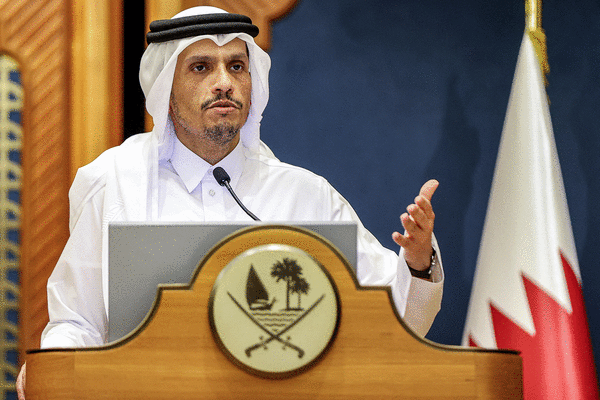
Qatar’s prime minister, Sheikh Mohammed bin Abdulrahman Al-Thani, said Gulf states must work together to restore stability in the region and help find a settlement between the U.S. and Iran.
“We are hoping this war is a wake-up call for everyone,” Al-Thani said at the Qatar Economic Forum in New York on Sunday. “We have to act together responsibly as a region.”
The premier said that messages are being passed between the U.S. and Iran. His country, which like its Gulf neighbors has come under missile attacks from Iran, has been one of the main mediators in the conflict.
Gulf leaders are aiming to meet with President Donald Trump this week on the sidelines of the United Nations General Assembly as the U.S. pushes for a resolution to the conflict with Iran that will reopen the Strait of Hormuz for energy exports.
Trump told Fox News Sunday that he would probably be open to meeting with Iranian President Masoud Pezeshkian, who is expected to visit New York this week for the U.N. meeting.
In an interview with Bloomberg’s Mishal Husain, Al-Thani said that Gulf countries need to “step up responsibly to stop their saboteurs, stop their troublemakers.” He said that ending the conflict between the U.S. and Iran will require more peacemakers.
As some Gulf states seek alternative export routes to bypass the Strait of Hormuz, Energy Minister Saad Al-Kaabi told the QEF that Qatar has decided not to build gas pipelines, insisting that the strait would never be obsolete.
The Qatari premier was speaking a day after Saudi Arabia issued air-raid alerts for Riyadh, the first in the capital since the height of the U.S.-Iran war in March and April.
Other areas across Saudi Arabia received similar warnings overnight into Saturday, including the Red Sea cities of Jeddah and Yanbu and Farasan Island in the Red Sea.
Saudi Arabia has come under renewed attack this month, with the Houthis, an Iran-backed group based in Yemen, targeting western towns and energy infrastructure. Last week, the Saudi government said a drone attack emanating from Iraq — which has several pro-Tehran militias — caused the vital East-West pipeline to be shut down.
Houthi strikes
Yemen’s Houthis have been carrying out almost daily strikes against Saudi Arabia in the last month, widening another front in the near seventh-month conflict.
Al-Thani described the Houthis’ escalation as “irresponsible.”
The group has launched a push recently to exert further control on the Red Sea’s Bab al-Mandeb and made significant gains on Yemen’s western coast, taking over the port city of Mokha and a series of islands close to the strait.
The closure of the pipeline bypassing Hormuz last week further squeezed an energy market grappling with supply shortage and pushed oil prices higher.
The government of the State of Qatar is the underwriter of the Qatar Economic Forum, Powered by Bloomberg.
_____
©2026 Bloomberg L.P. Visit bloomberg.com. Distributed by Tribune Content Agency, LLC.




Comments