Can pop-up shade sails and tents relieve LA in blistering heat waves?
Published in News & Features
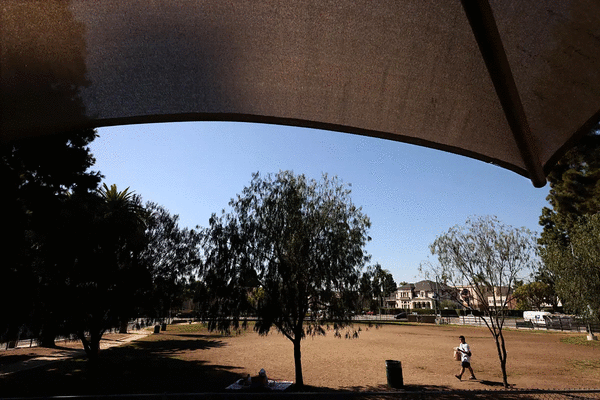
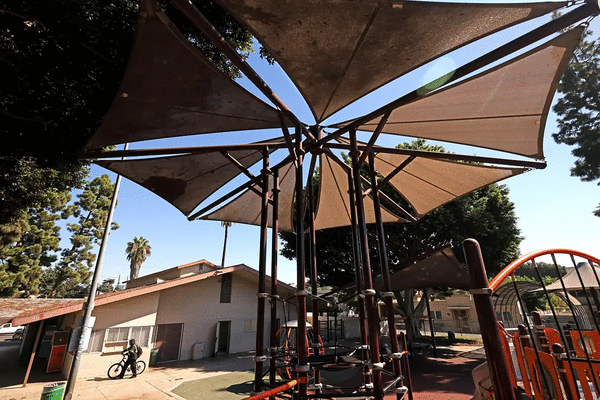
LOS ANGELES -- It didn’t look like much. Five red and yellow cloth sails, strung up between streetlights in Exposition Park, bridging the road between the Lucas Museum of Narrative Art and the Coliseum. But it was 103 degrees outside, and thousands of people were on the move, headed for Saturday’s USC Homecoming game.
The sails created shade, and “it really made a difference to be under it,” said Edith de Guzman, co-director of the year-old collaboration called ShadeLA. “It felt miserable to be out walking, but once we were under the shade sails, we hung out for a couple of hours, and it was doable,” she said. Led by UCLA and USC, ShadeLA partners with the city, county and other groups to shield Los Angeles from the blazing sun.
The sheets at Exposition Park were a one-day “micro pilot” with the L.A. Bureau of Street Lighting.
Stringing up some quick canopies in response to baking heat seems obvious. But De Guzman said that when it comes to shade, the city has historically focused almost exclusively on tree planting. ShadeLA is promoting a shift in strategy to include quick, temporary shade, such as pop-up canopies and tents, plus permanent shade structures, such as bus shelters, that can fill the gaps where trees aren’t growing.
“Trees are still our favorite and preferred way of greening because they bring multiple benefits that built infrastructure really cannot,” said De Guzman, a cooperative extension researcher at UCLA. “But we’re also very aware of the fact that in some communities, trees are a nonstarter because there isn’t the space.” Trees also take a long time to grow. Ongoing budget cuts to the city’s urban forestry division plus rapidly intensifying heat waves have advocates looking for other solutions.
Canopies, awnings and other forms of “built shade” can be erected immediately, in theory, and still reduce surface temperatures by tens of degrees. They don’t actively cool the air the way trees do by releasing water vapor, but with the right materials, they block the sunlight from reaching the ground and make a space feel cooler to be in.
They’ve also been around forever and are part of our shade DNA. In his book “Shade: The Promise of Forgotten Natural Resource,” journalist Sam Bloch writes about the tradition dating to early Roman times of erecting porticos and arcades in Mediterranean cities to cool pedestrians in shopping areas and centers of public life. “When the Spanish first came to L.A. hundreds of years ago, they did some of that too,” Bloch said.
But with the advent of air conditioning, cars that kept people off the streets, and wide avenues that are harder to sling shade across, we’ve lost the art. Attempts to reincorporate built shade have ranged from the painfully slow to the absurdly insufficient ( La Sombrita, anyone? ).
Today in L.A., the average amount of shade at noon from trees and built structures is only 24%. There’s less in neighborhoods with high poverty rates and more people of color.
Human-made shade does pop up in small pockets across the city, umbrellas outside a restaurant, a playground with UV-protective canopies over the swings, or a health clinic with awnings over its parking lot.
But navigating permitting across different jurisdictions and agencies is complicated, and there’s no one, streamlined way to make it happen in public spaces. “There’s a standard process for planting trees across Los Angeles, but we don’t have that road map for built shade,” Michelle Barton, ShadeLA’s other co-lead and climate and sustainability director at USC Dornsife Public Exchange said.
To that end, the group is for pushing policy changes and working on other small pilots to help the city deploy shade quickly ahead the 2028 Olympics. Last year, it held a student design competition with Los Angeles Metro that resulted in a temporary shade structure outside the Downtown Inglewood station. During the World Cup, it erected a big pop-up tent at Harvard Park in South L.A. that city parks staff has since used elsewhere. It’s now seeking to build a lending library of such tents.
Bloch said the pilot in Exposition Park last weekend was “proof of concept” for an idea discussed under Mayor Eric Garcetti’s tenure but never brought to life.
“They’re not as effective at cooling, but those shade sails are nimble in a way that trees never will be,” Bloch said. “If the city knows it’s going to be hot, string them up for the week and then take them down. ... It should be an attractive option for places trying to quickly shade themselves.”
©2026 Los Angeles Times. Visit at latimes.com. Distributed by Tribune Content Agency, LLC.






Comments