A new kind of gang violence is rattling Twin Cities suburbs
Published in News & Features
MINNEAPOLIS — Recent bursts of gunfire have shattered the peace in these typically placid suburban Twin Cities settings: A high school homecoming game, a church basketball court, a middle class residential street.
Police are sounding the alarm about the recent shootings, saying they’re believed to be connected, and the result of a new kind of gang activity — loosely organized and mobile groups of young Somali men.
But it also points to the difficulty of curbing the violence among these groups without casting aspersions upon an entire community.
Law enforcement leaders say these more recently-formed gangs are distinct from the organized groups of decades past such as the Bloods and the Crips. There’s little to no hierarchy, and the feuding stems from social media beefs rather than drugs, money or territory.
“We do have a Somali gang problem. We know who these kids are, we know their parents, we know where they live; they’re very mobile, and they’re causing a lot of problems in the community,” said Ramsey County Sheriff’s deputy Jama Shine, a Somali American who specializes in gang investigations. “I have to say this: the Somali community are not the first immigrants that dealt with gang issues ... The only way to overcome it is if they address the issue, and the thing I’ve seen in the Somali community is we’re still denying that we’ve got a problem.”
Mahdi Warsama, CEO of the Somali Parents Autism Network, said that a problem exists, but it isn’t as simple as acknowledging it and demanding parents get involved.
“It affects everybody, whether the gangs are Somali Americans, African Americans, Mexican Americans or white Americans. Public safety is public safety,” Warsama said. “We have to work together among all communities to mitigate the problem. That’s how we see it. But singling out the Somalis, calling us names, using blame games — that doesn’t help anybody.”
The path to gangs
Warsama, whose organization helps Somali families with autistic children, previously worked extensively with delinquent youths in Columbus, Ohio. He’s observed similar patterns of gang activity through his work in the Twin Cities, watching as “negative peer pressure” leads a small number of children down a dangerous path.
After their parents immigrate to the United States, Warsama believes first generation Somali American children and young men often face an “identity crisis” and struggle to connect with either the non-Somali American community or the older Somali generations that were born overseas.
That leads to Somali American kids primarily socializing with each other, where Warsama believes most interactions are positive, but a small number of teenagers and men are using their networking for “nefarious” purposes. Some may be directly offered to join a gang, but for others, it begins as a loose affiliation, hanging out with someone, not realizing it may later turn out to be a “trap” to get them to assist with shootings against rivals, Warsama said.
“They just start hanging with this person, and this person ends up recruiting them to something close to what we call a street gang, but sometimes it’s not a criminal street gang,” he said. “Sometimes they are using it as as a social trap.”
Shine also said that culturally, Somali kids are different. Many don’t drink or go to bars, or hunt or fish. Instead, they gather at coffee shops or department store parking lots, sometimes in the middle of the night. Trouble can start, he said, “and the guns eventually get involved.”
Ali Gedi, a 37-year-old Uber driver who lives in Coon Rapids, believes some gang members’ parents need to do a better job of knowing what their kids are up to and preventing them from sneaking out late at night.
But that’s not always easy, he said, when they’re being raised by a single parent who is busy and may not be able to track the late-night activity.
“When a single mom has like four, five, six kids and she’s tired from working all day, she’s wanting to go to bed at 8 or 9 p.m. and she cannot control what her 18-, 16-year-old does,” Gedi said.
He thinks the focus should not be solely on crime, but on problems with some families not knowing that their kids are going out late at night.
One night around 1 a.m. driving for Uber, Gedi saw about 20 Somali children gathered outside of a Target store in New Brighton. After posting it to YouTube, several parents called him the next day, shocked when they saw their children in the video.
Adam Abdi, a 27-year-old social worker who grew up in Minneapolis, never participated in gang culture. But he noticed that kids would sometimes join gangs on the belief it would help them be seen as cool.
“It could start over jealousy, gender, race, culture or tribes,” he said.
A group of Somali leaders condemned the shootings during a Wednesday news conference, while also asking that the broader community not be unfairly labeled for the actions of a few. Several took issue with officials using the term “Somali gangs” and said it’s feeds into stigmatizing rhetoric and anti-Somali sentiments.
“This is not simply a Somali problem, it is a youth violence and a gang violence problem,” said Asad Aliweyd, a longtime Eden Prairie resident. “The actions of a few should never define an entire community.”
Chiefs describe gang dynamics
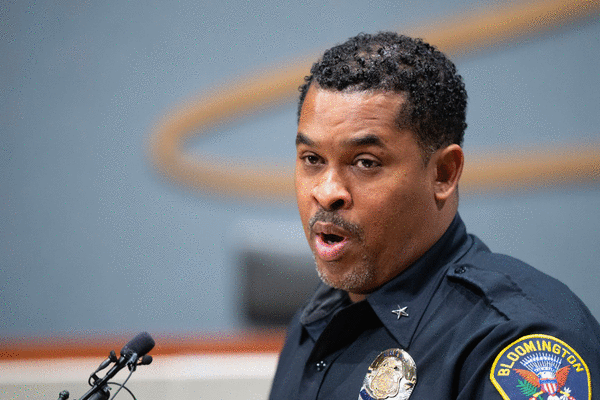
On Tuesday morning, Ramsey County Sheriff Bob Fletcher and Bloomington Police Chief Booker Hodges held dual news briefings to address the ongoing gunfire. Fletcher, who has been outspoken about the issue, urged a metro-wide task force to take on Somali gang violence.
Fletcher sparked both backlash and support this past summer when he released a social media video alleging an increase in violent behavior by 12 Somali gangs. He estimated it’s about 300 children and young adults who participate out of more than 100,000 Somalis in Minnesota.
At his Tuesday news conference, Hodges, known for his outspokenness, held up an image from the comedy film Malibu’s Most Wanted and said these people in gangs are the “violent version of B-Rad,” the wannabe gangster spoofed in the movie.
“These kids are different,” said Hodges, who was joined by Hennepin County Sheriff Dawanna Witt, and Police Chiefs Todd Milburn of Edina and Matt Sackett of Eden Prairie. “These kids have come from good homes, and they have money. They’re living in houses that cost more than my mortgage.”
Warsama pushed back against the assessment, saying it’s a “bit of a generalization” and that he believes kids who go into gangs sometimes come out of low- and medium-income homes as well.
“Shakopee? We got gangsters in Shakopee? We got gangsters named after Burnsville?” Hodges said. “I grew up in north Minneapolis. The Sheriff grew up in south Minneapolis. We had the Bloods and the Crips, Latin Kings. And we’ve got Shakopee, Burnsville, Hopkins? Come on.”
Hodges and Milburn turned to what’s inspiring shootings that include last Friday’s outside Eden Prairie High School’s Homecoming football game and on Sept. 22 at an outdoor basketball court at Our Lady of Grace Catholic Church in Edina. A Sept. 30 gun battle on Highway 100 in St. Louis Park injured one man and is also believed to be connected.
Milburn said the combatants are taking these “social media beefing and arguments (that become) this quick reaction into gun violence to settle those disputes out in public spaces.”
He said the gangs “are not organized. They argue, they roll on the social media, and then we’re all dealing with it on the streets, right?”
While Hodges’ generation of gang activity bears little resemblance to what is being perpetrated by young Somalis in Bloomington and other suburbs, the code of silence largely lives on.
“We’re seeing here in our cases ... the lack of cooperation with those that know what’s going on,” Milburn said. “It’s very clear to us in our Edina cases that we have witnesses, we have victims who know exactly what happened and are not being forthcoming with what they know, and that’s hampering our investigations.”
____
Abby Simons of the Minnesota Star Tribune contributed to this story.
_____
©2026 The Minnesota Star Tribune. Visit startribune.com. Distributed by Tribune Content Agency, LLC






Comments