Blue Origin expansion plans aim for multiple Space Coast launches a week
Published in News & Features
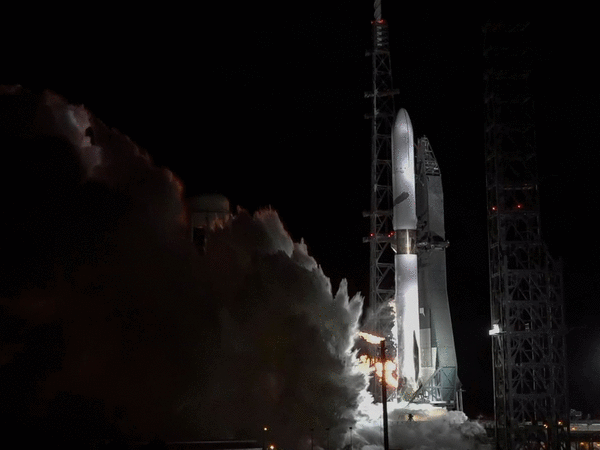
More launch pads. More rockets. More ships to land them on.
These are the plans for Blue Origin, which announced Friday major expansion plans to its already $3 billion footprint in Central Florida that has more than 20 sites in Brevard and Orange counties employing more than 5,000 people.
“Launching at a high cadence requires a connected system – one that manufactures vehicles at scale, prepares customer payloads efficiently, supports reliable launch operations, and quickly returns reusable boosters to service. We are building that system here in Florida,” said Blue Origin Senior Vice President of Operations Ian Richardson in an updated posted to the company’s website.
The big news was plans to get two more launch pads built on Cape Canaveral Space Force Station to add to the two already in the works at Launch Complex 36. The location of those pads, though, were not announced.
“As we look ahead, this infrastructure is designed to support multiple flights per week by the end of the decade,” Richardson said.
Neither of its two in-the-works pads are launch ready yet, but the company is surging forward with reconstruction of the pad at LC-36 it had been using for its existing New Glenn rocket launches.
That pad, now dubbed LC-36A, was devastated by a massive explosion during a test back in May, but construction crews have worked 24/7 to try and build it back to launch capability before the end of the year.
Construction also has already begun on a second pad, LC-36B, for an even larger version of New Glenn, and with it a new vertical integration facility that can handle the new rockets’ heights.
Richardson also announced the company plans to bring online two more rocket recovery vessels to join its existing ship, Jacklyn, named after Blue Origin founder Jeff Bezos’ mother. All three ships would be based out of Port Canaveral to support capture out at sea of the New Glenn rocket first stages after launch.
To date, the company had managed three launches of New Glenn from LC-36A before the explosion including once this year. The last two missions also saw successful landings of its boosters on Jacklyn. The company had been gearing up to fly several more this year having already been given approval to fly as many as 12 times a year.
While hitting that cadence awaits LC-36A’s reconstruction, the company recently filed a request to expand that to 50 launches per year. A federal Environmental Assessment report, required under the National Environmental Policy Act, is underway on that effort.
Expanding to four pads could see that launch rate be at least 100, and Blue Origin has infrastructure in the works to support that.
Work, for instance, has also begun on another building near LC-36 called the Customer Integration Facility (CIF), that is part of a contract from the U.S. Space Force to support national security missions. That site will support Blue Origin rockets, but other customers as well to integrate payloads for government missions.
Expansion also continues at Blue Origin’s Rocket Park, where a $330 million building is in the works to support the manufacture of the upper stages needed for its larger New Glenn rockets.
Completion is targeting summer next year, after which it will have the capacity to knock out up to 150 of the upper stages per year.
“This is one piece of a connected system designed to run at rate: manufacturing, integration, launch, recovery, refurbishment, and back to flight,” said Blue Origin CEO Dave Limp in a post on X. “Every step optimized for cadence.”
The company also has two lunar lander manufacturing plants on the Space Coast, including one at Rocket Park for its human-rated lander called the Blue Moon MK2, and one for its uncrewed version, the Blue Moon MK1, located in Cape Canaveral.
“Together, these facilities create the bridge between manufacturing capacity and flight-ready missions,” Richardson said.
Elsewhere, sites in Cocoa and Melbourne support fabrication, tooling, thermal protection systems and development while sites in Orlando and Titusville have logistics and materials operations.
Blue Origin became the first company to launch from Florida rockets that were primarily build in Florida, although SpaceX looks to soon join that list with its major investment to build out and fly Starship and Super Heavy rockets on the Space Coast.
“Our manufacturing and operations footprint has more than doubled in the last couple of years,” Richardson said. “These investments are centered on one goal: building the capacity to support more missions, more reliably, and more efficiently. As we look ahead, this infrastructure is designed to support multiple flights per week by the end of the decade.”
_____
©2026 Orlando Sentinel. Visit orlandosentinel.com. Distributed by Tribune Content Agency, LLC.






Comments