ICE officer's false claim draws scrutiny in Minnesota conspiracy case
Published in News & Features
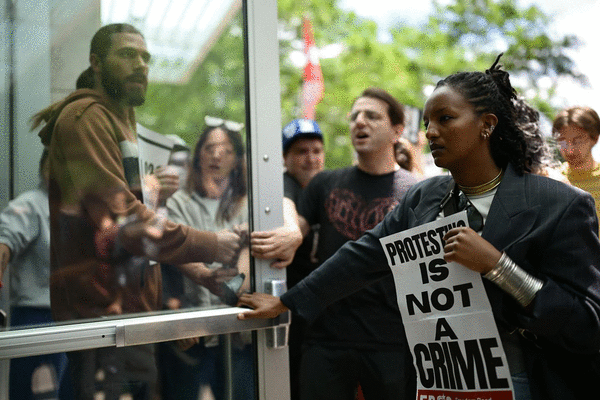
An ICE officers’s accusation against an assistant federal defender has added fresh scrutiny to the case against 15 Minnesotans accused of coordinating with each other to impede federal immigration officers, leading to blistering rebukes by a judge against an attorney for the government.
The allegation, detailed in a memo written by ICE deportation officer Michael O’Neal, was inadvertently disclosed in a batch of evidence produced by Minnesota’s U.S. Attorney’s Office while building the case against 15 people accused of conspiring against and impeding immigration officers.
The District of Minnesota federal defender, Matthew Deates, is not representing any of those defendants. In the memo, O’Neal accuses Deates of helping his client avert an immigration arrest — despite the fact that the client was court-ordered to remain free as his case proceeded.
Though Deates has no connection to the case, the memo was disclosed by prosecutors to lawyers for the defendants, spurring adamant denials from Deates and his attorney, Chris Madel, who said it “exposes a sitting assistant federal defender to public suspicion of criminal conduct.”
Lawyers for the 15 Minnesotans indicated they will move to use the federal government’s mishap to build their defense that the conspiracy case is an example of selective prosecution.
“It confirms that this entire investigation is being driven by people who have no idea what they’re doing,” said attorney Kevin Riach.
O’Neal’s memo centers around the immigration case of a man arrested in California last year.
A judge in California released the man from ICE custody and ordered that he not be re-arrested for immigration purposes while his case proceeds. He was allowed to visit Minnesota — where he faced an illegal reentry charge — solely for his court appearances.
During a hearing last spring in Minneapolis, a judge allowed the immigrant’s continued pretrial release in the reentry matter over no objection from prosecutors and granted his return to California. After the hearing, Deates arranged for his client to get some food and walked him to a nearby train station to return home. Unbeknownst to Deates, O’Neal and two deputy U.S. Marshals followed him and his client out of the courthouse with the intent to arrest the immigrant, despite the court order prohibiting them from doing so.
Deates said he had no idea they were being followed until he read the memo.
O’Neal, under the memo’s subject line “Aid and Abetting,” accused Deates of helping avert the immigration arrest. O’Neal noted that he was not aware of the court’s order barring the immigrant’s arrest until he later called a special agent with the Department of Homeland Security.
In court records, Madel called the accusation baseless, riddled with falsehoods and damaging to Deates’ reputation as a revered member of the federal defender’s office. Madel demanded that the court order the U.S. government to say the allegation was inaccurate and retract it after the memo was sent to lawyers for the 15 Minnesotans.
“It recklessly smears the integrity of a sitting, highly respected Assistant Federal Defender,” Madel wrote.
Minnesota’s U.S. Attorney’s Office initially asked the lawyers to either return or destroy the memo, saying the accusation did not reflect the position of the office. Madel countered that was not enough, and excoriated the office for refusing to explicitly cast the allegations as false.
Pressed by a visibly concerned judge, Assistant U.S. Attorney Tory Saileracknowledged that the memo’s surfacing in the conspiracy case was an oversight on the Minnesota U.S. Attorney’s Office part.
“Frankly, it is a tad bit embarrassing that I’m having to stand here explaining [this],” Sailer said.
Sailer said there is no active investigation into Deates and that while he personally does not believe he committed a crime, the office would stop short of explicitly saying so.
U.S. Magistrate Judge David Schultz admonished Sailer on the apparent discrepancy.
“The government doesn’t see a basis to investigate, and yet the government is unwilling to say that Mr. Deates did nothing wrong,” he said. “I’m looking at you, as the United States of America, taking an absolutely unjustifiable position that is besmirching the reputation of one of the finest lawyers in this district and being unwilling to have the courage to make it right.”
Schultz, who did not make a decision from the bench, said he would weigh whether he had the authority to order the government to correct the record. He noted that should he determine he can issue an order on the matter, he would undoubtedly rule that Deates did not commit a crime. Schultz then took a minute to apologize to Deates, who sat in the jury gallery in the Minneapolis courtroom.
“On behalf of the United States: I apologize to you. This should not have happened,” Schultz said. “I think it’s outrageous that agents of the United States government would follow a federal defender who is actually in the act of making sure that his client complies with a court order.”
The ICE agent’s memo is not the first revelation to surface from discovery in the conspiracy case. Over the summer, attorneys for the 15 defendants filed a number of motions showing that federal investigators conducted a broad surveillance campaign against labor unions to find evidence in the case.
Critics have largely taken aim at the government’s characterization of the accused as members of “antifa,” a term short for anti-fascist movement. Academics have also pointed out that the U.S. Attorney’s Office brought the indictments against the 15 people at a time when prosecutors have moved to dismiss a number of criminal charges against protesters in Minnesota for lack of evidence or contradictory statements, among other reasons.
©2026 The Minnesota Star Tribune. Visit at startribune.com. Distributed by Tribune Content Agency, LLC.





Comments