María Corina Machado makes surprise return to Venezuela after months of failed attempts
Published in News & Features
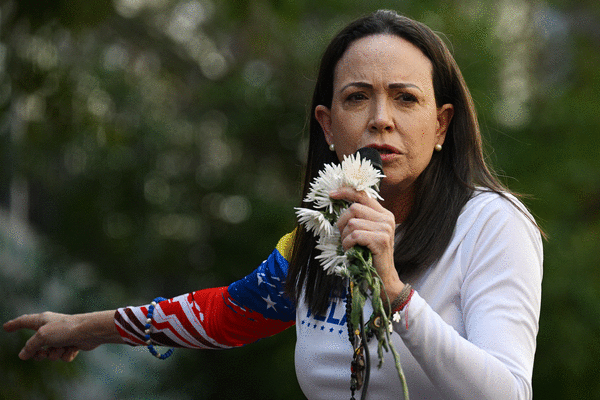
Venezuelan opposition leader María Corina Machado returned to her homeland Sunday after more than 10 months abroad and repeated unsuccessful efforts to reenter the country, making a surprise appearance at a Catholic church in western Venezuela as questions persisted about her safety and her role in the country’s political transition.
Machado, the 2025 Nobel Peace Prize laureate, attended Mass in Santa Rosa, a town in Lara state, where supporters embraced her and gathered around her, according to images released by her communications team. It was her first public appearance in Venezuela since leaving the country in December 2025.
“I’m here. With you,” Machado wrote on X, without explaining how she had returned or whether she had received assurances that she would not be detained.
President Donald Trump, asked about her return in Washington, said he hoped she would remain safe but offered no details about the circumstances of her arrival.
“She’s a very nice woman. She gave me her Nobel Prize, so how can I say anything else? And I hope she’s safe,” Trump told reporters Sunday.
Trump added that his administration was doing “very well in Venezuela,” without saying whether Washington had helped facilitate Machado’s return.
Miami Republican Rep. Carlos Gimenez issued a much sharper warning, saying he would hold Venezuela’s top government and security officials responsible for any harm that came to Machado.
“From the U.S. Congress, I directly hold Delcy and Jorge Rodríguez, Diosdado Cabello, Padrino López, and González López responsible for any harm that may come to María Corina Machado,” Gimenez wrote on X in Spanish.
“If they continue with the threats, they will end up pulverized like the Castroist henchmen who guarded Maduro,” he added, referring to the U.S. military operation that captured the former Venezuelan president. “You already have the example. Understood?”
Machado’s arrival follows months of uncertainty over whether she could safely return to a country now governed by interim President Delcy Rodríguez, who assumed power after a U.S. military operation captured Venezuelan strongman Nicolás Maduro earlier this year.
Although Maduro’s removal transformed Venezuela’s political landscape, his former allies remain in control of the government, leaving unanswered questions about Machado’s security and whether the opposition will be allowed to play a significant role in the country’s political future.
Machado returns as Venezuela’s most popular political figure, according to recent surveys by the Venezuelan polling firm Meganálisis. In a nationwide survey conducted September 23–30, 60.6% of respondents said they would vote for her if a presidential election were held immediately, compared with 6.7% for businessman Lorenzo Mendoza and just 3.6% for Rodríguez.
The survey, which included 1,357 respondents and reported a margin of error of 2.66 percentage points, reinforced findings from an August poll that gave Machado 61.2% support against Rodríguez’s 3.1%. The results reflect hypothetical voting preferences rather than predictions of an election outcome.
Neither Machado nor her representatives immediately disclosed how she entered Venezuela, which route she took or whether the Rodríguez administration knew of her plans.
It also remained unclear whether the restrictions that had frustrated her previous attempts to return had been lifted or whether she managed to enter without the Venezuelan government’s cooperation.
Months of failed attempts
Machado’s return follows a series of unsuccessful efforts to reach Venezuela that had frustrated her supporters and raised questions about the obstacles preventing one of the country’s most prominent opposition figures from returning home.
A previous Miami Herald investigation documented at least seven attempts or proposed operations to bring Machado back, involving private aircraft, maritime routes and possible commercial flights.
One of those efforts involved a September 22 flight that was denied permission to land in Curaçao, a Caribbean island off Venezuela’s coast. Peter Steinmetz, Curaçao’s aviation chief, independently confirmed the denial to the Miami Herald.
The incident highlighted the logistical and political difficulties facing Machado’s representatives as they explored different routes into Venezuela amid aviation restrictions, security concerns and uncertainty over how regional governments would respond.
Other plans involved maritime approaches and alternative air routes, but none had succeeded in bringing her home.
Machado’s team said last month that she had encountered at least seven impediments involving air and maritime travel.
How she finally succeeded remained a mystery Sunday. Her representatives did not say whether she arrived by air or sea, crossed a land border or benefited from arrangements with regional governments.
Earlier efforts had been complicated by uncertainty over Washington’s position on her return and whether Venezuelan authorities would allow her to enter without interference.
Trump’s remarks Sunday did little to resolve those questions.
Back in public after years of secrecy
Machado’s appearance at a Catholic church in Lara state marked a dramatic departure from the secrecy that had surrounded her movements since Venezuela’s disputed July 2024 presidential election, when a sweeping crackdown by Nicolás Maduro’s government forced her into hiding to avoid arrest.
The repression intensified after Venezuela’s National Electoral Council, widely criticized for its ties to the ruling socialist movement, declared Maduro the winner without releasing a detailed breakdown of the results. Security forces arrested protesters and opposition activists as the government moved to suppress demonstrations and challenges to the official outcome.
The opposition, which collected copies of voting tallies from polling stations across the country, maintained that Edmundo González Urrutia, the candidate Machado supported after authorities barred her from running, had defeated Maduro by a wide margin.
González Urrutia fled to Spain in September 2024, while Machado remained in Venezuela, spending much of the following period in hiding as authorities intensified their pursuit of government opponents. Although she occasionally emerged for public appearances, the threat of detention severely restricted her movements and political activities.
She eventually left Venezuela in December 2025 to receive the Nobel Peace Prize in Oslo, ending more than a year in which she had largely avoided public exposure. Her departure was followed by months of unsuccessful efforts to return to a country where many of the officials responsible for the crackdown remained in positions of power, even after Maduro’s capture by U.S. forces.
Her appearance Sunday at a religious service in Santa Rosa, followed by greetings with supporters in the town square, represented a striking reversal. Images released by her communications team showed people embracing Machado as she moved among those attending Mass and others gathered outside the church, openly engaging with supporters after spending much of the previous two years avoiding public exposure.
Yet the circumstances of her return remained undisclosed, and it was unclear whether the Rodríguez administration had provided assurances that she would be allowed to remain in Venezuela without facing detention or other restrictions.
González Urrutia, who has lived in exile in Madrid since September 2024, celebrated Machado’s arrival and announced that he also intends to return to Venezuela.
“Venezuela! I am tremendously excited to announce that our leader, my dear María Corina, is on Venezuelan territory,” he wrote on X.
“Today is a very important day for Venezuelans. Our sovereign voice returns with her to lead and guide this process,” he added.
González Urrutia said he would return “very soon” so Venezuela could move toward freedom, although he did not specify when or explain how he intended to make the journey.
His announcement raised the possibility that both leading figures in the opposition movement that challenged Maduro’s disputed reelection could soon be back in Venezuela, potentially strengthening demands for a political transition that would reflect the outcome claimed by the opposition in 2024.
Her arrival, however, does not establish that the Rodríguez administration has accepted her political demands or that she can operate without interference. Nor does it clarify whether Washington has changed its position regarding her role in Venezuela’s political transition.
_____
©2026 Miami Herald. Visit miamiherald.com. Distributed by Tribune Content Agency, LLC.






Comments