Maryland voters head to polls with change on their minds
Published in News & Features
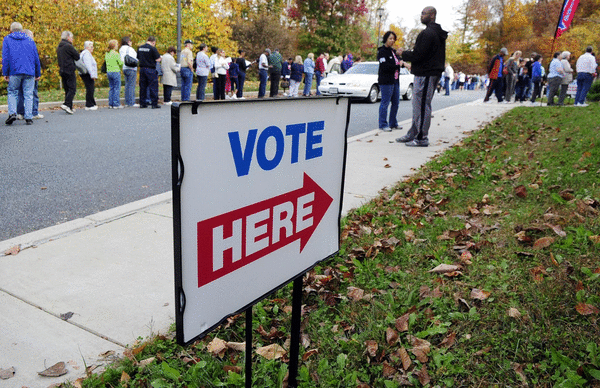
BALTIMORE — The polls had barely opened for the 2026 midterm elections Tuesday morning when about two dozen voters were already waiting in the 46-degree chill outside William Paca Elementary School in East Baltimore.
Beneath colorful murals of birds and mountains inside, election workers hauled out a 13th voting booth to accommodate the growing crowd.
Among those casting ballots was Joseph Dye, 34, a medical manufacturing worker who had done some online homework before heading to the polls.
Of all the issues confronting Maryland voters, Dye found Question 3 — a controversial proposal concerning congressional redistricting — the most confusing. It was also the one, he said, that “everyone was making a stink about” in political mailers and online ads.
“I’m not really for the whole gerrymandering thing, but if it benefits my side, I guess I might as well,” Dye said. “Everyone else is doing it.”
Question 3 asks voters to loosen restrictions on how Maryland lawmakers may draw congressional districts. If approved, it could threaten the seat held by the state’s only Republican U.S. representative, Andy Harris.
Supporters say the amendment would counter Republicans’ recent strategy of reshaping congressional districts to gain congressional seats, a tactic that has proved successful in Texas, North Carolina and other states. Opponents argue it would encourage further partisan gerrymandering.
Across Maryland, voters streamed into schools, churches and recreation centers Tuesday to choose a governor, Maryland’s eight U.S. House members and local officials, and to decide ballot questions ranging from congressional redistricting to public spending.
Motivations varied as much as the voters. Some wanted to curb the influence of President Donald Trump. Others were focused on rising food prices, public safety, schools and the direction of state government.
But whether they favored Democrats or Republicans, many shared a conviction that something needed to change.
In Towson, Chris Allen, a 76-year-old nurse, said she came out to help Democrats win more seats in Congress and support Question 3.
“I just feel that’s what we need,” she said, crediting an advertisement by former President Barack Obama with encouraging voters to participate.
At Towson University, Bradley Gillenwater, 52, of Rodgers Forge, described his goal as “a return to sanity, stability, sound government, something that’s been lacking the past going on two years at a national level.”
Gillenwater, a Maryland Department of Commerce employee, said he was supporting Gov. Wes Moore and U.S. Rep. Johnny “Johnny O” Olszewski Jr., both Democrats.
Moore is heavily favored to win a second term over Republican Dan Cox, whom he defeated four years ago. Olszewski is seeking reelection for the first time in a district encompassing portions of Baltimore City, Baltimore County and Carroll County.
In Catonsville, Callie Lewis, 73, a retired medical worker voting at Woodbridge Elementary School, had a more immediate concern.
“Gas prices, food, can’t afford to eat, can’t pay your bills,” she said. “Just need a change.”
A battle over representation
Few issues generated as much discussion as Question 3, a constitutional amendment placed on the ballot by Maryland’s Democratic-controlled legislature and backed by Moore.
If approved, it would markedly improve Democrats’ chances of unseating Harris, a conservative who has represented the Eastern Shore and part of Harford County since 2011.
In Charles Village, Linda Ridings-Rubino said she regretted that such a measure was necessary but believed Democrats needed to respond to Republican actions.
“The Republicans have been so underhanded with all this gerrymandering that it’s totally taking the voice away from people,” she said.
On the traditionally conservative Eastern Shore, voters offered a sharply different perspective.
“We need proper representation. We don’t need people across the bridge telling us what to do,” said Rosalyn Chappeau of Mount Vernon, who voted against Question 3 at Princess Anne Elementary School in Somerset County.
William H. Wilson, another voter there, opposed the measure and offered a succinct assessment of Moore’s performance as governor.
“I don’t like it,” he said.
The issue also exposed differences among voters who otherwise shared political sympathies.
Outside the Maryland State Boy Choir polling place in East Baltimore, Juliette Tower, 62, said she supported reconsidering the boundaries of Harris’ sprawling district, which includes all nine Eastern Shore counties, but not for partisan reasons.
“If I lived in a massive area and I had one representative, I would be pretty upset,” she said. “I don’t care how people vote or who they end up electing, just as long as they have representation.”
From Washington to the neighborhood
While national politics dominated many conversations, voters also arrived with concerns closer to home.
In Charles Village, Rohan Patari, a 36-year-old college student, said funding local programs was a priority. If he were governor, he said, his first move would be to fund Baltimore’s proposed Red Line transit project.
Patari had researched the city’s bond questions before voting, finding their language complicated to navigate.
Ridings-Rubino, meanwhile, supported ballot questions that would authorize Baltimore to borrow $280 million for schools, affordable housing, economic development and infrastructure improvements.
She hoped the measures would improve the city and help projects such as the controversial $900 million redevelopment of Harborplace.
“We chose to live in the city. We came to Baltimore by choice. We love Baltimore,” she said.
In Baltimore County, Amanda Edmonds, who grew up in the city and now works in education, said her family had always emphasized the importance of voting.
This year, she was especially concerned about the political climate and what she saw as an erosion of civility.
But Edmonds, too, found Question 3 confusing. Among other things, its language calls for “providing that nothing in the Maryland Constitution provides applicable criteria for the boundaries of a congressional districting plan.”
“I think we overcomplicate things when we’re looking at how the ballots are written,” she said. “I think that can be a turnoff for voters.”
Elsewhere, the issues were often distinctly regional.
In Harford County, three-term Republican Sheriff Jeffrey Gahler, who has emphasized aggressive crime fighting and new policing technology, faced Democrat Terrence Rogers, a former police officer who argues that the sheriff’s office has become too political.
“I’m a public servant, not a politician,” Rogers said.
The morning brought signs of enthusiastic participation in several communities, although the pace varied. At Margaret Brent Elementary School in Baltimore, a line stretched out the door by 9 a.m. And across the Chesapeake Bay, at Snow Hill Middle School on the Eastern Shore, Democratic volunteer Nancy Hickman described stretches of “really kind of heavy voting.”
For some voters, the election was less about any single candidate or issue than the opportunity to register their general dissatisfaction.
In Havre de Grace, Keith Opher, 69, a 30-year military veteran, said he was dismayed by the country’s direction and the financial pressures facing ordinary Americans.
“We got people who can’t put food on the table. We got homeless people lying in the street; gas is ridiculous,” he said. “It is sad to say, but I never thought I’d see anything like this.”
Opher said voters should remember that elected officials work for them, not the other way around.
And in Catonsville, Lewis offered a more succinct explanation for showing up on a chilly November morning.
“I just wanted to make my vote count,” she said. “I don’t want to complain, you know, if I don’t come out and vote.”
_____
(Baltimore Sun reporters Josh Davis, Shaela Foster, Ahmad Garrett, Karl Hille, Matt Hubbard, Jay Judge, Luke Kaiser, Konnor Metz, Lorraine Mirabella, Sofia Montoya-Deck, Luke Parker, Nicole Pilsbury, Chevall Pryce, Benjamin Rothstein, April Santana, Matthew Wynn and Marissa Yelinek contributed to this story.)
_____
©2026 Baltimore Sun. Visit baltimoresun.com. Distributed by Tribune Content Agency, LLC.






Comments