Trump power to shape Supreme Court doused by Democratic rout
Published in News & Features
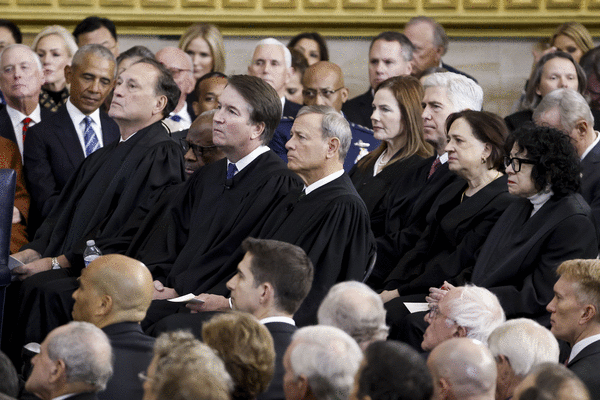
WASHINGTON — President Donald Trump probably has appointed his last U.S. Supreme Court justice.
With Democrats poised to hold at least 54 Senate seats starting Jan. 3, the party will have the power – and the motivation – to stop Trump from filling any vacancy that arises over the next two years.
Republicans had been quietly eyeing the seats of Justices Clarence Thomas, 78, and Samuel Alito, 76, the court’s oldest members and most consistent Trump supporters. Had either retired over the last two years, Trump could have appointed a like-minded successor who could have served for decades, further entrenching the conservative hold on the court.
With no sign that either justice would take the highly unusual step of retiring in the middle of a Supreme Court term before Democrats take control, even some Republicans acknowledge that dream is all but dead.
“Chance of confirming a worthy successor to Justice Thomas and/or Alito during President Trump’s term: Zero,” Florida’s Republican Governor Ron DeSantis said in a social media post Tuesday night.
Trump has already named three Supreme Court justices, creating the conservative supermajority that has overturned abortion rights, bolstered gun and religious freedoms and broadly shielded the president from criminal prosecution.
The court potentially now could shift back toward the middle if Democrats capture the White House and keep the Senate in 2028. By then, Thomas will be 80, Alito 78 and conservative Chief Justice John Roberts 73.
There is now “a real possibility of starting to move the court back in a more balanced direction and ultimately towards a liberal majority,” said Phil Brest, who directed judicial nominations under Democratic President Joe Biden and now is president of the progressive American Constitution Society.
Supreme Court justices serve for life, but some have stepped down in advanced age and allowed the president in power to appoint a younger successor. Two sitting justices have died in recent years: Antonin Scalia, 79, in 2016 and Ruth Bader Ginsburg, 87, in 2020, and their deaths helped open the way for the current six-justice conservative majority.
Alito stance
Thomas and Alito are likely to face pressure to retire now so Trump can secure confirmation of a successor in the lame-duck congressional session while Republicans still have control. But that would be a highly unorthodox step that would disrupt the court’s current term and cast a new shadow of partisanship over an institution already struggling with its public image.
Alito ruled out a postelection retirement in a Sept. 30 interview. “I intend to stick around through this term,” Alito said, referring to the nine-month Supreme Court session that runs through June.
Asked whether he was giving a “firm no” to the idea of announcing his retirement after the election to let the Senate confirm a successor while Republicans retain control, Alito responded, “Yeah.”
Two people close to Thomas said they’d be shocked if he stepped down. The people, both former law clerks, were granted anonymity in order to speak frankly about their assessments of Thomas’ plans. Alito and Thomas didn’t immediately respond to a request for comment.
Although Senate Majority Leader John Thune told Punchbowl News in July that a so-called lame-duck confirmation “can be done,” Republicans would face political headwinds. They will lose a member of their caucus on Dec. 15, when Senator Jon Husted must vacate his seat after losing a special election to Democrat Sherrod Brown Tuesday.
Court expansion
And it’s not clear how some outgoing senators – including North Carolina’s Thom Tillis, who is retiring, and Maine’s Susan Collins, who lost her reelection bid – would view a rushed effort to confirm another Trump nominee. Alaska Senator Lisa Murkowski, who opposed Justice Brett Kavanaugh’s 2018 nomination and ultimately voted “present,” would be another question mark.
“There will not be a Supreme Court confirmation in the lame-duck period between now and January 3, 2027,” conservative commentator Ed Whelan of the Ethics and Public Policy Center wrote in a blog post. “No justice is going to announce in the next few days that he will be stepping down at the end of the court’s term. Justices don’t make snap decisions about retiring.”
Any such effort could also fuel Democratic calls to expand the court from its current nine members. Democrats are still seething after Republicans prevented a vote on President Barack Obama’s nomination of Merrick Garland in 2016. The seat stayed open for 14 months, and Trump ultimately filled it with Justice Neil Gorsuch.
Then after Ginsburg died, Republicans rushed to confirm Justice Amy Coney Barrett, approving her just eight days before Trump lost the 2020 election.
“I could absolutely see a politically driven move like a retirement in the lame duck increasing the broad support both among the electorate and among elected officials to engage in court reform,” said Brest, the former Biden official.
Brest said the Democrats’ Senate gains could also increase the chances of a court overhaul if the party wins the White House in 2028.
But Brian Fitzpatrick, a Vanderbilt University Law School professor who clerked for conservative Justice Antonin Scalia, said the opposite effect is more likely.
“If it looks like for the foreseeable future any new justice is probably going to be a Democrat, there may be less need to expand the size of the court,” said Fitzpatrick, who studies judicial selection. “I do think it probably takes a little bit of the wind out of those sails.”
_____
©2026 Bloomberg L.P. Visit bloomberg.com. Distributed by Tribune Content Agency, LLC.






Comments