Lunar rocket launch tore 'hole' in Earth's atmosphere, disrupted GPS, study finds
Published in News & Features
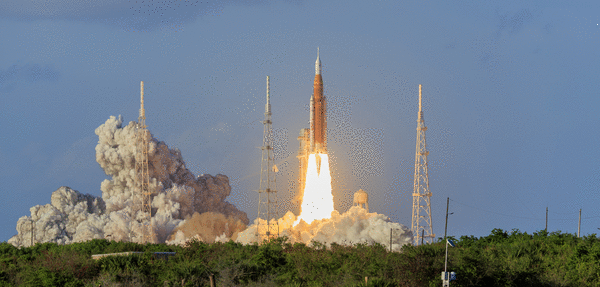
A NASA rocket launch for a lunar mission may have punched a hole in Earth’s atmosphere, potentially disrupting GPS signals, a new study found.
The Artemis II mission launched April 1 from Florida, carrying astronauts around the moon on humanity’s first lunar mission since the Apollo program ended in 1972, NASA said.
Atmospheric disturbances recorded during the launch suggested the rocket may have punched a hole in Earth’s ionosphere, according to a study by researchers at Taiwan’s National Cheng Kung University.
The study was published in July in the journal Geophysical Research Letters, Newsweek reported.
Earth’s ionosphere is a region of the upper atmosphere, extending from roughly 30 to 600 miles above sea level, where solar radiation ionizes atoms and molecules, according to the National Oceanic and Atmospheric Administration.
“The ionosphere is important because it reflects and modifies radio waves used for communication and navigation,” the agency said.
The Artemis II launch produced three surges of “perturbations” in the ionosphere, the Taiwan study found.
Changes in the ionosphere equivalent to GPS positioning errors of several meters were found, according to Space.
“A positioning error of a couple of meters is enough to cause an autonomous car to change lanes,” researcher Charles Lin told the publication. “It could have a strong impact not only on self-driving cars but also on drone positioning.”
However, no GPS failures, navigation disruptions, accidents or other real-world effects were identified, Newsweek reported. The study identified potential disruptions, not confirmed impacts.
Such disturbances could become more problematic as powerful rocket launches become more frequent, Lin told the publication.
____
©2026 The Sacramento Bee. Visit at sacbee.com. Distributed by Tribune Content Agency, LLC.






Comments