In major pivot on wildfire prevention, San Diego halts brush crackdown in favor of 'Zone Zero' education
Published in News & Features
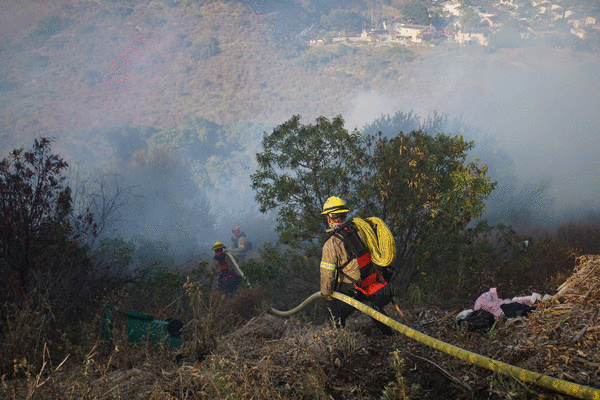
SAN DIEGO — San Diego has halted proactive enforcement of flammable brush on private property to focus instead on educating residents about new “Zone Zero” rules that focus on flammable items within 5 feet of a home.
The significant pivot will end such proactive enforcement for the first time since the city comprehensively revamped its wildfire prevention strategies in the wake of the 2007 Witch Creek fire.
The city’s only enforcement of brush management violations during the next few years will be in response to complaints and when inspectors become aware of egregious violations, officials said.
Proactive enforcement will resume after all of the 220,000 properties in the city’s very high fire-hazard severity zone have been visited by a fire inspector – or had educational literature left at their doorstep if no one is home.
Fire department officials said the shift in focus is being prompted by a staffing shortage that makes it impossible to simultaneously do proactive brush enforcement and educate residents about Zone Zero, a statewide policy that took effect last May but won’t be fully enforced until 2029.
Officials also said new state wildfire guidelines make removing flammable brush less of a priority than the focus of Zone Zero: preventing hot embers from landing on older structures like fences or vegetation within 5 feet of a home.
“Enforcement and brush management is not what the primary mission of the Fire Department is — it’s addressing Zone Zero and any combustibles up against the home,” Alex Kane, an assistant fire marshal who serves as the city’s wildfire program manager, told the City Council’s Audit Committee.
“We know through studies — recent studies — 90% of the homes are being burnt down from ember casts,” Kane said.
Kane’s announcement came during discussion of a recent audit that found San Diego isn’t effectively clearing flammable brush from private properties due to a haphazard inspection system that doesn’t include hefty fines and often fails to re-inspect properties deemed dangerous.
Instead of making the improvements recommended by the audit, the fire department is eliminating proactive enforcement and likely won’t resume such efforts for roughly three years.
City Auditor Andy Hanau said during the Nov. 12 Audit Committee meeting that the fire department’s significant pivot was news to him.
On Monday, he said the recommendations in the audit still apply.
“We made recommendations to ensure that the program’s educational and enforcement efforts are efficient and effective, which still apply despite the recent shift in program focus,” he said. “Specifically, our recommendations will help ensure that routing is efficient, clear performance goals and expectations are established for staff, and appropriate enforcement measures are used when property owners do not address fire hazards.”
Councilmember Vivian Moreno said she was disappointed that the shift away from enforcement in favor of education was not discussed with City Council members.
“The brush proactive management program exists for a reason,” Moreno said during the Audit Committee meeting. “It came out of the after-action report from the 2007 Witch Creek fire.”
Kane stressed that a lot can change in two decades.
“This is a very dynamic field so we have to be nimble,” he said.
He cited a 2018 study by fire officials and insurance companies that found embers were far more dangerous than overgrown brush.
Deputy Fire Chief Ted Moran said the department feels strongly that the pivot makes sense.
“Our staffing levels are extremely low,” he said. “It’s an overwhelming task for them to do this enforcement to the standard that is expected. We can touch a lot more people with the broad approach of education.”
Kane said the five people tasked with the education campaign have visited 3,900 of the 220,000 homes subject to the Zone Zero rules. He said they plan to do the whole city from south to north, noting that they are nearly done in San Ysidro and plan to tackle southeastern San Diego next.
“It’s a significant amount of outreach we have to do,” Kane said. “But we’re very effective with our limited staffing.”
Regarding complaints the city receives about properties with dangerous flammable brush, Kane said they get rated on a scale from 1 to 4 and plotted on a map.
“We’re documenting them and addressing the highest priorities first,” he said.
Zone Zero rules go beyond rules for Zone 1, which refers to the area within a 5- to 35-foot radius of a home, and those for Zone 2, the area between 35 and 100 feet, to address the 5 feet of space directly next to a home.
The rules essentially say that nothing flammable can be in that zone. While plants and landscaping are the chief focus, the law also applies to fencing, patios and decks made of wood or other flammable materials.
The most impacted neighborhoods will likely be Scripps Ranch, where 98% of properties are in the very high fire-risk zone, and Rancho Peñasquitos, where 95% are.
But nearly every neighborhood in the city has at least one small finger of land that is in a high-risk zone.
©2026 The San Diego Union-Tribune. Visit sandiegouniontribune.com. Distributed by Tribune Content Agency, LLC.






Comments