A year after ICE raid, questions remain about St. Paul police response
Published in News & Features
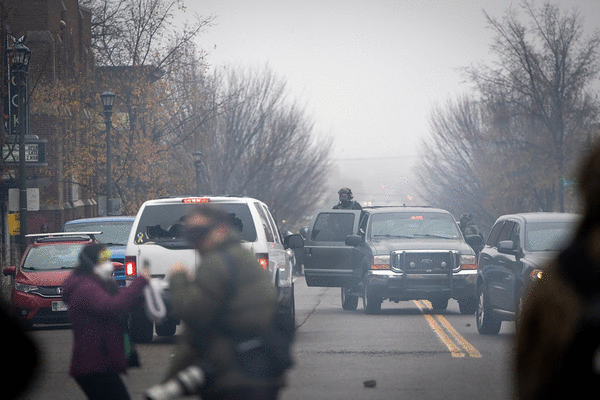
MINNEAPOLIS — A year after St. Paul police officers pepper sprayed and shot rubber bullets at anti-ICE protesters, deep distrust lingers in the city and the internal investigation into what officers did is still ongoing.
The ICE raid on Rose Avenue on Nov. 25, 2025, became a prelude to the stifling presence of federal immigration officers on St. Paul’s East Side and across the Twin Cities, and it deepened distrust about the role of police officers who, activists say, attacked protesters and journalists with little provocation.
The drawn-out review has also spurred calls to give the civilian review board more power in the internal affairs process, as the Police Department’s internal investigation stretches on with no end in sight. This month, three photojournalists sued the St. Paul Police Department over the incident.
In an email, Police Department spokesperson Alyssa Arcand said no one in the department could discuss “anything related to Rose Avenue” because of the suit.
Many of those who responded to the call for observers at Rose Avenue had seen the ICE operation in St. Paul a week before, where federal agents detained several people who worked at the Bro-Tex factory in an industrial corner of the city. It was a surprise to see St. Paul officers on Rose Avenue, said demonstrator Amber Mathwig, because they had been conspicuously absent from the prior week’s operation.
What happened on Rose Avenue
At first glance, demonstrator Jacqueline Zhang said, St. Paul officers were indistinguishable from ICE. They stood side by side, she said as she showed videos she took that day. From her point of view, St. Paul officers appeared to be working in concert with ICE, with police standing around the back of the house while federal agents stood at the front.
St. Paul has a separation ordinance that is meant to prevent city employees, including police, from acting as federal immigration enforcers, but many on Rose Avenue that day said they think St. Paul officers went too far in controlling anti-ICE protesters.
Ethan Besser Frederick said he linked arms with other protesters and a St. Paul officer pointed what looked like a gun at him. The experience was shocking, he said. “I didn’t expect a police officer, from where I lived, to threaten my life.”
A St. Paul officer detained Mathwig less than 20 minutes after she arrived, Mathwig said, recalling the officer put her in the back of a squad car and said she needed a “time-out.” She eventually received a citation for interfering with police.
A protester who declined to be named because he said he feared retaliation saw police officers on the block very early, and watched more arriving, some carrying batons. At one point, he said he lost his balance and fell into a federal agent, and several agents pinned him down on the ground. He was held in the backyard of the house before being taken by ambulance to Regions Hospital in handcuffs with an ICE agent and a St. Paul officer. He was later held at the Whipple Federal Building.
Police officers used pepper spray and less-lethal munitions such as pepper balls and rubber bullets on the crowd, Mathwig said, even spraying from the windows of moving cars. The irritants, Besser Frederick said, “felt way out of proportion to a winding-down scene.” The assertion that police were maintaining order incensed him.
“ICE was more restrained than St. Paul police that day,” he said.
Mathwig filled out a complaint form with the Police Civilian Internal Affairs Review Commission the next day.
The protester never filed a federal civil rights complaint because he said he worried that complaint would trigger some retaliation from the U.S. government, and he didn’t believe a complaint in St. Paul would make a difference. Zhang and Besser Frederick likewise opted not to file complaints.
More than a dozen people did submit complaints. But it is not yet clear what effect their complaints will have.
Changing the civilian review process
The investigation is complex, police have said during public portions of meetings of the civilian review commission. They said it involves many unique complaints and hundreds of hours of submitted video and video from body-worn cameras taken over several hours last November.
Mathwig said she was skeptical anyone would face consequences as a result of her report. “What Rose Avenue solidified for me was how complicit the police departments could be,” she said. “Because they’re accountable to no one.”
The Civilian Internal Affairs Review Commission was set up a decade ago, and some say it’s time to update the board’s procedures and give it more power.
“Rose Avenue really illustrated we have an issue with timeline and process,” said Ward 5 City Council Member HwaJeong Kim, who was at the raid and protest that day.
Commission members have presented the mayor’s office with a list of proposed changes to the civilian review process. Their recommendations include allowing civilian reviewers to look at complaints that the Police Department’s internal affairs unit closes without findings, setting up a process to hire outside investigators in certain situations and letting commissioners consider past complaints against officers as part of their review of different accusations of misconduct.
The timeline needs to feel “acceptable and accountable,” Kim said during a listening circle about Rose Avenue and its aftermath, held earlier this month. She said she is also frustrated by the balance of privacy requirements around the commission’s work, which tend to keep most of the findings secret.
Other city council members, including Ward 7 Council Member Cheniqua Johnson, urged people to keep calling the mayor’s office to lobby for an external investigation. Mayor Kaohly Her said she supports creating a process to hire an independent investigator, but only after the completion of the internal affairs and civilian review commission’s probes are complete.
For many witnesses, it will be difficult to rebuild trust in police, Kim said. “If you had any trust in the police department, it was shattered that day.”
©2026 The Minnesota Star Tribune. Visit startribune.com. Distributed by Tribune Content Agency, LLC






Comments