A lifetime of David Byrne's curiosity comes together for 'Theater of the Mind'
Published in Entertainment News
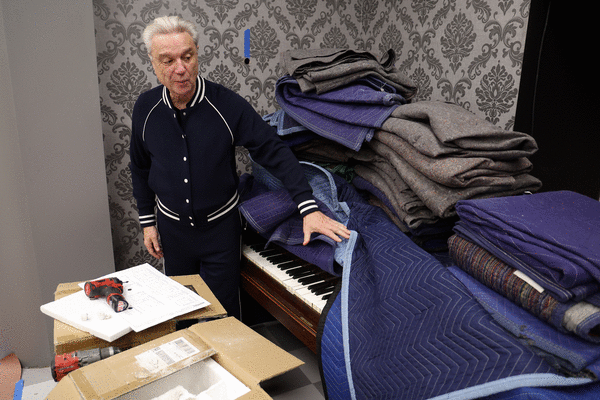
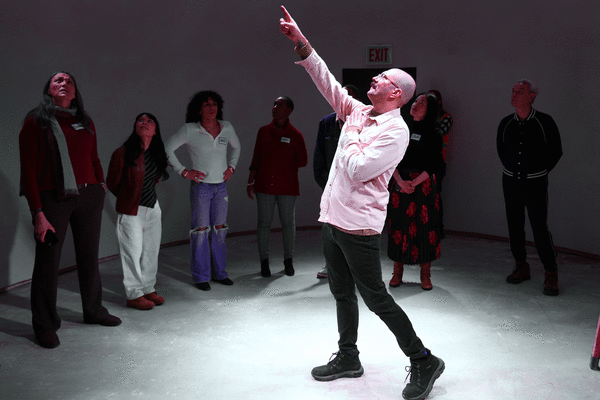
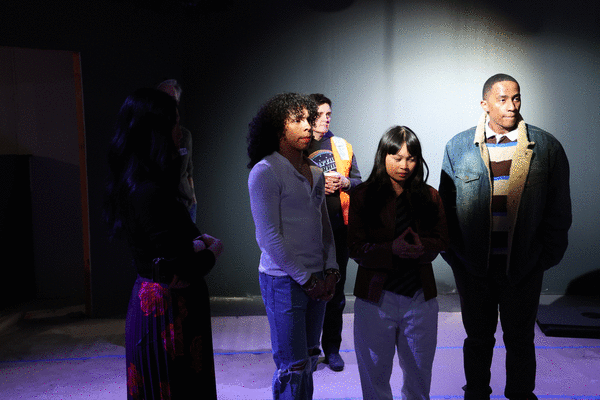
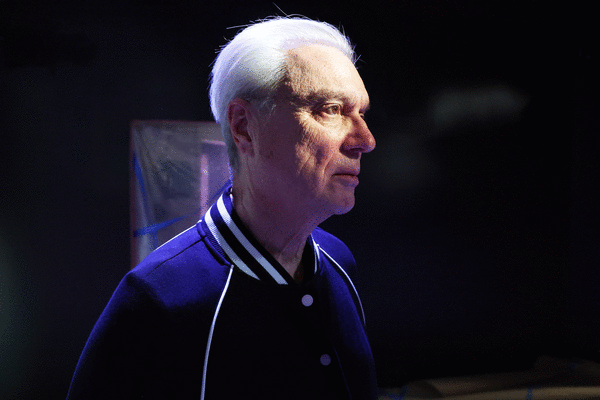




CHICAGO — “Theater of the Mind,” a huge long-term gamble for Chicago’s Goodman Theatre, is, in essence, a tour inside the skull of David Byrne.
Or, as he puts it over dinner with me one night, “each room there has a memory of something that happened.”
Or, as he also puts it, “each room there was designed for a neurological phenomenon.”
The famously quizzical Scottish-born musician, a founding member of the American new wave band Talking Heads, is not, of course, going under the knife eight times a week beside the Chicago River to expose his grey matter, or his childhood traumas, or his 73 years of life experiences, including those as the Talking Heads’ main songwriter, guitarist and vocalist.
Rather, his life experiences are to some degree the subject of a trippy new show, penned and developed by Byrne in collaboration with his girlfriend, Mala Gaonkar, and first seen in Denver but now revised and produced by the Goodman at an off-site location in the Reid Murdoch Building on the north bank of the river.
It’s a risky and costly off-campus swing that the theater hopes will run for a year, if not more, also potentially raising the economic fortunes of Chicago’s River North neighborhood.
By life experiences, I don’t mean to imply this is a personal history of David Byrne in the biographical sense, walking through a collage of a life or a career, but rather a viewing of a set of psychological experiences, or a Byrne “memory palace,” constructed by a wholly unreliable narrator but built on the premise that one life is not unlike another, even when the comparative is a life of a big rock star.
“Theater of the Mind” is directed by Andrew Scoville, something of a Byrne whisperer who describes his work here as “falling down a rabbit hole.” Now in preview performances, it opens March 25. It can variously be understood as a interactive piece of theater performed for just 16 people at a time in the company of one human actor, or “guide”; a scientific experiment; a high-end fun house; an escape room; a therapy session; or just another chapter in the creative life of a beloved rock star who figured out that long-term happiness for a restless artist does not come from churning out 43-year-old old hits like “Burning Down the House” from Birmingham to Berlin, but from being continuously open to risk taking.
So this is not exactly “Masquerade,” the interactive version of “Phantom of the Opera,” the famed melodrama now going gangbusters in New York City. Not at all.
“There is a scientific rigor with which we figured this show out,” Byrne says, cheerily, amused at the comparison. “The trick is always not falling into sentimentality.”
Sentimentality he has always avoided, not just in his Talking Heads career but in his two prior Broadway endeavors, both collaborations with the director Alex Timbers.
“American Utopia” was, in essence, a theatricalized concert experience that dispensed great gobs of pre-COVID joy and struck me at the time as being in direct, cheeky contrast to Green Day’s dystopian show “American Idiot.” More recently, and less commercially successfully, Byrne was responsible for “Here Lies Love,” a wildly unconventional Broadway show about Imelda Marcos, the former first lady of the Philippines, based on Byrne’s 2010 album with Fatboy Slim. That show required the very costly retrofitting of a Broadway theater to create what Byrne wanted, which was a 360-degree, disco-fueled experience in a venue that had been built for staring straight ahead. The show was among the most inventive, entertaining and musically compelling of any of the offerings in recent Broadway seasons, but it opened at a time when Broadway still was recovering from COVID and it proved too much, in many of the senses of that word.
Through all of this, Byrne has maintained curiosity and an openness to the outside world and has floated above the usual confining boxes of fame. Most longtime famous people avoid eye contact and dread interaction — or, like the great Pete Townshend, are warm and likable in person but also hold the view that a certain elusiveness is an essential part of their art and their appeal. Anyone spending time with Byrne, a “Yes, and …” adherent if ever there was one, can see he is the opposite.
His collaborators are young. His gestalt is curiosity. His ego appears nonexistent. Walking through Chicago’s River North neighborhood one recent late afternoon, beanie in place, chatting away, he moved entirely unnoticed, which meant that I could watch him noticing and reacting to most everything.
How he has achieved this is perhaps the most interesting aspect of this unique artist.
You could argue the nonconformity was there from the start with Talking Heads, a culturally curious band founded in New York in 1975 by college friends from the Rhode Island School of Design; their first gig under that name was opening for The Ramones at the famed CBGB in New York’s East Village. In 1983, while the Talking Heads were touring at the Pantages Theatre in Hollywood in support of their 1983 album, “Speaking in Tongues,” the filmmaker Jonathan Demme showed up to film them over four nights for a movie titled “Stop Making Sense,” regarded as the greatest concert movie of all time, not least because it ignored the noise of the audience and focused on the movement and sounds from the artists themselves.
Demme’s influence on Byrne is self-evident; “Stop Making Sense” clearly showed him what his music could do, and be.
Much of that, to my mind, is manifest in Byrne’s interest, or you could say his obsession, with the details of how his art resonates with his audiences, which is uncommon among musicians, who more typically focus on what they want to write and sing and argue that how their work is received is strictly a matter for the listener. But Byrne also has an uncommon interest in science, especially psychology. One of his and Gaonkar’s prime objectives with the piece was to “make the public aware of how creative the science world is” and dissolve whatever art/science, left brain/right brain binary might exist.
Byrne tells me that “Theater of the Mind” came close to landing as an art installation in London’s Victoria and Albert Museum. But its history has turned out differently. After being developed in a warehouse on Long Island, the project first saw the public light of day in 2022 at the Denver Center for the Performing Arts, a large regional theater with an innovative and highly unusual immersive theater unit, Off-Center, run by Charlie Miller and Emily Tarquin.
Over the last 15 years, Off-Center has produced complex, game-like shows, 360-degree stagings of musicals like “The Wild Party,” and some 70 other immersive productions, playing to more than 653,000 people and, the Denver Center has said, generating more than $80 million in local economic impact.
But the creation of such projects is expensive. “Theater of the Mind,” for example, needs some 15,000 feet of space and an elaborate technical setup (rooms have to look like actual rooms, as one might find in a movie), not to mention a custom show-control system replete with a network of cameras, sensors and miles of cable.
In Denver last October, with regional theaters feeling strapped across the country, the plug was pulled on developing future new immersive works. Tarquin moved to the Actors Theatre of Louisville. Miller, who knows as much about immersive theater as anyone I have ever met, left and is now a consultant on the Goodman project and has a mind bursting with ideas for the future.
“Theater of the Mind” got mixed-to-positive reviews in Denver. Critics generally admired its collapsing of boundaries between artistic subject and spectator, its sometimes startling relatability and its exploration of life’s many paradoxes, such as our inability to truly revisit the formative experiences of our lives, however hard we might wish or try. “There’s an endearingly earnest wonkiness to the proceedings,” Megan O’Grady, one of the show’s bigger fans, wrote in The New Yorker. “The effect is not unlike watching a philosophy professor perform magic tricks.”
The Denver Post, though, said the creative process had resulted in a “good-natured but lanky, disjointed production.”
Miller notes that the venue in Denver, the York Street Yards, was far from ideal and that the new Goodman space will serve the project far better. Also, the timing will be much improved. The Denver event, like so much art of the early 2020s, was born of postponements, fits and starts, tests, masks, stressed performers and all the other COVID restrictions and scrambled audience perceptions. That’s all gone now.
Miller, Byrne and Scoville all say they have made some changes, especially in the service of clarity and cohesion, even if the core of the work remains the same. Early on in the process, Byrne says, the original idea of using numerous actors as guides in different rooms was dropped when one performer argued successfully that the show would work better if there was just one guide on the whole journey.
So that is how it will go: attendees will be led through the installation by a Chicago actor from a cast that includes such well-known names as Elizabeth Laidlaw, James Earl Jones II and AJ Paramo, among others. The “journey,” as Byrne likes to call it, will last about 75 minutes and can begin at roughly 45-minute intervals between 10 and 17 times a night, depending on the day, allowing attendees to choose showtimes between about 5 p.m. and 9 p.m. As at Walt Disney World, more than one group can be underway at once, since there are multiple places to go.
As you enter your journey through one person’s life, lived backwards, you will get a name tag, chosen at random for you. “My hope,” Byrne says, “is that people will get a very inappropriate name.”
“The odds are good,” Scoville says, “that you will get something you don’t think you are.”
“All it takes is a name tag,” says Byrne, “and you will see that other people start passing judgment and people will make assumptions about you.”
Still, anyone with 15 friends, or who is part of a group, can buy out an entire show and turn it into an experience together.
Not every guide will be doing the same thing. Byrne says he has baked in “opportunities for creativity,” and Scoville says that “the persona of the group can determine the guide’s persona,” so make of that what you will.
However, unlike some immersive productions where the audience can follow multiple narrative strands, “Theater of the Mind” is not a matter of choosing your own adventure, with all of the FOMO worries that can result. Audience members will make choices, but on a deeper level, inside their own heads. As Byrne puts it, the show strives for “an earned complexity.”
Byrne is never personally present, but the sound of his voice and the image of his body will be there (as will a bar and merch).
“If I were writing a thesis on this show,” Scoville tells me, “I’d say it is the culmination of all David’s endeavors, all his curiosities about the world. And he is the most curious person I know.”
I ask Byrne about why he keeps making forays into immersive theater, surely a distraction from his global touring. Not long before our conversation, he’d sold out three straight nights at the Auditorium Theatre, in a concert that had many theatrical references, from images of the surface of the moon to footage of Immigration and Customs Enforcement agents carrying out deportations.
“My sense has always been that if you keep giving people what they say they want, they are going to get tired of that,” he says. “They want to be challenged, but not too much, but they always want to be taken somewhere new. That is what makes them happy.”
Hearing that, I thought back to one of Byrne’s lines in “American Utopia,” one that I wrote down at the time, even as everyone around me was dancing and cheering to his Talking Heads hits and beyond.
It was: “I must change.”
If you go
“Theater of the Mind” is currently scheduled through May 31 at the Reid Murdoch Building, 333 N. LaSalle St.; tickets and more information at www.goodmantheatre.org.
©2026 Chicago Tribune. Visit chicagotribune.com. Distributed by Tribune Content Agency, LLC.









Comments