Will The Hand & The Eye, Chicago's new luxe mansion of magic, save the Magnificent Mile?
Published in Entertainment News
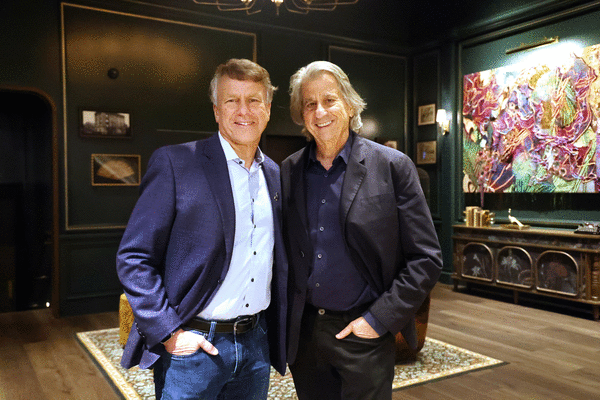
CHICAGO — Glen Tullman made his fortune in the health care industry, especially from business ventures in the world of electronic prescriptions. But on this March morning, the 66-year-old is staring at a beautiful piano in a transformed place where waiters once spun salads and generations of Chicagoans ate prime rib served on silver carts with Yorkshire pudding.
“Maybe you’ll just talk to the piano,” he says with a wink, like a child with a fabulous new toy, “and it will play any song you ever imagined.”
There are a lot of maybes involved in The Hand & The Eye, the 36,000-square-foot magic-themed entertainment and dining complex set to open this month inside the distinctively eccentric McCormick Mansion on the corner of Ontario and Rush streets alongside the struggling Magnificent Mile. The castle-like mansion is best remembered as the throwback home of Lawry’s the Prime Rib, which closed in 2020 after a 46-year run, but further back in the 20th century, it was also the home of The Kungsholm, a renowned Scandinavian smorgasbord with its own improbable puppet opera theater.
Tullman, a magic geek since he was a boy, has just dropped some $50 million on a very upscale venture in this very mansion that, if it succeeds, will be the most substantial visitor-friendly addition to the Magnificent Mile area since before COVID, creating at least 200 new Chicago jobs and potentially lifting the midsection of Michigan Avenue out of its current economic malaise. It will be a far cry from escape rooms or tacky museums, will attract national media attention and could become one of the city’s signature attractions for the upscale visitor.
There are no other investors in The Hand & The Eye. This is Tullman’s money, Tullman’s vision and thus Tullman’s risk.
But he has numerous collaborators. The complex is composed of an astonishing seven different intimate performance spaces of varied seating capacities and technical capabilities (most seat between 40 and 100 people), not to mention a similar number of bars and upscale dining spaces. Each is gorgeously designed to reflect a distinct personality and suit a particular kind of magic.
All are the design work of David Rockwell, arguably America’s leading theatrical and restaurant architect and designer, whose eclectic portfolio includes Broadway shows like “Hairspray” and “Kinky Boots” as well as the Dolby Theatre in Los Angeles, The Shed and Perelman arts centers in New York City, the Cosmopolitan Hotel in Las Vegas and Nobu restaurants worldwide. His Rockwell Group employs 350 and has diversified so widely that a keen-eyed attendee at last year’s National Restaurant Show in Chicago could spot a David Rockwell-designed outdoor grill. (It was cool.)
Nonetheless, “this was a once-in-a-lifetime opportunity,” Rockwell says from New York, “in that it tied together my two main interests in how people come together, which is performance and dining. It also came with a fascinating unicorn of a building with a monolithic facade that is both elegant and mysterious and entirely differentiated from every other building nearby. And as I think of all the things I have ever designed, this one has the largest amount of detail per square foot.”
Rockwell says his designs for The Hand & The Eye were inspired in part by the artist Joseph Cornell’s famous boxes, cabinets of curiosities that functioned as intimate dioramas and theaters.
“We started with the notion that each room would be quite different,” Rockwell said, “and that an audience member would feel as they moved from room to room that they were in a collection of spaces, not in a place all designed at once. I like to design things that people can touch.”
Tullman also hired Bre Smith as his executive vice president, an artist in her own right but also a veteran of hospitality at the Ritz-Carlton Marina del Rey and elsewhere, and a woman with a hefty budget who obsesses over everything from the flatware to the level of customer service.
“We want to bring back a true fine-dining experience encompassing the art of the table setting,” Smith says as she caresses one of the bespoke dinner plates from Italy, replete with an inscription visible only to the observant: “Here’s looking at you, kid.”
Smith and Rockwell have combined to forge a glamorous, old-school vibe. “We are called The Hand & The Eye,” Smith says. “So we wanted our dining rooms to feature pieces made by hands and eyes.”
“This may be the most analog place in the world,” Rockwell says. “We’re totally the opposite of anything digital.”
Tullman’s new complex will, of course, hardly stand alone in a city that long has been a mecca for magic.
Competitors, albeit hardly on this scale, include The Magic Lounge, a two-venue magic theater in Andersonville established in 2018 that cost around a tenth of the investment of The Hand & The Eye but has proved highly successful over the last eight years, surviving COVID by offering a rotating array of magicians, illusionists and hypnotists who perform in a main-stage theater, a close-up room and as bartenders in the attached saloon — paying visual tribute to Chicago’s long tradition of bar-room magic from such practitioners as Matt Schulien, known as the godfather of Chicago magic and who operated out of his father’s German saloon at 1800 N. Halsted St. Schulien was widely seen as a blue-collar magician, in that he would approach your table like an old pal before pulling his tricks, creating an intimate Chicago style of magic that was very different from the world of Harry Houdini and, later, David Copperfield, who hung their hats on large-scale illusions.
The Magic Lounge is by no means alone in present-day Chicago. Dennis Watkins, a longtime Chicago magician from a family of magicians, successfully operates The Magic Parlour in the Loop in a joint venture with the Goodman Theatre. And the Chicago physician-magician Ricardo Rosenkranz purchased the historic Morse Theater in Rogers Park in 2022, reopening it as the Rhapsody Theatre and presenting a variety of magicians there, including himself.
Rosenkranz is taking the position that a rising tide lifts all boats. “I hope it succeeds,” he said of The Hand & The Eye.
What is different about The Hand & The Eye, aside from its scale, is that Tullman has conceived the operation as a combination of members club with privileged access (you get your own safety deposit box with a key and a private bar and dining room), somewhat akin to The Magic Castle in Los Angeles, and a dinner-theater experience wherein ticketed audiences buy an admission for the evening and make their way through the multiple venues with magicians and have dinner.
As he explains it, members will be able to enter through their own door, hang out at the various bars and attend shows of their choice, allowing him to offer an experience akin to that of the Soho House or the University Club, albeit with magic. Meanwhile, he hopes tourists, suburbanites and local residents will come for a full evening’s experience, and return as his roster of resident magicians changes.
Rockwell adds that he has baked in what he calls “mixing chambers” in this environment, conceived as places where members and more casual fans can find themselves together in the same spot. Add in spaces for private corporate events, family-themed offerings during weekend days, and a beautiful merchandise store, staffed by magicians and selling magic kits, and that is the essence of Tullman’s business plan.
This is, for sure, a matter of build it and hope they will come.
As of this week, details including the ticket price have yet to be revealed, and the website, until recently, remained a mysterious provocation. The Hand & The Eye likely will open with little in the way of advance reservations, a situation that would terrify most producers of live entertainment. A spokesperson said the initial admission price would start at $225, including a $75 credit for drinks and dinner in the restaurant and some three hours of magic. The full website went live on Tuesday in advance of a soft opening on April 18.
Tullman says he wants the venue, which clearly will have hefty running costs, to be open seven days a week, even if the history of performance venues elsewhere suggests that weeknights during, say, a frigid Chicago February might be a tough sell. Tullman is relying on what he sees as the endeavor’s unique appeal. At this juncture, it seems he wants to carefully curate this rollout, limiting information to some degree and ensuring that everything is to his aesthetic satisfaction. “Doing it right is so important to us,” he says.
The Hand & The Eye clearly is a passion project, the creation of a man who has made something of a fortune and now wants to spend a hefty portion of it on something he loves for a city he loves. (Rockwell has Chicago roots, too.) He emphasizes words like authenticity, connection, uniqueness. He sees his creation, clearly, in terms of his legacy and the reputation of the venue, within the famously close-knit and famously competitive world of magic, is of importance to him.
“Our aim,” he says, “is not just to make this the best place to see magic in the world but the best place to perform it.” With that in mind, there are many nods to the past on display, including one of Houdini’s famed milk cans.
“This is not just a place. We’re trying to create an experience and a feeling,” he says as he leads a tour of the almost completed, Gatsbyesque complex, a multifloor palace of velour and wood, historic trim, artworks and generously sized bars, some of which are also performance spaces. There is even a bespoke scent in certain rooms.
The mansion’s historic staircase remains intact. So does an original fireplace. The balustrade was built in Highland Park in the 1920s. There is an outdoor patio and a basement vault. “This is a 100-year venture,” Tullman says of his palace of varieties.
Small visual tricks are ubiquitous yet nothing here feels tacky. On the contrary, The Hand & The Eye is as upscale a venue as Chicago has, calling back to a more glamorous era of Mag Mile nightlife when you could tip, top, tap in hotel ballrooms in your finery. At least one of Tullman’s magicians, Nicholas Locapo, who has moved here from Columbus, Ohio, seemed very happy in that magician’s way. “I love this room,” he says, as he presses a secret button in his table and manipulates cards for a visitor in one of the theaters.
Ending up at the members’ door of The Hand & The Eye, Tullman waves outside at the immediate surroundings on Ontario, Rush and Michigan Avenue — surroundings with a few empty storefronts.
“I wanted to do something upscale so as to send a message of stability and investment to everyone around us,” he says. “Other retail spaces are beginning to rent because we are here.”
He pauses at the cloakroom, a necessity of a Chicago winter. “We wanted to have it so that your coat would recognize you when you came back and return to you all on its own,” he says, “but you can’t use facial recognition in Illinois.”
Tullman smiles at that, given all that he has been able to build here.
But you still can feel his disappointment at what could have been yet more magic.
©2026 Chicago Tribune. Visit chicagotribune.com. Distributed by Tribune Content Agency, LLC.







Comments