Chris Jones: Reasons for optimism in cultural Chicago -- and a few concerns
Published in Entertainment News
CHICAGO — Cultural Chicago has much to celebrate this fall. And a few things to worry about.
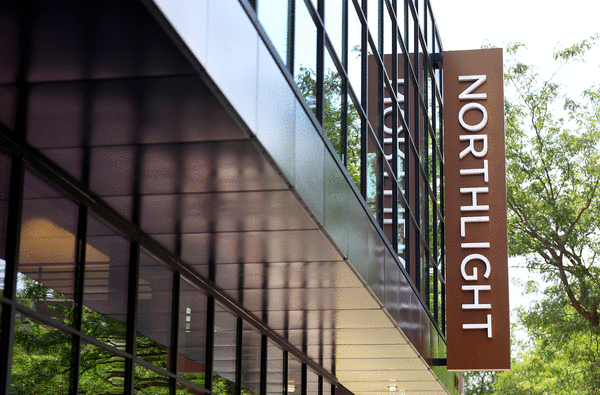
Two new theaters — TimeLine Theatre in Chicago’s Uptown neighborhood and Northlight Theatre in Evanston — will be welcoming audiences to what are modest buildings by the standards of some new debt-driven arts edifices across the country, but are judiciously built for artists and audiences to come together. The Studebaker Theater has found its restored feet on Michigan Avenue. A world-class music theater is also rising next to the United Center as part of the 1901 Project on the city’s growing West Side, with long-term residencies from musicians as its stated goal. And, although football comes first, Evanston will now have a brand-new stadium that looks set to also offer a highly enjoyable concert experience (with good food, even), assuming you stay away from the annoyed neighbors.
Chicago’s historic role as a center for magic and illusion has taken a big leap forward with the arrival of The Hand & The Eye, a truly gorgeous palace of prestidigitation, just off the city’s Magnificent Mile and featuring numerous venues therein. That has helped Michigan Avenue reinvent itself by including new, immersive attractions among its retail attractions, including, recently, The Cube, an interactive game experience inspired by a television show and enjoyable by all ages.
The Joffrey Ballet has retired its budget deficit, placing the company in the best financial position in its long history, and has created the Rudolf Nureyev Fund to support the creation and presentation of full-length story ballets. Yet another Steppenwolf Theatre premiere, “Downstate,” is moving to Broadway this fall. And the museum sector is thriving, too, with the Shedd Aquarium housing whales from Canada and the Griffin Museum of Science and Industry preparing to open its south door so as to better connect to the Obama Presidential Center, the lynchpin of what is becoming a new cultural district on Chicago’s South Side.
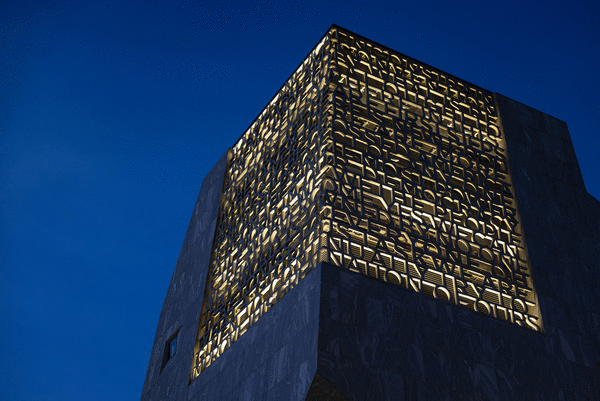
It’s also worth noting that the Obama Center has quietly added another world-class contemporary art museum to Chicago’s roster of galleries, including outdoor sculpture and dramatic, large-scale pieces. There is a performance venue there, too.
Gutsy programming has made a return. The Lyric Opera will produce the Pulitzer Prize-winning opera “Omar” by Rhiannon Giddens and Michael Abels, a co-commissioned work inspired by the memoir of the 19th-century Islamic scholar Omar Ibn Said, and featuring a score that fuses hymns, spirituals, and bluegrass music. The thriving Writers Theatre in Glencoe will stage “The Royale,” Marco Ramirez’ play about a Black boxer in the Jim Crow era. And the Art Institute of Chicago will pay tribute in a major exhibition to the remarkable Mary Cassatt, the only American to exhibit with the French Impressionists and the creator of a major mural for the 1893 World’s Columbian Exposition in Sweet Home Chicago.
It’s not all good news. The once constant pipeline of pre-Broadway tryouts and tour kickoffs in Chicago’s historic Loop venues has slowed, a victim not of a lack of enthusiasm from Broadway producers but of competition from other less exciting cities without hefty amusement taxes and offering formidable amounts of subsidy to alleviate the growing costs. This is a significant problem for a city that must see itself as a cultural transmitter, not merely a receiver or a stop on someone’s tour. It’s vital that city and state come together to create a more competitive package. These days, Broadway is looking far more to London, improbably a city with lower production costs, than to the city on which it historically has relied for an early judgment. And of course, those who follow Chicago’s roster of theaters are well aware that some companies disappeared during COVID and have yet to return. We’re now seeing that the old ways of doing business — full seasons of plays, planned and sold long in advance — no longer work. They’re giving way to combinations of productions and presentation, of theater standing alongside comedy, cabaret and magic. That’s the smart way to go, just as it is smart for smaller companies to put their resources behind one show at once and see how it goes.
The Uptown Theatre has yet to be restored; any alternative would not be forgiven by future generations. Costs are, of course, ever-rising. And, equally problematic, no public plan has emerged for the old Blackstone Theatre, most recently known as the Merle Reskin Theatre and now surplus to the requirements of DePaul University and yet, for generations, a beautiful place to see a play, it being far more intimate than the Chicago venues built originally as movie palaces.
A trip to the Loop remains daunting for some, although that is easing with more effective policing and a more visible, nonthreatening presence. But, as the Zoom meeting cliché goes, there is yet more work to be done.
As the holiday season approaches, Chicago must pay attention to the ugly, multiyear construction zone at the north end of State Street, potentially swallowing the beauty of an urban celebration involving a show at the Chicago Theatre and perhaps a stroll to see what it left of State Street’s holiday windows. And the city’s venerable German holiday Christkindlmarket has yet to move from the cramped confines of Daley Plaza to Millennium Park, a far more comfortable home.
But more and more people are moving into the Loop as commercial office buildings give way to apartments, surely growing the potential culture audience in the center of the city, historically the place where Chicagoans come for their entertainment.
There is a whole lot to see in Chicago this fall. And we have many suggestions for you.
———
(Chris Jones is editorial page editor, as well as chief theater critic for the Chicago Tribune.)
———
©2026 Chicago Tribune. Visit chicagotribune.com. Distributed by Tribune Content Agency, LLC.





Comments