Mary McNamara: 25 years ago, television was the only guide through the horror and chaos of 9/11
Published in Entertainment News
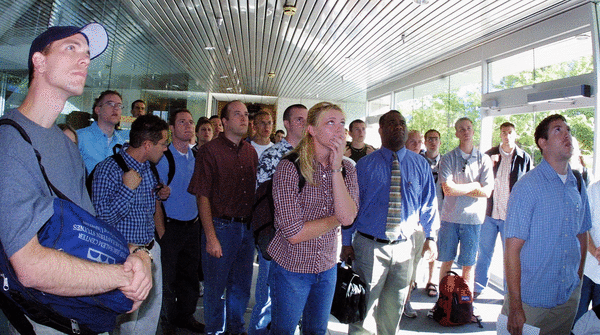
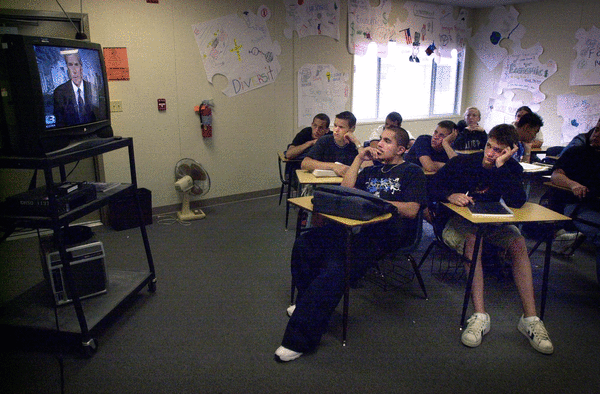
A hundred and two minutes. From first impact to final collapse, the Sept. 11 terrorist attacks on the World Trade Center, the Pentagon and United Airlines Flight 93 took less than two hours, on a day that felt like it would never end, in large part because so much of it was documented live on television.
Everyone over the age of 35 remembers where they were when they saw the Twin Towers fall, either in real time or in replay. No one could watch and not be changed. And everyone watched; 90% of Americans received news about the attacks from television, in homes, offices, restaurants, schools — anywhere and everywhere Americans gathered transfixed by screens filled with images that burned into our collective consciousness. ABC, NBC and CBS provided five full days of 24-hour coverage.
Twenty-five years later, 9/11 exists in context: an event with background, details, aftermath. The victims, the survivors, the heroes all have names, faces, life stories; many of the terrorists identified as being involved in the attacks are dead or in jail. There are books, films, series, news specials, memorials and a museum devoted to understanding and remembrance. Safety measures, particularly in airports, remind Americans every day that there is a “before 9/11” and an after.
On the actual day, however, there was mostly television. Unfathomable, disorienting and heart-rending television. There was no context, no warning, no words to explain the enormity of what was happening as it happened. Terrorist attacks had occurred in the United States before — the 1995 bombing of the Alfred P. Murrah Federal Building in Oklahoma City was still fresh in our memories and the World Trade Center had been attacked in 1993 by a van bomb that killed six.
But the idea of suicide bombers using commercial aircraft as weapons was beyond comprehension — as Ray Bradbury said at the time, no fiction writer would dare. Operating in real time with no information about the attackers or any meaningful historic references, news anchors and reporters could only pass on what little they knew to be true, relying for hours on images and descriptions, with additional updates running in near-constant tickers at the bottom of the screen.
Nothing, not the assassination of President John F. Kennedy, not the explosion of the space shuttle Challenger, no apocalyptic film or series had prepared us for such cataclysm and chaos.
Only French documentarian Jules Naudet, filming footage of FDNY‘s Ladder Company 1 in Lower Manhattan on the morning of Sept. 11, 2001, caught the horrific image of American Airlines Flight 11 crashing into the north tower of the World Trade Center at 8:46. Minutes later, all the major news networks were broadcasting live, cameras trained on the smoky, fiery wound made of floors 93-99. As newscasters and viewers struggled to make sense of what many assumed was an appalling accident, United Flight 175 hit the south tower.
Suddenly the familiar faces of morning television, already struggling to make sense of the first crash, went wide-eyed and silent in momentary shock. A possible tragic accident had become almost certainly a coordinated attack. On “Live With Regis and Kelly,” Regis Philbin first called for a commercial break, then returned to the unenviable task of attempting to lead his audience through the early moments of the most hideous live-news cycle in this nation’s history. “It’s kind of difficult to continue the kind of show we do here every morning under these circumstances,” he said, before the show joined the live WABC coverage.
Even those Americans who did not regularly watch morning television were soon turning on their sets to see if what they had just heard, on the radio or from friends, could possibly be true only to find a situation even more dire.
In moments, the towers’ dazzling height had transformed from the proud punctuation of this country’s signature skyline into a disaster-movie nightmare. News camera operators maintained a safe and respectful distance, choosing not to film footage of identifiable human remains, but it soon became apparent to viewers that not everything falling from the buildings was debris. Faced with inevitable death by flame, some in the towers had chosen the sky.
At 9:37, American Airlines Flight 77 hit the Pentagon, but the eyes of the world remained on the World Trade Center — the thousands of workers evacuating into the streets, the valiant mass of firefighters moving in the opposite direction, up toward the now-molten, smoking seams, to rescue whoever might be trapped.
Millions were watching when, at 9:59, a little over an hour into live coverage, the south tower collapsed, falling into itself like it was made of sand. An enormous pale cloud of debris billowed through the surrounding streets, turning corners as if it were alive, chasing and engulfing survivors, emergency workers and camera crews.
Even as the south tower fell, an impossibly brave group of passengers aboard United Airlines Flight 93 fought terrorists they now knew were intent on attacking another building in Washington, D.C. At 10:03, the plane crashed into a field outside Shanksville, Pennsylvania. Anchors and reporters struggled to relay all that was happening with updates and images of the burning Pentagon, but the cameras were still fastened on New York, now covered in ash and smoke, where the burning north tower still stood filled with rescue workers who were being called back.
At 10:28, the north tower also collapsed, 102 minutes after it had been struck.
I had two young children in 2001 so my husband and I did not turn on the television in the morning. The first plane must have struck the World Trade Center while I was getting dressed. I learned of the attacks on my way to work. My 18-month-old daughter was with me; her daycare was in a downtown federal building, which no longer seemed safe, so I took her to The Times. The south tower must have fallen as we pulled into the parking garage. When we reached the features department, those who weren’t on the phone were standing in front of television screens in disbelief.
To distract my daughter from the screens, I chattered brightly as I put her at my desk with paper, markers and a cookie. Then I called my brother to come collect her. In my memory, I had just hung up when the north tower fell.
For many, the clear skies and beauty of that early autumn morning served as a tragic contrast to the appalling and terrifying events that would unfold. For me, it was the ordinary early morning routine my family and I went through in utter ignorance. Like many, I couldn’t quite comprehend the enormity of the situation until I saw it, and even then it felt unfathomable to the point of being unreal, a terrible dream or some ghastly cosmic mistake, a glitch in the matrix that could somehow be put right.
But there it was, a new and unexpected reality that was far worse than anything we could imagine. As a journalist, it was my job to reach out to others, to chronicle their experience and reactions, but like millions of others, I watched the TV coverage obsessively. As if by watching, I would find closure, or clarity, or some narrative that could live in my head without forcing me to burst into tears several times a day. As if by watching, I would conjure a different ending, in which angels or superheroes descend from the sky to stop the planes or empty the buildings, to catch the people as they jumped from the flames.
There were angels, of course, and superheroes — men and women who gave or endangered their lives to aid and/or rescue others and those who quelled the natural instinct to panic and managed to simply survive. We lost 2,977 people that day, but an estimated 15,000 people escaped the World Trade Center and the courage of passengers on United Flight 93 saved countless more lives.
In the weeks that followed, it seemed like life as we knew it had stuttered if not stopped. Images of the smoldering rubble, of Manhattan streets blanketed in ash and the sheets of paper that remained of so many working lives, of American flags hung from windows and car antennas, continued to fill our screens. As the dead were named and vengeance sworn, it felt like nothing could mend the collective loss and trauma of that day.
But time remains oblivious and moves only forward, pulling us in its wake. Many wonderful and terrible things have happened in the 25 years since, some related to the 9/11 attacks, many not at all. A generation, which includes my own children, has come of age knowing the facts of the attacks and its legacy but unconnected to its immediate emotional and psychological impact.
Even so, television continues to own both the narrative and emotions. New footage, new interviews, new perspectives continue to emerge in documentaries, series and anniversary specials; it‘s the most media-documented terrorist attack in history. For television news, 9/11 remains a watershed, a reminder of when millions turned to trusted networks in a time of crisis in the justified belief that anchors and reporters would do their best to calmly let us know what was happening.
Even when we didn’t want to believe it.
———
(Mary McNamara is a culture columnist and critic for the Los Angeles Times.)
———
©2026 Los Angeles Times. Visit at latimes.com. Distributed by Tribune Content Agency, LLC.








Comments