Sasha Alex Sloan has a (hit) song for that
Published in Entertainment News
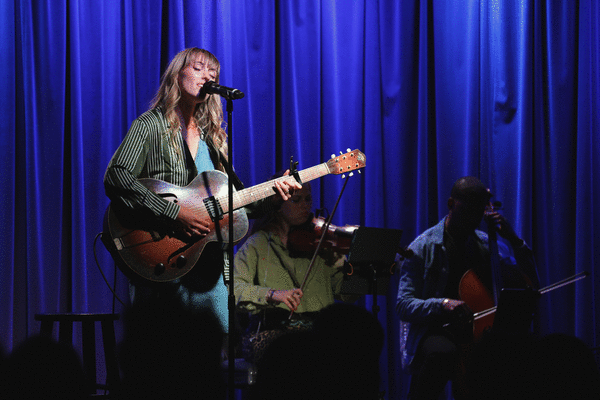
LOS ANGELES — More than once this past spring, Sasha Alex Sloan woke up in a panic, convinced she’d spilled the juicy music-industry secret with which she’d been entrusted: Olivia Rodrigo had recorded a duet with the Cure’s Robert Smith.
“I would literally open my eyes and be like, did I tell anyone?” says Sloan, who co-wrote the song “What’s Wrong With Me,” with Rodrigo and the singer’s longtime producer, Daniel Nigro. “My OCD was telling me, ‘You did — you tweeted it.’”
In fact, the 31-year-old songwriter kept a lid on the news until Rodrigo surprise-debuted the tune with Smith himself at Barcelona’s Primavera Sound festival in June — an occasion Sloan calls “one of the coolest moments of my career, just being on my couch at home, watching it on the internet.” A week later, the heartsick “What’s Wrong With Me” helped drive Rodrigo’s third album, “You Seem Pretty Sad for a Girl So in Love,” to the second-biggest opening of 2026 (after BTS’ “Arirang”); this month, the singer told the Hollywood Reporter that the duet with Smith is the best track on the LP.
Now, “What’s Wrong” and “You Seem Pretty Sad” are both expected to land multiple Grammy nods when nominations are announced Nov. 16. Yet among Sloan’s competition is … herself, thanks to her work as a songwriter on another two-hander: Karol G and Bruno Mars’ glossy “Still,” which she wrote with the siblings Isabel and Thomas LaRosa and which has more than 75 million streams on Spotify and YouTube. In addition to the hit duets, Sloan has racked up credits this year on a wide variety of tunes by country singer Tucker Wetmore (“Yours”), the K-pop girl group Aespa (“Switchblade”) and veteran R&B star Ne-Yo (“Wish I Didn’t Know You”). She’s also got a funny and moving bedroom-pop album of her own due Friday called “And the Crowd Goes Mild.”
Sloan’s stylistic range reflects a music industry in which the borders between genres have never been more porous. Though Karol G came up as a reggaeton artist in her native Colombia, “Still” is an English-language pop-soul ballad; Aespa’s clubby “Switchblade,” meanwhile, features a guest verse by R&B singer Ty Dolla Sign.
“I’m a little scared of being perceived as a jack of all trades and a master of none,” Sloan admits with a laugh on a recent morning. The way she sees it, though, the key to a successful songwriting career in 2026 is adaptability in both an emotional and a creative sense.
Because she writes for herself in addition to other acts, “people will sometimes ask me, ‘How do you know when the song is for you or for them?’” she says. “But it’s so different. When you’re with an artist, it’s really not about you — it’s about them and their ideas and how to take what they’re feeling and craft it the best possible way.”
Sloan and I are talking in the living room of the Glendale house she calls home when she’s in Los Angeles; she and her husband, the producer King Henry, moved from L.A. to Nashville in 2020, though she reckons she’s back here for work every two weeks or so. On this trip, she’s been busy in the studio with Camila Cabello, but tonight she’s headed to SoFi Stadium to catch Mars’ latest tour.
“I’ve only seen him once at Lollapalooza like a hundred years ago,” she says. “I was on substances, so I’m not sure this is completely accurate, but it was genuinely the best show I’ve ever seen.”
Sloan, who’d originally come to L.A. in the mid-2010s after studying at Boston’s Berklee College of Music, signed a publishing deal at age 19 and began scoring credits with the likes of Cabello, Idina Menzel and Charli XCX. In 2018 she released her debut EP as an artist; a handful of albums followed, including 2024’s “Me Again,” which included a devastating account of losing a pet. (It’s called “Tiny’s Song,” and I’d advise you to prepare yourself if you choose to listen.)
Despite acclaim from critics and peers in the industry, Sloan eventually lost the drive to become a pop star herself. “I feel like I never fully loved being an artist,” she says now. “I hate cameras — I’ve always struggled with an eating disorder. I love the craft of a song, and then I like to go home, and I think when I signed up to be an artist, I didn’t understand that that’s not really what you do. There’s fans, there’s touring — you’re a stock in a company.”
Last year Sloan decided to recommit herself to songwriting; she changed managers, joining the same firm that represents Tobias Jesso Jr., who’s written hits for Adele, Harry Styles and Olivia Dean and who won the Recording Academy’s inaugural songwriter of the year award in 2023. (Jesso was nominated again but lost to Amy Allen in February.)
Yet this week Sloan will release her latest album as a singer-songwriter — and it’s pretty great, with knowing, incisive tunes about her marriage and about the record business. So what gives?
“I’m a control freak, and as a songwriter, you have no control,” she says. “You can control the effort you put in, and that’s about it. I’d written a couple songs, and I was like, You know what? I’m just gonna put these out because you never know.” She laughs.
“Also, I don’t get points,” she says, meaning royalties on the recordings of songs she writes for pop stars. “I’d love to have points floating around in the world somewhere. So I definitely care about my album. But I care about the songs I’m making with other people more.”
To complete the thought about songwriters recording their own introspective records — a tradition that stretches back through Luke Laird and Jon Brion and Jimmy Webb — Sloan asks if I’ve seen HBO’s “Silicon Valley.”
“There’s an episode where they make an app, and they show it to all their friends who understand programming,” she says. “And all the friends are like, ‘This app is incredible — it’s gonna blow up.’ And then it gets released to the general public, and people are like, ‘We don’t know how to use this.’”
-------------
©2026 Los Angeles Times. Visit at latimes.com. Distributed by Tribune Content Agency, LLC.







Comments