Review: With simple gender switch, 'The Fantasticks' gets a new life on Broadway
Published in Entertainment News
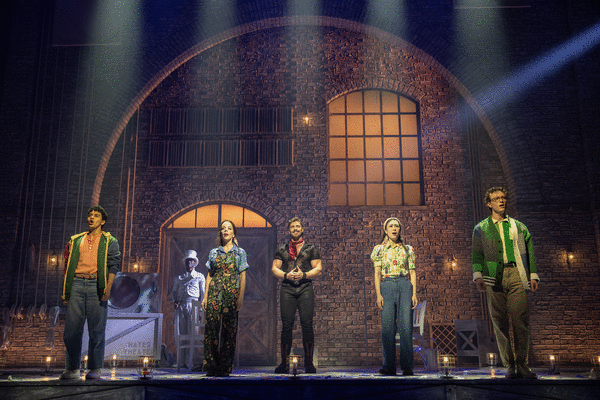
NEW YORK — At the top of the sweet new Broadway production of “The Fantasticks,” there’s a little homage to this show’s origins at the Sullivan Street Playhouse in Greenwich Village, where this esoteric musical with a score by Harvey Schmidt and book and lyrics by Tom Jones ran for 17,162 performances over a head-spinning 42 years. The show finally closed in 2002. I doubt we will see the feat repeated; people now don’t so much try to remember as move on to the next algorithmic thing.
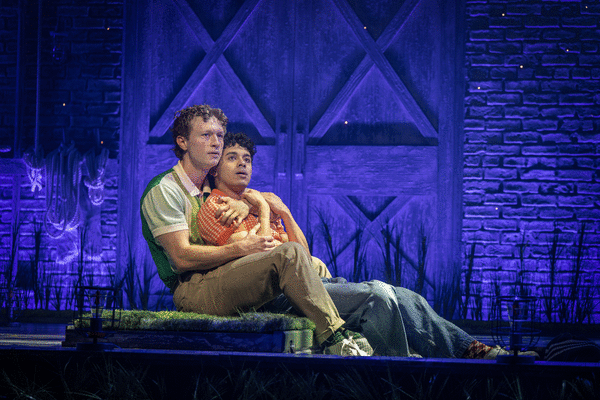
From there, a curtain falls away, and we find ourselves in a new gender-swapped “Fantasticks,” created with the late author’s consent and help, a new version that replaces the traditional neighboring boy and girl, divided by a wall erected by their wily fathers to motivate their eventual union, with a boy and a boy.
The wall is now erected by their equally wily mothers. Two boys with two conspiring moms! The show now is widely described on the Rialto as “the gay Fantasticks.” Aptly enough. So it is.
Sitting in the Second Stage’s Hayes Theater, the smallest of the Broadway theaters, I was struck by what seeing this show, which is quite charming, will mean to some older gay men, especially Broadway fans who sat through decades of heterosexual relationships in musicals written and scored by gay men. Sure, that’s changed over the last decade or so, but those are new, pop-driven shows and this lyrical one was born in 1960 (with Jerry Orbach as the narrator El Gallo, no less) and felt retro even when I first saw it as a teenager in the early 1980s. It speaks a different language from, say, “The Prom,” and therein lies the nobility (yes, nobility) of this new production, even though it is a modest affair by today’s Broadway standards.
Apropos of that, it’s probably a high compliment to say that if you liked “The Fantasticks” in its original form, then you will like this one, too. (The reverse might also be true). That’s because the director, Christopher Gattelli, manages to make this switch to two boys and their mothers not only feel like the most natural thing in the world, but that the show originally was penned that way.
That’s no mean feat, folks. A whole suite of bad, out-of-compliance choices must have beckoned and it is a great credit to the set designer, Jason Sherwood, that the show was not forced to become something it cannot be. Sherwood deftly navigates between the comfortable, the modest and the beautifully fresh.
“The Fantasticks” also was not originally scored this way, but merely for a piano and a harp. This production, though, has a full-ish orchestra, which is not new. I try to remember first hearing “Soon It’s Gonna Rain,” and “They Were You” played this way (then by 27 musicians) about a dozen years ago. Sure, there’s a certain simplicity in hearing the inestimably gorgeous melodies of “Try to Remember” with one keyboard and one hand-plucked set of strings, but give me the violins every time. It’s such a slow, lush, sad and memory-laden song. Peerlessly so, perhaps. It has me sniffling and lamenting the passage of time every time.
One other advantage of this conceit is that it actually makes El Gallo make rather more sense. He always was a weird dude in a show that was weird enough already, persisting as he did from an earlier version of the musical set in Texas and apparently in need of a Mexican accomplice. The once swashbuckling El Gallo has been softened over the years from the hearty Robert Goulet version I remember viewing on tour. The inimitable Goulet held the note on “Try” for about 10 minutes; he sounded like a wind-up music box that just got the juice. Now the show’s narrator is more benignly interpreted by the gym-primed Zane Phillips, who becomes a flirty object of interest for the two moms, as performed by Ruthie Ann Miles and with notable wit by Leslie Rodriguez Kritzer. He’s rather like one of the pliable guys on “Sex and the City,” or a retro and hetero guest at a bachelorette party, and I mean that as a compliment. He will broaden the show’s appeal at the box office.
The two boys are essayed by newcomers, which feels appropriate. Job one here is to sing well and job two is to be guileless, and both Maxim Chlumecky and Nathan Levy pull those off. I wasn’t entirely convinced they were in love at any point, but, well, perhaps that will grow, as love does. Or does not, as the case may be.
Betwixt all these sweet affairs of the heart comes some visiting old-actors shtick, a lift from “Hamlet” with a “Godspell” or “Pippin” vibe, similarly reflecting the tastes of the aesthetically glorious early 1970s. David Patrick Kelly and Kevin Del Aguila have no trouble with any of that, charmers as both turn out to be. Add in Ahmad Simmons as The Mute (there’s a character type you don’t see much anymore) and you have “The Fantasticks” reborn, not so much as a new creation but in its own image. Updated a little, sure; the world only spins forward.
The Hayes Theater becomes like a little oasis for those with a fondness for green grass, yellow grain and a life more tender and mellow.
Callow fellows, we all.
———
At the Hayes Theater, 240 W. 44th St., New York; fantasticksbroadway.com
———
©2026 Chicago Tribune. Visit chicagotribune.com. Distributed by Tribune Content Agency, LLC.






Comments