
2026 Mazda CX-70
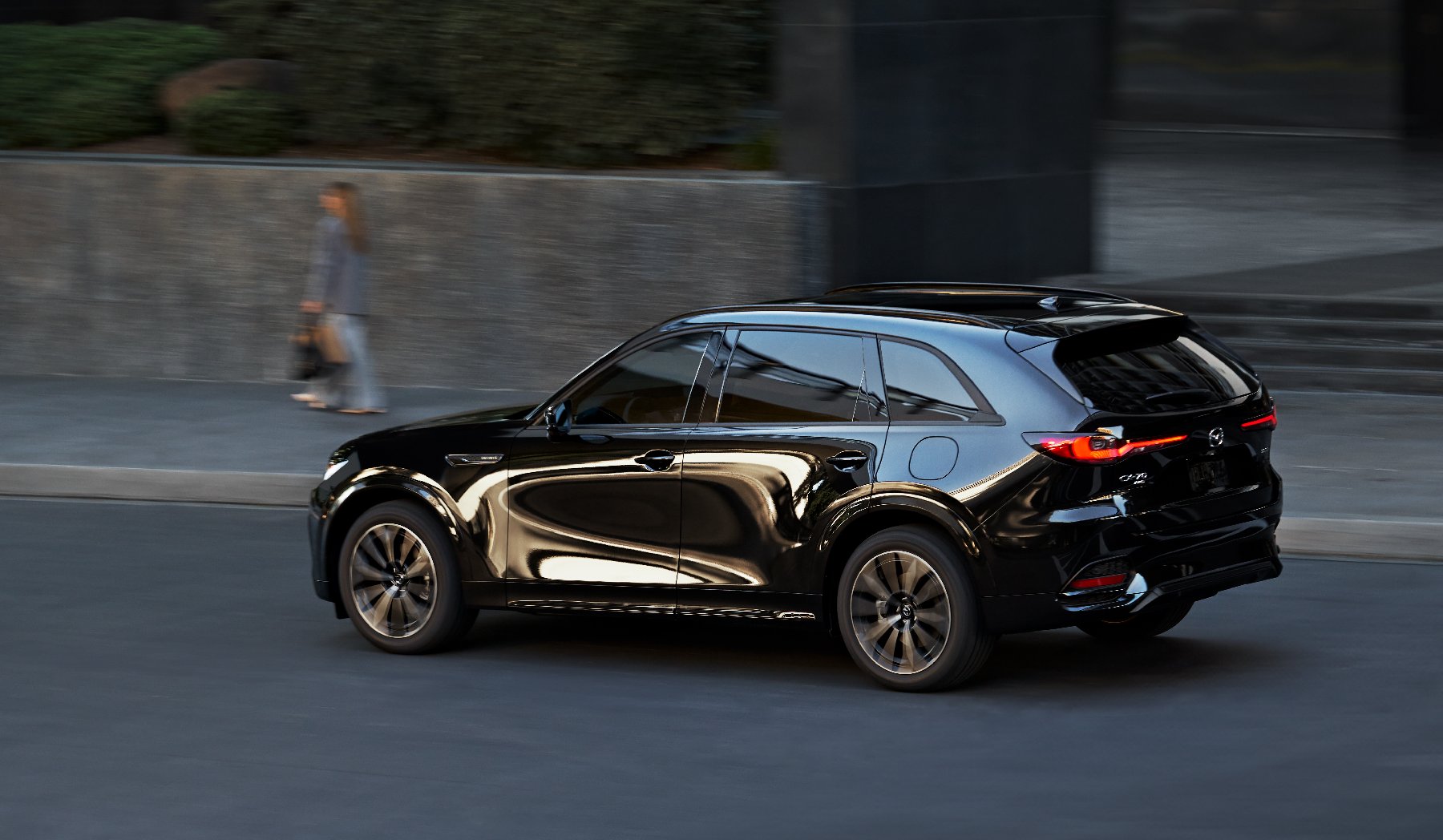
What's the difference between the Mazda CX-70 and the Mazda CX-90 -- other than the latter having three rows while the former has two?
Next to nothing.
And that's not a bad thing.
What It Is
The CX-70 is the two-row iteration of the CX-90. Or you could say the CX-90 is the three-row iteration of the CX-70. It amounts to the same thing as both are otherwise pretty much the same large crossover, with identical standard and optionally available drivetrains.
There are, however, some differences in trim -- and price.
Interestingly, you can get the three-row CX-90 for several thousand bucks less than two-row CX-70 because Mazda offers the three-row CX-90 in a "base" 3.3-liter Turbo Select trim that lists for $38,800. The two-row CX-90 isn't available in that trim. It starts at $40,445 for the Turbo Preferred, which comes with 21-inch rather than 19-inch wheels, standard leather seats covers, a heated steering wheel, sunroof, wireless connectivity and a larger, upgraded 12.3-inch LCD center display.
The reason for this difference is probably that Mazda assumes the three-row CX-90 will be more attractive to people who have kids to carry around and so are probably focused a bit more on practical considerations -- which includes budgetary ones -- while the likely CX-70 prospect is more focused on amenities for adults.
Still, the base trims of both CXs come standard with Mazda's new 3.3-liter inline/turbocharged six, which is augmented by a mild-hybrid system that's chiefly there to pump up the gas mileage by powering accessories electrically when the load is light and the six can be shut down (automatically) to conserve fuel.
A high-performance version of this same engine is standard in Turbo S versions, which sticker for $53,240 to start and top out at $56,670 for the Turbo S Premium Plus, which also gets pretty much all the luxury amenities in the lower trims, plus quilted leather seat covers.
There's also a third option.
Mazda offers the CX-90 with a plug-in hybrid drivetrain that replaces the 3.3-liter six with a 2.5-liter four augmented by a more powerful hybrid system that can be externally charged, like an electric vehicle -- and that can driven for about 25 miles on battery power alone -- but that does not have to be plugged in to continue driving it (like an EV) when the charge is depleted; the gas engine takes over at that point and charges the batteries as you drive.
The plug-in PHEV (partial hybrid electric vehicle) CX-70 is available in two trims: the $44,250 PHEV SC and the $47,250 PHEV SC Plus.
What's New for 2026
The most notable change for the new model year is a new/standard tow mode (Premium and Premium Plus trims) that increases the CX-70's towing capacity to 5,000 pounds. The base Turbo Preferred trim also gets standard heated seats, which were formerly optional.
What's Good
-- In addition to being all around a very nice large crossover, the CX embarrasses higher-priced luxury-brand crossovers from Lexus and Audi that come standard with four-cylinder engines.
-- Plug-in variant offers almost as much power as the Turbo S six and EV capability without the EV liability.
-- Driving verve -- and not just in a straight line -- both qualities lacking in so many other crossovers.
What's Not So Good
-- "Mild-hybrid" augmentation is a compliance technology that adds to the cost of the CX-70 (and CX-90) and arguably isn't of much benefit to the vehicle owner.
-- Optional (and desirable) higher-powered version of the 3.3-liter inline six is restricted to much more expensive trims.
-- As is true of almost every new vehicle, the CX-70's LCD touch screen interface isn't as easy to use as "old-fashioned" switches and buttons.
Under the Hood
Mazda did something interesting, brave -- and smart. Instead of replacing a six with a turbo four -- as has become very common, as a compliance measure -- Mazda developed a brand-new inline six for its top-of-the-line models, the CX-70 and CX-90.
This Mazda six isn't just a six, either. It is an inline six, which is the kind of six generally found only in luxury-brand vehicles, like, for example, those made by BMW and Mercedes-Benz. There are two reasons why. One is that the inline configuration is exceptionally smooth and free revving, because inline sixes don't need heavy balance weights to smooth out what would otherwise be a rough idle. The other reason is, they are long -- relative to a V6 -- and so generally only fit (front to back rather than side to side) under the hood of vehicles built around a rear-wheel-drive layout. These are generally luxury-brand vehicles, such as those from BMW and Mercedes.
Or Mazda.
While the CX-70 (and CX-90) come standard with all-wheel drive, it is a rear-biased system -- meaning it default sends most of the engine's power to the rear wheels rather than the front wheels, as in the case of vehicles built on a front-biased system, with the engine sending power to the front wheels most of the time. The Mazda's six is mounted front to back and not side to side. There are definite benefits to both, which we'll get into shortly.
The standard version of the 3.3-liter six makes 280 horsepower; the higher-output version in the Turbo S trim touts 340 horsepower, enough to get the CX-70 to 60 mph in six seconds. Gas mileage with the stronger engine is -- interestingly -- essentially the same as with the base version of the engine, which touts 24 mpg city, 28 mpg highway versus 23 mpg city, 28 mpg highway for the stronger engine. Both engines have one of those "mild-hybrid" systems that automatically cuts off the gas engine during coasting/deceleration and when the vehicle isn't moving -- to help with compliance.
An eight-speed automatic is standard with both versions -- as is full-time AWD.
Mazda also offers a four-cylinder engine -- augmented with a plug-in hybrid system -- as an optional choice, for those who like the idea of a vehicle that can operate for short hops as an EV without the long having-to-waits of an EV. The 2.5-liter four plus the hybrid stuff touts 323 horsepower and the ability to drive about 25 miles on battery power. After that, the gas engine automatically kicks on, and you can keep driving until you run low on gas. Touted mileage with this PHEV is 24 mpg city, 27 mpg highway -- about the same as with the inline six.
On the Road
This Mazda is unusual in another respect, already mentioned. It is the only nonluxury-brand large crossover that's based on a RWD layout, with its engine mounted front to back rather than side to side.
This distributes the weight of the drivetrain more evenly, front to back. Front-wheel-drive-based vehicles with their engines mounted sideways have a transaxle -- transmission and axle bundled together into a single unit -- snugged up against the engine; most of the drivetrain's weight is thus over the front wheels. This is not something that matters much in terms of driving feel unless you like to drive fast, especially in the curves.
Then, it does.
FWD-based vehicles are nose-heavy and tend to understeer. They push toward the outside of the curve. RWD vehicles are better balanced, and when pushed, they tend to oversteer. The rear end will start to come around, unless you keep on the gas -- which can be a little scary until you master the art of the thing.
The difference is, one feels better than the other to the enthusiast driver. The type of driver who'd really prefer to have a Miata but has kids and needs the extra seats.
Even if you don't want to corner like an SCCA driver, you'll find the Mazda just feels intangibly better than the FWD-based stuff. And you'll find the sound of the six a lot more appealing than the under-engined sound of a 2.0-liter four.
At the Curb
The CX-70 is 200.8 inches long, which defines it as full-size. The main difference between it and the CX-90 is that inside, there are two rather than three rows, so you've got more room for stuff and a bit less for people. Specifically, you have 39.6 cubic feet behind the second for whatever you need to haul around versus 14.9 cubic feet behind the CX-90's third row. Both CXs have roughly the same total available space -- 75.3 and 74.2 cubic feet, respectively -- but it's easier (faster) to make full use of it in the CX-70 because it's not necessary to spend any time or effort folding away a third row that's not there to begin with.
Like the exterior, much attention was given to the CX-70's interior, to make it appealing to look at. This isn't easy within the parameters set by the "crossover" template; at least, not without taking away from the practicality and utility that are the main reasons why most people buy a crossover. Many would probably love to have a Miata instead, but the family won't fit into one.
Mazda wants to keep them in the family, though -- by getting the buyer's family into a crossover that does not look, drive or feel like an appliance.
The Rest
It's a small thing in the grand scheme of things, but it's curious that Mazda prices the three-row CX-90 just a little bit higher to start than the two-row CX-70. On the other hand, the CX-70 does come with more standard stuff (as described earlier) for the extra $1,645 you pay.
The Bottom Line
It's hard to get excited about crossovers -- because most of them are just transportation appliances.
That's why it's exciting to come across one that isn't.
========
Eric's latest book, "Doomed: Good Cars Gone Wrong!" will be available soon. To find out more about Eric and read his past columns, please visit the Creators Syndicate webpage at www.creators.com.
Copyright 2026 Creators Syndicate, Inc.






Comments