AI job loss forecasts loom as unions push for protections
Published in Science & Technology News
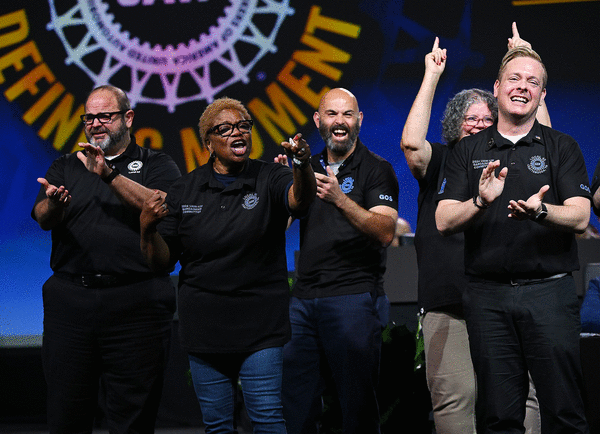
Labor unions understand artificial intelligence isn't going anywhere.
The battle for them thus becomes ensuring that their members have a seat at the table to determine how that technology is implemented in their workplace and perhaps even find a way to benefit from it, as some forecast layoffs and major shifts in employment and economic activity from the digital tools.
“We think about AI and other technologies as not inherently good or bad,” said Maite Tapia, a professor at Michigan State University’s School of Human Resources and Labor Relations. “But of course a technology needs to be designed, produced and implemented in a workplace. There is a power dynamic at play. What is important is that workers have a voice in that conversation. The best way of having a voice is, of course, through a collective bargaining agreement. The technology doesn’t come into the workplace top-down, but through democratic negotiations.”
From Microsoft Corp. founder Bill Gates to a survey of more than 200 economists, experts predict major disruption as a result of AI. The latest forecast from Joseph Briggs, an analyst at investment bank firm Goldman Sachs Group Inc., predicts 9% of workers — roughly 15 million people — could be displaced by AI in the next 10 years. That gloomy projection comes as nonfarm employment hit a record of 159.07 million in August, according to the St. Louis Fed.
Visionaries even cast an image of a future where no one works, and goods and services are provided at no cost.
“At face value, it’s unbelievable,” said Chad Cyrowski, communications director for the AFL-CIO in Michigan. “I don’t think anyone really knows where this is going. Workers are concerned, rightfully, based on what we know. It’s hard to put this genie back in the bottle, so we need to have a central role in it. That includes building and maintaining it, putting policies in place — guardrails — to ensure it benefits workers and doesn’t hurt them, that it’s not a tool for billionaires.”
Mass layoffs from AI haven’t taken place at this point, though companies have cited AI for jobs cuts, including in Michigan. Still, U.S. payrolls added a more-than-expected 162,000 jobs in August with unemployment holding steady at 4.1%, the Bureau of Labor Statistics said last week. Information-related industries, however, reported a loss of 23,000 positions, bringing the 12-month average to a decrease of 8,000.
With certain sectors more disrupted than others, that could shift talent pipelines toward skilled trades and other blue-collar positions as students and workers seek job security. Union membership is increasing, but anecdotally, there also are examples of this career shift, Cyrowski said.
Labor groups traditionally have faced challenges with organizing in the tech sector, and it’s unclear if AI disruptions could change that, especially under a Republican-majority National Labor Relations Board.
“The current labor law is very hard to get through,” said Art Wheaton, director of labor studies at Cornell University. “There’s more interest and more favorability for unions. That doesn’t make the labor law easier for people to organize.”
Close to half of Americans — 47% — want labor unions to have more influence than today, a record high in the past quarter-century and about double those (23%) who want unions to have less influence, according to analytics firm Gallup. Unions have a 71% approval rating overall.
A familiar battle
Since the Industrial Revolution, labor movements have faced battles around new technologies, Wheaton added. The term “luddite,” a person who opposes technology, came about from collective worker actions in textile factories against machines in the early 1800s. But AI affects the workplace environment, and that makes it a mandatory subject of bargaining in union-represented workplaces, Wheaton said.
“They have the right to bargaining, maybe not if (employers) use it or don’t, but how it’s implemented,” he said. “Unions will, by and large, work with an employer to make their jobs better and improve productivity so long as it doesn’t eliminate people. There’s not as much resistance to AI as you might expect, so long as they’re willing to work with people instead of replacing people.”
However, even if automation and other digital tools don’t replace workers today, they could limit job creation.
The United Auto Workers union is no stranger to the automation conflict. President Shawn Fain earlier this year described the situation around AI as a "fight for humanity" and a "profound threat." He likened its potential impact to the North American Free Trade Agreement, which unions have blamed for the movement of American factory jobs to lower-cost countries. Fain emphasized that as AI improves efficiency, productivity and profits, workers need to see the benefits of that.
"The fruits of our labor have multiplied like never before, but workers aren't reaping the harvest," Fain said at the union's constitutional convention in June. "And if AI continues to be used as an accessory to that crime, it has to be stopped. It doesn't have to be this way; in a just society, when workers create more value, they see more of the benefit."
AI affects contracts
Perhaps the clearest example of unions creating boundaries around AI came in the 2023 strikes by the SAG-AFTRA actors union and the Writers Guild of America. The efforts secured contractual protections like consent and payment for digital replicas of performers and requirements to use human writers, not just generative AI chatbots.
But unions are also addressing AI through joint committees, monitoring privacy protections, pushing for training or upskilling opportunities, and seeking protections from technologies that replace workers in classrooms, at technology companies or in management.
In other cases, automation can improve the job experience and make some roles like manufacturing parts sequencing, quality checking and information gathering easier.
The Michigan Education Association has yet to see a school district push for humanoid robots in classrooms or digital teachers, spokesperson Thomas Morgan said, but that’s certainly a subject the union is monitoring in education settings and in legislative policymaking.
The biggest impact for educators, Morgan said, is AI’s impact on the classroom, and how to ensure a robust education that ensures students are learning how to think critically, find solutions and learn the information they need instead of an AI chatbot spitting out the information for them. In many cases, that’s turned back to students using pencils and paper.
The MEA is working to ensure that, whatever approach a district takes, its teachers and other members influence those decisions, Morgan said.
“Educators are the experts in the classroom and schools,” he said. “They’re the ones who know this best.”
Government policies
Unions are on the front lines of regulating AI’s impact, especially as policymakers in Washington, D.C., have shown to be slow in formulating regulations on other cutting-edge technologies of the computer age like social media and self-driving vehicles.
Nevertheless, some members of Michigan’s federal delegation are trying.
“We have to be. We need guardrails,” U.S. Rep. Debbie Dingell said in a phone interview, adding that AI “can’t be a partisan issue.”
The Ann Arbor lawmaker is a chair of Democrats’ Congressional Labor Caucus and co-wrote a letter in March urging her party to consider the role of unions in protecting workers as AI becomes more powerful and commonplace.
“AI and other emerging technologies hold the potential for safer workplaces where AI and other advances complement workers, boost productivity, and lay the groundwork for greater shared prosperity,” Dingell and her co-authors wrote.
“But this vision can only be realized when two key conditions are met: First, workers must be able to form a union free from intimidation or retaliation to have a seat at the table when decisions about development and deployment are made. Second, there must be a legal and regulatory framework that ensures AI is developed and deployed responsibly, safely, and fairly.”
While the letter pushed for federal policies that consider AI’s impact on workers, it also emphasized that decision-makers in Washington should not try to stop state and local leaders from acting more quickly.
President Donald Trump and his administration have pushed for federal AI rules that would preempt local action, an unpopular position among many Democrats and Republicans alike.
The Michigan AFL-CIO is backing the RAISE Act, proposed legislation that would put limits on technology’s ability to set wages and monitor workers.
“It would put guardrails on how it can be used to monitor workers, track how long they use the bathroom, if you’re smiling enough at your service job,” Cyrowski said. “It impacts someone’s privacy and the way they operate that needs to be addressed.”
Also in Michigan, SAG-AFTRA is pushing protections for people’s name and image, while the United Food and Commercial Workers Union is advocating for laws that place regulations and prohibitions on electronic shelf labels and surveillance pricing.
“Americans are hurting under the affordability crisis, and UFCW members see the pain in their faces every time they enter the grocery store,” UFCW International President Milton Jones said in a previous statement about the union's campaign to promote the legislation. “We are starting this national campaign to stop corporations from being able to change prices in front of their eyes just because they live in the wrong zip code or are a new parent."
Another member of the federal Michigan delegation, GOP Rep. Tim Walberg, has taken the approach of asking the federal government to collect more data on how artificial intelligence is already reshaping work.
The Tipton lawmaker introduced a bill in June that would task the Bureau of Labor Statistics with compiling statistics on AI use in the workplace “to provide the clarity necessary to support workers, guide training, and ensure the United States stays at the forefront of technological innovation.”
“Clear, timely data on how AI is reshaping jobs is essential,” he said in a statement.
The bill recently passed the House Committee on Education and the Workforce, which Walberg leads, though it faced opposition from Democrats who pointed to existing government data on the topic.
AI is also changing how workers are trained. The AFL-CIO emphasized in its AI policy earlier this year the need for programs to train employees for new jobs created to build, maintain and operate the technology.
Michigan Works! Association, a statewide network supporting job seekers, found in a report with labor market data firm Lightcast that more than four of every five training programs on Michigan’s Eligible Training Provider List lack AI skills or literacy. The organization announced a partnership to offer Grow with Google’s career certificates and artificial intelligence training at no cost.
©2026 www.detroitnews.com. Visit at detroitnews.com. Distributed by Tribune Content Agency, LLC.





Comments