Bulgarian president to resign, hints he may run in snap vote
Published in Political News
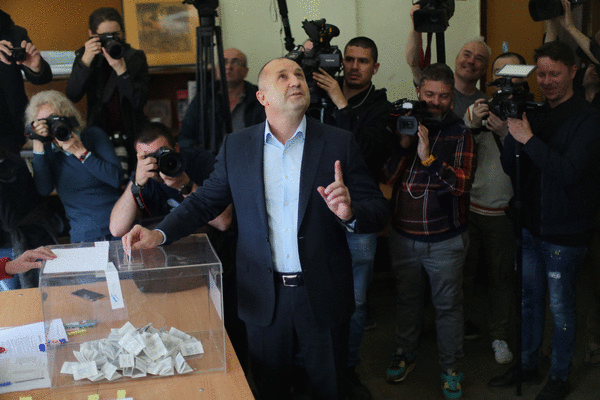
SOFIA, Bulgaria — Bulgarian President Rumen Radev announced his resignation as the country prepares for its eighth national election in five years, fueling speculation that he may enter the fray to end the entrenched political deadlock.
“Today’s political class betrayed the hopes of the Bulgarians in compromises with the oligarchy,” Radev said in a televised address on Monday. “Your trust obliges me to protect the statehood, institutions and our future.”
The unprecedented move by Radev, Bulgaria’s most popular politician, would shake up the political establishment and potentially change the electoral dynamic. A former air force general, Radev has helped steer the country through successive failed governing coalitions since being elected as head of state in 2016.
Every election this decade has produced fragmented majorities that failed to advance crucial reforms even as the country became the latest to adopt the European Union’s single currency this year. Outgoing Prime Minister Rosen Zhelyazkov took office a year ago, but was forced to step down in December amid the country’s largest protest rallies in more than a decade.
The catalyst was his controversial budget bill for next year, proposing higher spending that many said would only benefit corrupt elites.
Radev has sought to tap into the surging anti-elite mood and supported the protests against Zhelyazkov. That strategy helped him win reelection in 2021, when he called on citizens to force the “mafia” out of the government and judiciary. The most recent deadlock has been accompanied by widespread speculation over Radev’s political ambitions.
“The battle for the future of the fatherland lies ahead of us, and I believe that we will wage it together with all of you — the worthy, the inspired, and the uncompromising,” Radev said on Monday.
The main target of Radev’s ire is Boyko Borissov, a former prime minister who leads the country’s largest party, Gerb. Borissov’s party has usually managed to win the most votes, but with each election its share has declined.
The series of inconclusive contests means Bulgaria has been governed by a series of fragile coalitions, several of which were undermined by corruption scandals. They’ve also depended on informal backing from the former media mogul Delyan Peevski, a powerful lawmaker who’s sanctioned by the U.S. and UK and is seen as the face of state capture in Bulgaria. He denies wrongdoing.
Meanwhile, the political crisis and Russia’s war on Ukraine, taking place across the Black Sea from Bulgaria, has boosted popular backing for anti-establishment and Russia-friendly parties.
Radev has been criticized in Brussels for echoing the Kremlin’s talking points. He’s repeatedly opposed the bloc’s sanctions against Russia and military aid to Ukraine, which he describes as helping “warmongers.” He has also questioned Bulgaria’s readiness to adopt the euro, advocating for a referendum on the currency switch, which came into effect on Jan. 1.
About 40% of Bulgarians think it’s best that the country’s government is led by a new political party, according to an Alpha Research poll conducted Dec. 5-12. A party led by Radev may attract about half of those voters, while the rest could go to others, including anti-EU and nationalist groups, the Sofia-based pollster said.
Vice President Iliana Yotova, a former Socialist member of the European Parliament, is set to take over Radev’s role as president, a largely ceremonial position. She has to schedule the date for the snap vote and pick an interim prime minister.
Radev’s resignation must now be affirmed by the country’s Constitutional Court, which doesn’t have a fixed deadline.
_____
©2026 Bloomberg L.P. Visit bloomberg.com. Distributed by Tribune Content Agency, LLC.

















Comments